 Vertex Learn
Expansion, density, and why ice floats
What this lesson covers
- Heating makes particles move faster and push further apart
- Why materials expand when heated and contract when cooled
- Why most substances are denser as a solid than as a liquid
- Why water is different: ice is less dense than liquid water, so it floats
- In a change of state the particles move and rearrange, but the particles themselves stay the same
- Mass stays the same when a substance changes state
- Using particle diagrams to explain what you see in an experiment
Heating speeds particles up
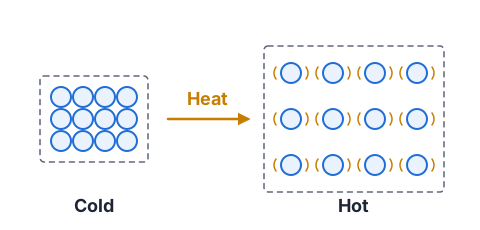
- When a substance gains thermal energy, its particles move faster: solid particles vibrate harder, and liquid and gas particles rush around more quickly.
- Faster particles bump into each other harder and push their neighbours further away.
- If they gain enough energy they can overcome the attractions holding them together, and the substance changes state.
- When a substance cools, the reverse happens: particles slow down and the attractions pull them closer.
Expansion and contraction
- Because hot particles push each other further apart, most materials get bigger when they are heated. This is called expansion.
- When they cool, the particles move closer again and the material shrinks. This is contraction.
- There are the same number of particles before and after; they just take up more or less room.
- Engineers plan for it. Long road bridges have expansion joints, small gaps that close up on hot days, and power lines are hung with some slack because they sag more in summer.
- A tight metal jar lid can be loosened under hot tap water, because the metal lid expands more than the glass jar.
Density: how tightly packed
- Density tells you how much mass is packed into a certain volume. A brick is denser than a sponge of the same size.
- Density = mass ÷ volume, often in grams per millilitre (g/mL) or grams per cubic centimetre (g/cm³).
- Something less dense than a liquid floats in it; something denser sinks.
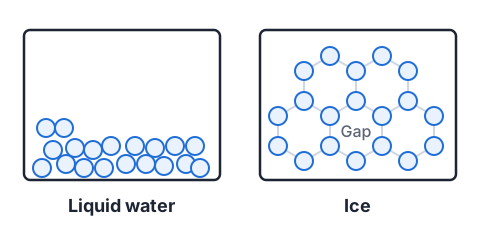
- For most substances the particles are packed most tightly in the solid, so the solid is denser than its liquid.
- Drop a lump of solid candle wax into melted wax and it sinks to the bottom. Solid iron sinks in molten iron in the same way.
Water breaks the rule
- Water is an unusual substance: it expands when it freezes.
- As water freezes, its particles lock into a regular, open pattern with gaps in it, so they end up further apart than in liquid water.
- The same mass now takes up more space, so ice is less dense than liquid water, and it floats.
- This matters for life. A pond in Central Otago in winter freezes from the top down, and the floating ice acts like a lid that helps keep the water underneath from freezing, so fish and insects survive.
- It also explains the burst bottle in the freezer: the ice needs more room than the water did.
Try it: why ice floats
Example: a class freezes 500 g of water
- A Year 7 class poured 500 mL of water (mass 500 g) into a soft plastic container, marked the level, and froze it overnight.
- The next day the ice had a volume of about 545 mL and a mass of 500 g. Find the increase in volume, and the density before and after.
- 545 mL − 500 mL = 45 mL biggerthe ice takes more space
- 45 ÷ 500 × 100 = 9% increaseas a percentage of the start
- Water: 500 g ÷ 500 mL = 1.0 g/mLdensity = mass ÷ volume
- Ice: 500 g ÷ 545 mL ≈ 0.92 g/mLsame mass, more volume
- Volume up 45 mL (9%); density falls from 1.0 to about 0.92 g/mL, so ice floats
What changes, and what does not
- Melting, freezing, evaporating and condensing are physical changes: no new substance is made.
- They are reversible. Melted ice can be frozen again, and steam can condense back into water.
- In these changes the particles move to new positions and the gaps between them change.
- The particles themselves do not get bigger, smaller, change shape or turn into a different kind of particle. A water particle in ice is the same as one in steam.
| In a change of state | Changes? |
|---|---|
| How the particles are arranged | Yes |
| The distance between particles | Yes |
| How fast the particles move | Yes |
| The size of each particle | No |
| The kind of particle | No |
| The number of particles | No |
Try it: what changes?
Mass is conserved
- Because the number and kind of particles stay the same, the mass stays the same when a substance changes state.
- This is called conservation of mass: no mass is made or destroyed.
- A puddle that dries up seems to lose its water, but the particles have only spread out into the air as water vapour. Their mass is now in the air.
- To test conservation of mass, use a sealed container so no particles can escape or get in.
Example: weighing ice as it melts
- Mia puts ice cubes in a jar, screws the lid on tightly and finds the mass is 250 g. An hour later the ice has melted and the scales still read 250 g.
- Her friend repeats it but the second reading is 252 g. Drops of water have formed on the outside of the cold jar. Explain both results.
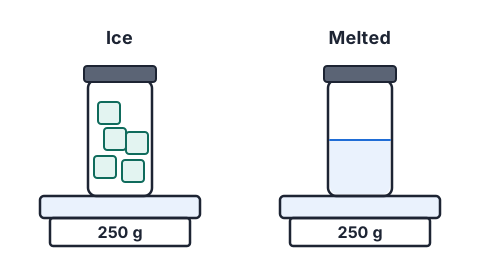
- Mia: 250 g before and 250 g aftersealed, so no particles left or arrived
- Ice to water only rearranges the particlessame number, same kind
- Friend: 252 g − 250 g = 2 g extrawater vapour from the air condensed on the jar
- Mass is conserved; the 2 g came from outside, so dry the jar before weighing
Example: explaining with particles
- In class, a balloon is stretched over the neck of an empty plastic bottle. When the bottle stands in a bowl of hot tap water, the balloon slowly inflates. In iced water it is sucked into the bottle.
- Use the particle model to explain what you see.
- Hot water heats the air in the bottlethermal energy goes in
- Air particles move faster and spread further apartthe gas expands
- There is no room in the bottle, so the expanding air pushes into the balloonthe balloon inflates
- In iced water the particles slow and move closer, so the air contracts and the balloon is pulled in
Common mistakes
- Things expand when heated because the particles themselves get bigger.The particles stay the same size; they move faster and spread further apart.
- Ice floats because it has air bubbles trapped in it.Even clear ice floats, because its particles are held in an open pattern that makes it less dense than water.
- When water evaporates, its mass is destroyed.The particles spread into the air as water vapour, so the mass is still there, just in the air.
- Ice has a bigger volume than the water it came from, so it must have more mass.The mass stays the same; the same particles just take up more room, so the density goes down.
Freeze it, weigh it, melt it
You need: a small plastic container or plastic cup, water, a marker pen, kitchen scales, cling film, space in the freezer
- Pour water into the plastic container until it is about two thirds full, and mark the water level on the outside with the marker.
- Cover it loosely with cling film, weigh it on the kitchen scales and write down the mass.
- Freeze it overnight, then look at the ice level against your mark and weigh it again.
- Leave it on the bench until all the ice has melted, wipe the outside dry, and weigh it a third time.
- Look for the pattern: the ice sits above the mark because water expands as it freezes, the melted water returns to the mark, and the mass stays the same all the way through.
Safety: Use plastic, never glass, in the freezer, and do not seal the lid tightly, because freezing water expands and can crack its container.
Your turn
Why do railway lines have small gaps between sections of track?
A solid block of chocolate sinks when dropped into melted chocolate. What does that tell you about the density of solid chocolate?
A 200 g ice block melts in a sealed bag. What is the mass of the water afterwards?
A student says that when water boils, its particles grow bigger to make steam. Correct the student.
Why does a can of fizzy drink left in the freezer sometimes burst?
Show answer
1. The steel expands on hot days, and the gaps give it room so the track does not buckle. 2. Solid chocolate is denser than liquid chocolate, like most substances. 3. 200 g, because mass is conserved in a change of state. 4. The particles stay the same size; they move much faster and spread far apart. 5. Most of the drink is water, which expands as it freezes, so the ice needs more room than the can has.
States of Matter: Basics
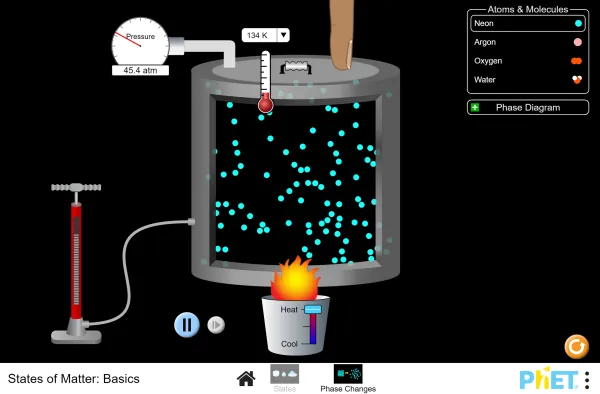
Full screen · PhET Interactive Simulations, University of Colorado Boulder, CC BY 4.0
Recap
- Heating makes particles move faster and push apart, so most materials expand when heated and contract when cooled.
- Density is mass divided by volume; less dense things float.
- Most substances are denser as a solid than as a liquid.
- Water is different: ice forms an open pattern, expands and is less dense than water, so it floats.
- Changes of state are reversible and only change the arrangement and spacing of particles, not the particles themselves.
- Mass is conserved in a change of state.
The maths behind it
Report a mistake
How is Year 7 maths going?
See the Year 7 maths guide