Percentages, fractions of amounts, and proportion
What this lesson covers
- Multiplying a whole number by a fraction and finding that fraction of that whole number have the same result.
- Percentages are decimal fractions with denominators of 100; they are represented using the percent symbol %.
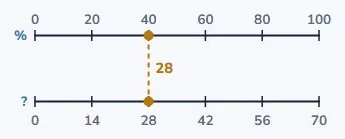
40% of a number is 28
- What is the number?
- Most people try to guess and check.
- There is a picture that just tells you.
First, a fraction of an amount
- Divide by the bottom, multiply by the top.
- That order, every time.
- It works even when the fraction is top-heavy.
| Question | Step | Working |
|---|---|---|
| 5/3 of 186 | divide by the bottom | 186 ÷ 3 = 62 |
| multiply by the top | 62 × 5 = 310 | |
| Answer | bigger than 186 | 310 |
5/3 of 186 is bigger than 186
- Five thirds is more than one whole.
- So taking five thirds of something grows it.
- 310, not something smaller.
A percentage is hundredths
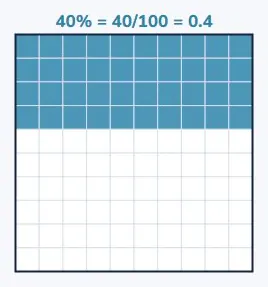
- 40% means 40 out of every 100.
- Which is the fraction 40/100, or 0.4.
- So percentages are fractions with a fixed bottom.
The ones you can do in your head
- 50% is half. 25% is half of that.
- 10% is a shift of one column.
- And 5% is half of 10%.
| Percentage | How | Same as |
|---|---|---|
| 50% | halve it | ÷ 2 |
| 25% | halve it twice | ÷ 4 |
| 10% | shift one column right | ÷ 10 |
| 5% | half of 10% | ÷ 20 |
| 1% | shift two columns right | ÷ 100 |
Find 10% first, then scale it
- 10% is the easiest one to get.
- Every other percentage is built from it.
- 30% is three lots. 5% is half a lot.
| Percentage | How | Same as |
|---|---|---|
| 50% | halve it | ÷ 2 |
| 25% | halve it twice | ÷ 4 |
| 10% | shift one column right | ÷ 10 |
| 5% | half of 10% | ÷ 20 |
| 1% | shift two columns right | ÷ 100 |
15% of 60
- 10% of 60 is 6.
- 5% is half of that, so 3.
- 6 + 3 = 9.
| Step | Working | Answer |
|---|---|---|
| 10% of 60 | 60 ÷ 10 | 6 |
| 5% of 60 | half of 6 | 3 |
| 15% | 6 + 3 | 9 |
Two scales, side by side
- Percentages on top, the real amount below.
- Both start at zero and end together.
- Every tick lines up with its partner.
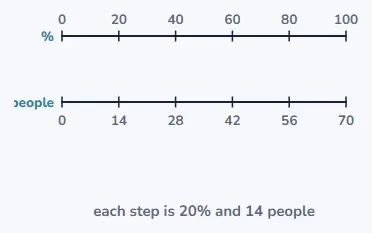
Reading it downwards: 40% of 70
- Find 40% on the top scale.
- Look straight down.
- 28.
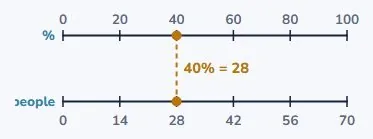
The same thing in numbers
- 10% of 70 is 7.
- 40% is four lots of 7.
- 28.
| Step | Working | Answer |
|---|---|---|
| 10% of 70 | 70 ÷ 10 | 7 |
| 40% | 4 lots of 7 | 28 |
Now upwards: 40% is 28
- Same picture, different end known.
- 28 sits at the 40% tick.
- Read along to 100%: the whole is 70.
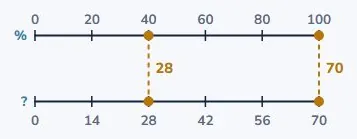
In numbers, through 10%
- If 40% is 28, then 10% is 28 ÷ 4 = 7.
- 100% is ten lots of 10%.
- 7 × 10 = 70.
| Step | Working | Answer |
|---|---|---|
| 40% is | 28 | |
| 10% is | 28 ÷ 4 | 7 |
| 100% is | 7 × 10 | 70 |
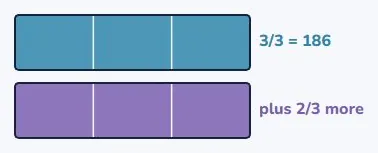
5/4 of a set is 85. How big is the set?
- Five quarters is 85, so one quarter is 17.
- The whole set is four quarters.
- 17 × 4 = 68.
| Step | Working | Answer |
|---|---|---|
| 5/4 of the set is | 85 | |
| So 1/4 is | 85 ÷ 5 | 17 |
| And 4/4 is | 17 × 4 | 68 |
Why 68 is smaller than 85
- Five quarters is MORE than the whole set.
- So the whole set has to be less than 85.
- If your answer came out bigger, check it.
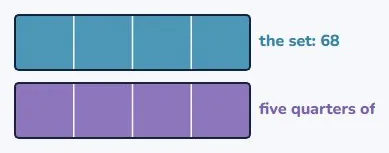
3 red for every 2 blue
- Not 3 red and 2 blue in total.
- A repeating group: 3 red with 2 blue, over and over.
- So count the groups.
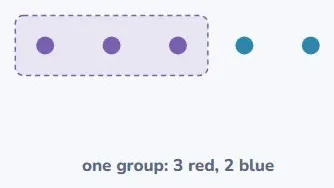
12 red. How many blue?
- 12 red is 12 ÷ 3 = 4 groups.
- Each group has 2 blue.
- 2 × 4 = 8 blue.
| Step | Working | Answer |
|---|---|---|
| For every | 3 red | 2 blue |
| 12 red is | 12 ÷ 3 = 4 groups | |
| So blue is | 2 × 4 | 8 |
Your turn: four questions
- Pause here and try all four.
- On question 3, find 10% before anything else.
- On question 4, count the groups.
| Question | |
|---|---|
| 1 | Find 3/8 of 96. |
| 2 | Find 35% of 80. |
| 3 | 60% of a number is 48. What is the number? |
| 4 | 5 apples for every 3 oranges. With 20 apples, how many oranges? |
Show answer
1. 36. 96 ÷ 8 = 12, then 12 × 3 = 36. 2. 28. 10% is 8, so 30% is 24; 5% is 4; 24 + 4 = 28. 3. 80. If 60% is 48 then 10% is 8, so 100% is 80. 4. 12. 20 apples is 4 groups of 5, so oranges are 3 × 4 = 12.
The answers
- 3/8 of 96 is 36. 35% of 80 is 28.
- 60% is 48, so 10% is 8 and the number is 80.
- 20 apples is 4 groups, so 12 oranges.
| Answer | |
|---|---|
| 1 | 36 |
| 2 | 28 |
| 3 | 80 |
| 4 | 12 |
What to take away
- Find 10% first; everything else is built from it.
- Going backwards, get to 10%, then up to 100%.
- The double number line reads in both directions.
| Remember | |
|---|---|
| A fraction of an amount | divide by the bottom, times the top |
| 10% first | then scale it to any percentage |
| Going backwards | get to 1% or 10%, then up to 100% |
| Double number line | works in both directions |
| Ratios | count the groups, then scale |
Is your child on track?
Take the free placement test