 Vertex Learn
Temperature, thermal energy and choosing insulators
What this lesson covers
- Kinetic energy is the energy anything has because it is moving
- Temperature tells you how fast, on average, the particles are moving
- Thermal energy, and why it is not the same as temperature
- Heat moves by conduction, convection and radiation
- How conduction passes energy from particle to particle
- Conductors, insulators and thermal conductivity
- Running a fair test and choosing insulating materials
Moving things have kinetic energy
- Kinetic energy is the energy an object has because it is moving.
- A rolling netball, a flying kererū and a gust of wind all have kinetic energy. The faster something moves, the more kinetic energy it has.
- Particles are always moving, so they have kinetic energy too, even in something that looks perfectly still, like a rock.
What temperature measures
- Temperature tells you how hot or cold something is. We measure it with a thermometer, in degrees Celsius (°C).
- In particle terms, temperature measures the average kinetic energy of the particles: how fast they are moving on average.
- In a hot cup of tea the particles move fast on average. In a glass of iced water they move more slowly.
- It is an average because not every particle moves at the same speed; some are faster and some slower.
Try it: heat the particles
Thermal energy is not temperature
- Thermal energy is the total energy of all the particles in something, from their movement and the pulls between them.
- Temperature depends on how fast the particles move on average. Thermal energy also depends on how many particles there are.
- A warm bath at 40 °C holds far more thermal energy than a cup of tea at 80 °C, because the bath has so many more particles.
- Heat is thermal energy on the move. It always flows from a hotter object to a colder one, never the other way on its own.
Three ways heat moves
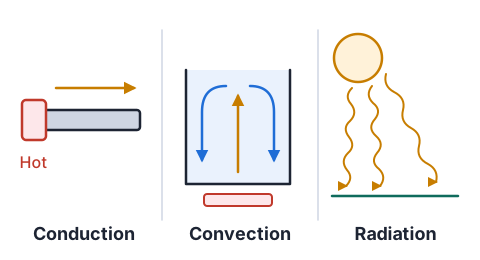
- Conduction: heat passes through a material from particle to particle. This is how the handle of a metal spoon in hot soup warms up.
- Convection: in a liquid or gas, the warmer part rises and the cooler part sinks, carrying heat with it in a loop. This is how a heater warms a whole room.
- Radiation: heat travels as invisible rays that need no material at all. This is how the Sun warms you across empty space, and why you feel the heat of a fire on your face.
Try it: conduction, convection or radiation?
Conduction close up
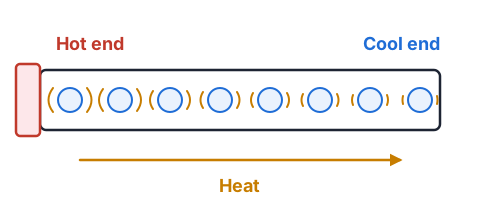
- Heat one end of a solid and the particles there vibrate harder.
- They bump into their neighbours and make them vibrate harder too, and so on along the material.
- The particles stay in place; only the energy is passed along. The material itself does not move.
- Metals conduct heat especially well. Materials with particles far apart, like gases, conduct heat very badly.
Conductors and insulators
- Thermal conductivity describes how well a material passes heat along by conduction.
- A material with high thermal conductivity is a good conductor: heat moves through it quickly. Metals such as copper, aluminium and steel are good conductors.
- A material with low thermal conductivity is an insulator: heat moves through it slowly. Wood, plastic, wool and still air are insulators.
- Many of the best insulators work by trapping lots of still air, which is a very poor conductor: think of wool, foam, feathers and bubble wrap.
- This is why a metal bench feels colder than a wooden one at the same temperature: the metal carries heat away from your hand much faster.
| Material | Conducts heat | Good for |
|---|---|---|
| Copper | Very well | Bottoms of pots |
| Steel | Well | Barbecue plates, pots |
| Glass | Poorly | Windows (better as double glazing) |
| Wood | Poorly | Spoon and pot handles |
| Wool | Very poorly | Jerseys, ceiling insulation |
| Polystyrene foam | Very poorly | Chilly bins, cups for hot drinks |
Try it: conductor or insulator?
Planning a fair test
- Question: which material keeps a can of hot water warm for longest?
- Change one thing only, the independent variable: the material wrapped around the can.
- Measure one thing, the dependent variable: how much the temperature drops in 20 minutes.
- Keep everything else the same (the controlled variables): the same cans, the same volume of water, the same starting temperature, the same thickness of wrapping, and the same place on the bench.
- Include a can with no wrapping to compare against, and repeat the test to check the results.
Example: which wrap insulates best?
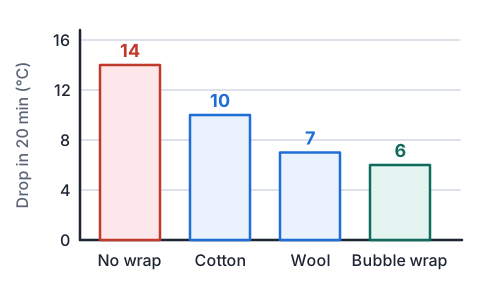
- A Year 7 class in Dunedin filled four identical cans with 300 mL of hot tap water at 50 °C. They wrapped three in one layer of a different material and left one bare, then read the temperature after 20 minutes.
- Use their results to rank the materials as insulators.
| Can | Start (°C) | After 20 min (°C) | Drop (°C) |
|---|---|---|---|
| No wrap | 50 | 36 | 14 |
| Cotton T-shirt | 50 | 40 | 10 |
| Wool jersey | 50 | 43 | 7 |
| Bubble wrap | 50 | 44 | 6 |
- Drop = start − after, e.g. 50 − 36 = 14 °Cfor each can
- Smallest drop = least heat lostbest insulator
- Bubble wrap 6, wool 7, cotton 10, no wrap 14in order
- Best insulator: bubble wrap, then wool, then cotton
- Wool and bubble wrap are close, so repeat the test before deciding
Choosing materials for the job
- Food: a chilly bin has foam walls so heat from a hot beach day gets in slowly and the food stays cold.
- Shelter: wool or fibreglass batts in ceilings and walls, and double glazing with a layer of air between two panes, slow heat loss from New Zealand homes in winter.
- Clothing: layers of merino or fleece trap still air next to your body, and a wetsuit traps a thin layer of water against your skin that your body warms.
- Sometimes you want a conductor instead: a pot base should be metal so heat from the element reaches the food quickly.
Example: designing a pot
- A designer is choosing materials for a cooking pot: one for the base and one for the handle. The choices are copper, wood and steel.
- Choose a material for each part and give a reason.
- Base: needs to pass heat to the food quicklyhigh thermal conductivity
- Handle: needs to stay cool enough to holdlow thermal conductivity
- Base: copper (or steel); handle: wood
Common mistakes
- A metal bench feels colder because metal is colder than wood.Both are the same temperature; metal is a better conductor, so it draws heat from your hand faster.
- A jersey makes heat to keep you warm.A jersey makes no heat; it is an insulator that slows the loss of your own body heat.
- Temperature and thermal energy are the same thing.Temperature is the average particle energy; thermal energy is the total, so a big cool bath can hold more than a small hot cup.
- Cold flows into your hands from a cold drink can.Heat flows out of your hands into the can; heat always moves from hotter to colder.
The ice cube race
You need: 3 ice cubes of the same size, a metal baking tray or pot lid, a wooden chopping board, a plastic plate, a timer or phone
- Leave the tray, board and plate on the bench for 10 minutes so they are all at room temperature, then touch each one and note which feels coldest.
- Put one ice cube on each surface at the same moment and start the timer.
- Every 2 minutes, write down how much of each ice cube is left.
- Note which ice cube melts first and which lasts longest.
- Look for the pattern: the ice on the metal melts fastest, because metal conducts heat from the room into the ice quickly, even though the metal felt coldest.
Safety: Wipe up the meltwater straight away so nobody slips on a wet floor, and ask an adult before using the baking tray.
Your turn
Which has more kinetic energy: a car at 30 km/h or the same car at 60 km/h?
Name the way heat travels from the Sun to Earth.
Why are saucepan handles often made of plastic or wood?
In a class test, a can wrapped in foil dropped 12 °C and one wrapped in felt dropped 5 °C. Which material is the better insulator?
Why does a puffer jacket keep you warm even though it is very light?
Show answer
1. The car at 60 km/h, because it is moving faster. 2. Radiation, which needs no material to travel through. 3. They have low thermal conductivity, so the handle stays cool enough to hold. 4. Felt, because its can lost the least heat (5 °C compared with 12 °C). 5. Its filling traps a lot of still air, which is a very poor conductor, so body heat escapes slowly.
Energy Forms and Changes
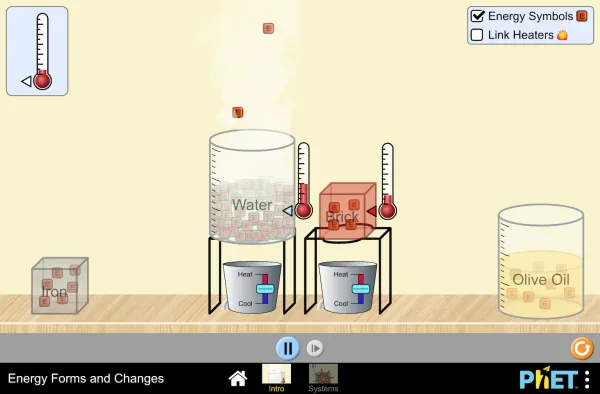
Full screen · PhET Interactive Simulations, University of Colorado Boulder, CC BY 4.0
Recap
- Kinetic energy is the energy of motion; faster means more.
- Temperature measures the average kinetic energy of the particles; thermal energy is the total energy of all of them.
- Heat flows from hot to cold by conduction, convection and radiation.
- In conduction, vibrating particles pass energy to their neighbours, but the material itself does not move.
- Good conductors such as metals have high thermal conductivity; insulators such as wool, foam and still air have low thermal conductivity.
- A fair test changes one variable, measures one, and keeps the rest the same.
The maths behind it
Report a mistake
How is Year 7 maths going?
See the Year 7 maths guide