Volume, formulae and working with time
What this lesson covers
- Measurement formulae for perimeter are: for a square P = 4l, for a rectangle P = 2(l + w).
- Measurement formulae for area are: for a triangle A = bh/2, for a square A = l², for a rectangle A = lw.
- Measurement formulae for volume are: for a cube V = l³, for a rectangular prism V = lwh.
- Duration questions can involve fractions of time and converting between units of time.
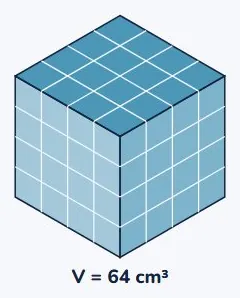
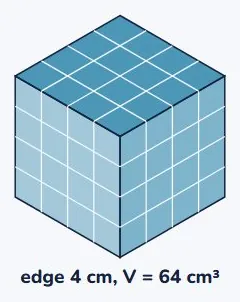
A cube holds 64 cm³. How long is one edge?
- Not 64 ÷ 3. That is not what cubing does.
- You need a number that times itself three times gives 64.
- And there is a short list of those.
Every formula, in one place
- Perimeter, area and volume for the shapes you need.
- Worth copying out once and keeping.
- Notice volume only appears for the 3D ones.
| Shape | Perimeter | Area or volume |
|---|---|---|
| Square | P = 4l | A = l² |
| Rectangle | P = 2(l + w) | A = lw |
| Triangle | Add the sides | A = bh ÷ 2 |
| Cube | Not needed | V = l³ |
| Rectangular prism | Not needed | V = lwh |
Volume of a rectangular prism
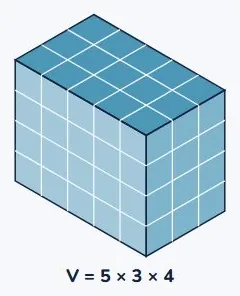
- Length times width gives the base.
- Times the height stacks it up.
- V = lwh: all three, multiplied.
5 by 3 by 4
- The base layer is 5 × 3 = 15 cubes.
- Four layers of those.
- 60 cm³.
| Step | Working | Answer |
|---|---|---|
| Formula | V = lwh | |
| Put in | 5 × 3 × 4 | |
| Volume | 60 cm³ |
Backwards: find the height
- Volume 60, base 5 by 3.
- The base is 15, so 60 = 15h.
- Divide both sides by 15. h = 4 cm.
| Step | Working | Answer |
|---|---|---|
| Known | 60 = 5 × 3 × h | |
| The base is | 5 × 3 = 15 | |
| So | 60 = 15h | |
| Divide both by 15 | h = 4 | 4 cm |
A cube is the easy case and the hard one
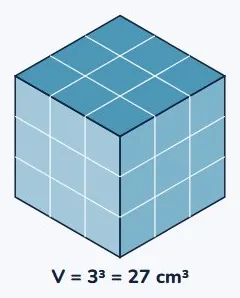
- All three edges are the same, so V = l³.
- Forwards that is very easy.
- Backwards there is no single step to undo it.
The cube numbers
- Six of them cover almost every question you will meet.
- 1, 8, 27, 64, 125, 216.
- Recognise 64 and the answer is 4.
| Written | Means | Value |
|---|---|---|
| 1³ | 1 × 1 × 1 | 1 |
| 2³ | 2 × 2 × 2 | 8 |
| 3³ | 3 × 3 × 3 | 27 |
| 4³ | 4 × 4 × 4 | 64 |
| 5³ | 5 × 5 × 5 | 125 |
| 6³ | 6 × 6 × 6 | 216 |
So the opening question
- Volume 64. Look it up: 64 is 4³.
- So each edge is 4 cm.
- Check: 4 × 4 × 4 = 64.
Now the strange one: time
- Every other unit this year has worked in tens.
- 1000 m in a km. 100 cm in a metre.
- Time does none of that.
| One | Is |
|---|---|
| 1 minute | 60 seconds |
| 1 hour | 60 minutes |
| 1 day | 24 hours |
| 1 week | 7 days |
Sixty, and twenty-four, and seven
- 60 seconds. 60 minutes. 24 hours. 7 days.
- No shifting digits. No cancelling zeros.
- So every conversion has to be done properly.
| One | Is |
|---|---|
| 1 minute | 60 seconds |
| 1 hour | 60 minutes |
| 1 day | 24 hours |
| 1 week | 7 days |
2.5 hours is not 2 hours 50 minutes
- With kilometres, 2.5 km really is 2 km and 500 m.
- With hours, 0.5 of an hour is 30 minutes.
- So 2.5 hours is 2 h 30 min. That is 150 minutes.
| This | That | |
|---|---|---|
| 2.5 hours | is NOT | 2 h 50 min |
| 0.5 of an hour | is | 30 minutes |
| So 2.5 hours | is | 2 h 30 min = 150 min |
Fractions of an hour
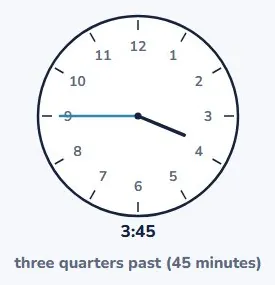
- Half an hour is 30 minutes.
- A quarter is 15. So three quarters is 45.
- And a third of an hour is 20 minutes.
The ones that come up
- Divide 60 by the bottom, times by the top.
- The same rule as any fraction of an amount.
- The amount just happens to be 60.
| Fraction | Working | Minutes |
|---|---|---|
| 1/2 hour | 60 ÷ 2 | 30 min |
| 1/4 hour | 60 ÷ 4 | 15 min |
| 3/4 hour | 15 × 3 | 45 min |
| 1/3 hour | 60 ÷ 3 | 20 min |
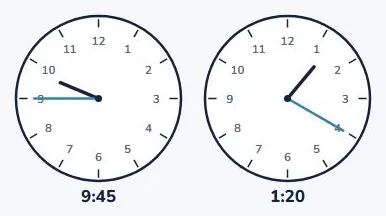
How long from 9:45 to 13:20?
- Do not try to subtract in columns.
- Borrowing sixty instead of ten goes wrong constantly.
- Count up instead, the same way you did change.
Counting up in chunks
- 9:45 to 10:00 is 15 minutes.
- 10:00 to 13:00 is 3 hours.
- 13:00 to 13:20 is 20 minutes. Total 3 h 35 min.
| From, to | Working | Adds |
|---|---|---|
| 9:45 to 10:00 | 15 min | |
| 10:00 to 13:00 | 3 hours | |
| 13:00 to 13:20 | 20 min | |
| Total | 3 h + 35 min | 3 h 35 min |
Reading a timetable
- Rows are stops. Columns are buses.
- Read down a column to follow one bus.
- Read across a row to compare buses at one stop.
| Stop | Bus A | Bus B |
|---|---|---|
| Avondale | 7:52 | 8:22 |
| New Lynn | 8:09 | 8:39 |
| Henderson | 8:37 | 9:07 |
How long does Bus A take?
- Avondale at 7:52, Henderson at 8:37.
- 7:52 to 8:00 is 8 minutes.
- 8:00 to 8:37 is 37. Total 45 minutes.
| Stop | Bus A | Bus B |
|---|---|---|
| Avondale | 7:52 | 8:22 |
| New Lynn | 8:09 | 8:39 |
| Henderson | 8:37 | 9:07 |
Your turn: four questions
- Pause here and try all four.
- On question 1, use the cube number list.
- On question 4, count up. Do not subtract.
| Question | |
|---|---|
| 1 | A cube has volume 125 cm³. How long is one edge? |
| 2 | A prism is 6 cm by 4 cm by h, and holds 96 cm³. Find h. |
| 3 | Convert 3.25 hours to minutes. |
| 4 | A train leaves at 10:48 and arrives at 13:15. How long is the trip? |
Show answer
1. 5 cm, because 5 × 5 × 5 = 125. 2. 4 cm. The base is 6 × 4 = 24, and 96 ÷ 24 = 4. 3. 195 minutes. 3 hours is 180, and 0.25 of an hour is 15. 4. 2 hours 27 minutes. 12 minutes to 11:00, then 2 hours to 13:00, then 15 minutes.
The answers
- 125 is 5³, so the edge is 5 cm. And h is 4 cm.
- 3.25 hours is 180 + 15 = 195 minutes.
- The train takes 2 hours 27 minutes.
| Answer | |
|---|---|
| 1 | 5 cm |
| 2 | 4 cm |
| 3 | 195 minutes |
| 4 | 2 h 27 min |
What to take away
- Volume backwards: divide by the other two, or use a cube number.
- Time does not work in tens. 2.5 hours is 150 minutes.
- For elapsed time, count up in chunks.
| Remember | |
|---|---|
| V = lwh | and backwards, divide by the other two |
| V = l³ | backwards needs a cube root |
| Cube numbers | 1, 8, 27, 64, 125, 216 |
| Time | does not work in tens |
| Elapsed time | count up, never subtract |
Is your child on track?
Take the free placement test