 Vertex Learn
The Moon as a clock, the maramataka, and eclipses
What this lesson covers
- Using the Moon's phases to measure time: about a week between quarter phases and about a month for the whole cycle
- Predicting future phase dates from one known date
- How the maramataka uses the Moon, stars and local signs to organise the year
- Modelling the phases with a ball and a light
- A lunar eclipse: the Moon moves into Earth's shadow
- A solar eclipse: the Moon passes between Earth and the Sun
- Why eclipses do not happen every month
The Moon as a clock
- Because the phases repeat in the same order, the Moon works as a natural clock in the sky that everyone can see.
- The whole cycle, new moon to new moon, takes about 29.5 days. The word month comes from Moon.
- The cycle has four main phases (new, first quarter, full, last quarter), so the gap between them is about 29.5 ÷ 4 ≈ 7.4 days: roughly a week.
- So if you know the date of one phase, you can predict the next ones by counting on about 7 or 8 days at a time.
Example: predicting a month of phases
- New moon is on 9 December 2026. Predict the dates of first quarter, full moon, last quarter and the next new moon, then compare with the published dates.
| Phase | Date and time |
|---|---|
| New moon | 9 December 2026, 1:52 pm |
| First quarter | 17 December 2026, 6:42 pm |
| Full moon | 24 December 2026, 2:28 pm |
| Last quarter | 31 December 2026, 7:59 am |
| New moon | 8 January 2027, 9:24 am |
- First quarter: 9 + 7.4 ≈ 16 Decemberone step of about 7.4 days
- Full: 9 + 14.8 ≈ 24 Decembertwo steps
- Last quarter: 9 + 22.1 ≈ 31 Decemberthree steps
- Next new moon: 9 December + 29.5 days ≈ 7 or 8 Januarythe whole cycle
- Predicted about 16 Dec, 24 Dec, 31 Dec and 8 Jan
- Published: 17 Dec, 24 Dec, 31 Dec, 8 Jan, all within a day
The maramataka divides the year
- The maramataka is the traditional Māori calendar, built on the movements and phases of the Moon and on the stars.
- It splits the year into seasons and months (marama), and each month into named nights, each linked to a phase of the Moon.
- Stars mark the year too. The rising of Matariki, which always happens in June or July, signals the start of the new year and the first month of the maramataka. Some iwi look to the star Puanga at this time instead.
- Because the months follow the Moon, a calendar like this needs resetting every so often to stay in step with the seasons, and the stars help with that.
| Part of the maramataka | What it tracks |
|---|---|
| Night names | Each night's Moon phase |
| Marama (months) | Most iwi count 12, each of about 30 nights |
| Matariki or Puanga | The start of the new year |
| Tohu | Signs in the local environment |
Local signs, local calendars
- A maramataka is not one fixed calendar for the whole country. Each iwi and region has its own, fitted to its own coast, rivers, forests and climate.
- It uses environmental signs (tohu), such as the arrival of migrating inanga (whitebait) or tītī, together with the Moon phase, to guide planting, fishing and gathering food.
- Because the climate is changing, some tohu used for hundreds of years no longer appear at the same times, so people who use the maramataka keep observing and adjusting it.
- That is how science works too: careful observation over long periods, checked against what really happens.
Modelling the phases
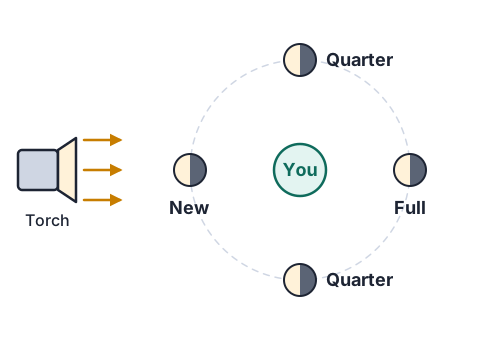
- You can model the phases in a dark room. A torch or lamp is the Sun, a ball on a stick is the Moon, and your head is Earth.
- Hold the ball at arm's length, a little above your head, and turn slowly on the spot so the ball orbits your head.
- Facing the torch, you see the dark side of the ball: new moon. With the torch behind you (and the ball above your shadow), you see the whole lit side: full moon.
- Halfway between, with the torch to one side, you see half the ball lit: a quarter moon.
- The ball is always half lit. Only your view of it changes, which is exactly what happens with the real Moon.
Example: using the model to explain
- In the model, you stand with the torch directly to your right and the ball held straight in front of you. How much of the ball looks lit, and which side?
- The torch lights the half of the ball facing itthe right-hand half
- You see the half of the ball facing youthe front half
- Overlap: half of what you seethe right side of the disc
- Half the ball looks lit, on its right side, like a quarter moon
A lunar eclipse
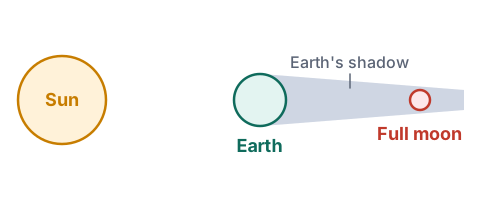
- Earth blocks sunlight and casts a long shadow into space, on the side away from the Sun.
- A lunar eclipse happens when the Moon moves into Earth's shadow. The Sun, Earth and Moon are then in a straight line, with Earth in the middle.
- This can only happen at full moon, because that is when the Moon is on the far side of Earth from the Sun.
- During a total lunar eclipse the Moon usually turns a dull red, because a little sunlight is bent through Earth's air and reaches it.
- Anyone on the night side of Earth can see it, and it is safe to look at.
A solar eclipse
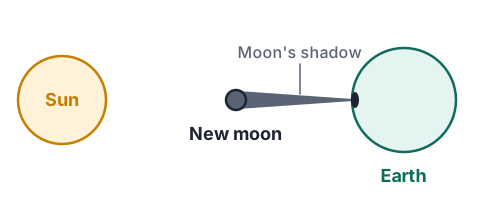
- A solar eclipse happens when the Moon passes exactly between Earth and the Sun, so the Moon blocks the Sun from view.
- This can only happen at new moon.
- The Moon's shadow is small, so it covers only a narrow strip of Earth. Inside that strip the Sun is completely hidden for a few minutes: a total eclipse. Nearby, people see only part of the Sun covered.
- Never look straight at the Sun, even during an eclipse: it can permanently damage your eyes. Use proper eclipse glasses or a pinhole viewer.
Try it: lunar or solar eclipse?
Why not every month?
- There is a new moon and a full moon every month, but not an eclipse every month.
- The Moon's orbit is tilted by about 5 degrees compared with Earth's orbit around the Sun.
- So most months the new moon passes a little above or below the Sun, and the full moon passes a little above or below Earth's shadow.
- Only when a new or full moon happens just as the Moon crosses the level of Earth's orbit do the three line up exactly, and we get an eclipse.
Try it: phases and eclipses
Common mistakes
- A solar eclipse is when Earth's shadow covers the Sun.In a solar eclipse the Moon blocks the Sun; Earth's shadow on the Moon is a lunar eclipse.
- There must be an eclipse every new moon and full moon.The Moon's orbit is tilted, so most months the three bodies do not line up exactly.
- The maramataka is the same everywhere in New Zealand.Each iwi and region has its own maramataka, fitted to local signs and conditions.
- A lunar eclipse can happen at any phase.A lunar eclipse needs Earth between the Sun and the Moon, which only happens at full moon.
Model the phases with a torch
You need: a torch (AA or AAA batteries), a light-coloured ball, such as a tennis ball, a pencil or stick, a dark room, a helper
- Push the pencil into the ball (or tape it on) so you can hold it up like a lollipop.
- Ask your helper to hold the torch at head height on one side of the dark room, shining towards you.
- Hold the ball at arm's length, slightly above your head, and turn slowly on the spot, anticlockwise.
- Stop at eight points around the circle and note the shape of the lit part you can see.
- Look for the pattern: the lit part grows from a thin crescent to a full circle and back again, just like the real Moon's phases.
Safety: Clear the floor before turning off the lights so nobody trips in the dark, and never shine the torch into anyone's eyes.
Your turn
Full moon is on 24 December 2026. Roughly when is the next last quarter?
Which phase must the Moon be in for a solar eclipse?
In a lunar eclipse, which body is in the middle of the line?
Why do iwi in different regions have different maramataka?
Why is a solar eclipse seen only from a small part of Earth, while a lunar eclipse is seen by everyone on the night side?
Show answer
1. About a week later, around 31 December 2026. 2. New moon. 3. Earth, between the Sun and the Moon. 4. Each region has its own climate, plants and animals, so the tohu and best times differ. 5. The Moon's shadow on Earth is small, but in a lunar eclipse the whole Moon goes into Earth's shadow, so everyone who can see the Moon sees it darken.
Recap
- The Moon's phases repeat about every 29.5 days, with about a week between main phases, so they can measure and predict time.
- The maramataka is the Māori lunar calendar: it names each night by the Moon, starts the year with Matariki or Puanga, and uses local tohu.
- A ball, a light and your head can model the phases: the ball is always half lit, and only the view changes.
- A lunar eclipse happens at full moon, when the Moon moves into Earth's shadow.
- A solar eclipse happens at new moon, when the Moon passes between Earth and the Sun.
- The Moon's tilted orbit is why eclipses do not happen every month.
The maths behind it
Report a mistake
How is Year 7 maths going?
See the Year 7 maths guide