 Vertex Learn
The Moon's phases, and why it rises later each day
What this lesson covers
- The Moon is Earth's natural satellite, a roughly round ball of rock that orbits Earth
- The Moon shines only by reflected sunlight, and half of it is always lit
- Phases happen because, as the Moon orbits, we see different amounts of its lit half
- The cycle of phases (new, crescent, quarter, gibbous, full) repeats about every 29.5 days
- Why the Moon rises about 50 minutes later each day
- Finding patterns in Moon data, and using a lunar calendar to plan ahead
Earth's natural satellite
- A satellite is an object that travels in a path (an orbit) around a larger object.
- The Moon is Earth's only natural satellite. It is a roughly spherical ball of rock, about a quarter as wide as Earth.
- It takes about a month to go once around Earth, held in its orbit by gravity.
- Human-made satellites, such as weather and GPS satellites, also orbit Earth, but they are artificial.
Half the Moon is always lit
- The Moon makes no light of its own. We see it because sunlight bounces off it.
- At every moment, the half of the Moon facing the Sun is lit and the other half is dark, just like day and night on Earth.
- As the Moon orbits, we on Earth see different amounts of that lit half. This changing view is what we call the phases.
- When the Moon is between Earth and the Sun, its lit half faces away from us and we see almost nothing: a new moon. When it is on the far side of Earth from the Sun, we see the whole lit half: a full moon.
- The diagram looks down from far above the South Pole, with sunlight coming from the left. From there the Moon travels clockwise around Earth.
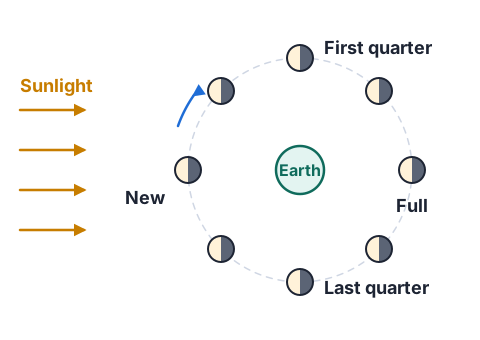
The cycle of phases from New Zealand
- After new moon, a thin crescent appears. The lit part grows each night: this is called waxing.
- About a week after new moon, half the disc is lit: the first quarter. Then comes a waxing gibbous moon (more than half lit), and then full moon.
- After full moon the lit part shrinks, called waning: waning gibbous, last quarter, waning crescent, and back to new.
- From New Zealand, a waxing Moon is lit on the left and a waning Moon on the right. In the Northern Hemisphere it looks the other way round.
- One full cycle, from new moon to the next new moon, takes about 29.5 days.
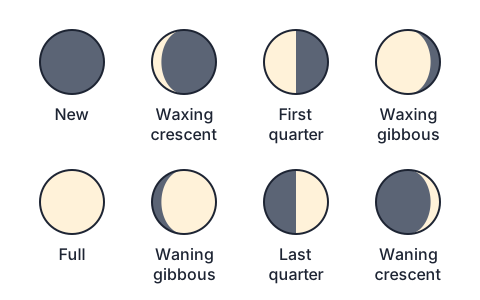
Try it: the Moon's phases from New Zealand
Why moonrise moves later
- Earth spins once a day, which makes the Sun, Moon and stars appear to rise in the east and set in the west.
- While Earth spins, the Moon is also moving along its orbit in the same direction.
- So after one full spin, Earth has to turn a little further to bring the Moon back into view. On average this takes about 50 minutes extra, so the Moon rises about 50 minutes later each day.
- That is why the phase and the time you can see the Moon go together.
| Phase | Rises about | Best seen |
|---|---|---|
| New | With the Sun | Not visible |
| First quarter | Midday | Afternoon and evening |
| Full | Sunset | All night |
| Last quarter | Midnight | After midnight and in the morning |
Try it: waxing or waning?
Example: finding the pattern in real dates
- Here are the main Moon phases for November and December 2026, in New Zealand time.
- How long is it between one main phase and the next, and from one new moon to the next?
| Phase | Date and time |
|---|---|
| New moon | 9 November, 8:02 pm |
| First quarter | 18 November, 12:48 am |
| Full moon | 25 November, 3:53 am |
| Last quarter | 1 December, 7:08 pm |
| New moon | 9 December, 1:52 pm |
- 9 Nov to 18 Nov: about 8 daysnew to first quarter
- 18 Nov to 25 Nov: about 7 days; 25 Nov to 1 Dec: about 7 daysthe next two gaps
- 1 Dec to 9 Dec: about 8 dayslast quarter to new
- 9 Nov 8:02 pm to 9 Dec 1:52 pm = 29 days 17 h 50 min ≈ 29.7 daysnew moon to new moon
- About a week between main phases, and about 29.5 days for the whole cycle
- The gaps vary a little because the Moon's orbit is not a perfect circle
Collecting your own Moon data
- Scientists find patterns by recording the same things again and again over a long time.
- A Moon diary records the date, the time, the shape of the Moon (draw it) and where it is in the sky, such as low in the east or high in the north.
- Over a few weeks you will see the phases change in order, and the Moon appear later each evening.
- Over several months you can check that the cycle really does repeat, and predict when the next full moon will be.
Try it: tonight's Moon
The maramataka
- The maramataka is a traditional Māori calendar based on the movements and phases of the Moon (te marama) and the stars (ngā whetū).
- Each night of the lunar month has its own name, linked to a particular phase of the Moon. Most iwi count 12 months in a year, each of about 30 nights.
- Maramataka differ between iwi and regions. Some iwi begin the month at the new moon, with the night called Whiro; others begin at the full moon, with Rākaunui.
- A local maramataka guides planting, fishing and gathering food, together with signs in the environment (tohu). To use one, find the maramataka for your own area, from your local iwi or marae.
| Practice | First night of the month | Moon phase |
|---|---|---|
| Some iwi | Whiro | New moon |
| Other iwi | Rākaunui | Full moon |
Example: planning with a lunar calendar
- Imagine your local maramataka marks the night of the full moon and the two nights after it as good for fishing in your area.
- In December 2026, the full moon is on 24 December at 2:28 pm, New Zealand time. Which nights should your whānau plan for?
- Full moon: afternoon of 24 Decemberfrom the phase table
- That night is the full-moon nightthe Moon rises around sunset
- Plus the next two nights: 25 and 26 Decemberthe two after it
- The nights of 24, 25 and 26 December 2026
Common mistakes
- The phases are caused by Earth's shadow falling on the Moon.Phases come from how much of the Moon's sunlit half we can see; Earth's shadow only reaches the Moon in a lunar eclipse.
- The Moon only comes out at night.The Moon is up for about half of each day, and you can often see it in daylight, especially near the quarter phases.
- A first quarter moon is a quarter lit.At first quarter, half the disc is lit; the name means the Moon is a quarter of the way through its cycle.
- The Moon gives off its own light.The Moon only reflects sunlight; half of it is always lit by the Sun.
Keep a Moon diary
You need: a notebook, a pencil, a clock or phone, a window or garden with a view of the sky
- Every clear evening for at least two weeks, look for the Moon at the same time, for example 8 pm.
- Draw its shape, and note the date, the time, and roughly where it is (which direction, and how high).
- If you cannot see it at 8 pm, write that down too; it may not have risen yet, or it may be cloudy.
- After two weeks, put your drawings in order and label each with its phase name.
- Look for the pattern: the lit part grows from the left towards full moon, and each evening the Moon sits further east than the night before at the same time.
Safety: Do your observing from home or with an adult, and never look at the Sun, even when looking for a daytime Moon.
Your turn
What do we call the phase when the Moon is between Earth and the Sun?
From New Zealand, a half Moon is lit on its left side. Is it first quarter or last quarter?
A full moon is on 23 January 2027. Roughly when will the next full moon be?
The Moon rises at 7:00 pm tonight. At about what time will it rise tomorrow?
Why do we see phases at all, if half the Moon is always lit?
Show answer
1. New moon. 2. First quarter, because from New Zealand a waxing Moon is lit on the left. 3. About 29.5 days later, around 21 or 22 February 2027. 4. About 50 minutes later, at around 7:50 pm. 5. As the Moon orbits Earth, we see different amounts of its lit half.
Recap
- The Moon is Earth's natural satellite, a roughly round ball of rock.
- It shines by reflected sunlight, and half of it is always lit.
- Phases happen because, as the Moon orbits, we see different amounts of its lit half.
- The cycle goes new, waxing crescent, first quarter, waxing gibbous, full, then waning back to new, in about 29.5 days.
- Because the Moon moves along its orbit, it rises about 50 minutes later each day.
- Recording the Moon over months reveals the pattern; the maramataka is a Māori calendar built on it.
The maths behind it
Report a mistake
How is Year 7 maths going?
See the Year 7 maths guide