 Vertex Learn
Speed: measuring it, calculating it and graphing it
What this lesson covers
- Speed tells you how fast something is moving
- Speed is the distance covered in each unit of time: speed = distance ÷ time
- Speed units, metres per second (m/s) and kilometres per hour (km/h), and converting between them
- Constant speed, changing speed, and average speed
- Measuring distance and time accurately, and why repeats make results more reliable
- Showing motion on a distance-time graph
- Faster objects have more kinetic energy
What speed means
- Speed tells you how fast something is moving: how much distance it covers in a certain amount of time.
- A speed of 3 metres per second means the object travels 3 metres every second.
- To compare how fast two things move, you compare their speeds, not just the distances or the times on their own.
- A snail and a sprinter can both travel 100 m. What makes them different is how long it takes.
Speed = distance ÷ time
- To calculate speed, divide the distance travelled by the time taken.
- If distance is in metres (m) and time in seconds (s), the speed is in metres per second (m/s).
- If distance is in kilometres (km) and time in hours (h), the speed is in kilometres per hour (km/h). Road signs in New Zealand use km/h.
- You can rearrange it: distance = speed × time, and time = distance ÷ speed.
| To find | Use |
|---|---|
| Speed | distance ÷ time |
| Distance | speed × time |
| Time | distance ÷ speed |
Example: who is faster?
- Aroha runs 100 m in 16 s. Ben runs 60 m in 10 s. Who is faster?
- Aroha: 100 m ÷ 16 s = 6.25 m/sspeed = distance ÷ time
- Ben: 60 m ÷ 10 s = 6 m/ssame method
- 6.25 m/s is more than 6 m/scompare the speeds
- Aroha is faster, by 0.25 m/s
Switching between m/s and km/h
- There are 1000 metres in a kilometre and 3600 seconds in an hour.
- So 1 m/s is 3600 m in an hour, which is 3.6 km/h.
- To change m/s into km/h, multiply by 3.6. To change km/h into m/s, divide by 3.6.
- A school zone limit of 30 km/h is 30 ÷ 3.6 ≈ 8.3 m/s: a car covers more than 8 metres every second, even when it is going slowly.
Example: a bike ride in km/h and m/s
- Sione cycles 18 km along a rail trail in 1.5 hours. Find his average speed in km/h and in m/s.
- 18 km ÷ 1.5 h = 12 km/hspeed = distance ÷ time
- 12 ÷ 3.6 ≈ 3.3 m/skm/h to m/s: divide by 3.6
- 12 km/h, about 3.3 m/s
Steady speed, changing speed, average speed
- An object moving at a constant (steady) speed covers the same distance every second.
- Most real motion changes speed: a bus speeds up, slows at stops and waits at lights.
- Average speed is the total distance divided by the total time. It treats the whole trip as if it were done at one steady speed.
- Sione's 12 km/h is an average: on hills he was slower, and on the flat he was faster.
Measuring speed well
- Measure distance with a tape measure or trundle wheel, in metres.
- Measure time with a stopwatch. A person takes about a fifth of a second to react when starting and stopping it, so very short times have big errors.
- Use a longer distance so the reaction-time error is a smaller part of the total.
- Repeat each measurement at least three times and take the mean (average). If one result is very different from the others, check it, and leave it out if it was a mistake.
- Results are reliable when repeats give similar values, and accurate when they are close to the true value.
Example: timing a rolling ball
- A Year 7 class in Nelson timed a ball rolling 5 m across the hall floor, three times each by two methods.
- Find the average time and the speed, and say which method was more reliable.
| Method | Trial 1 (s) | Trial 2 (s) | Trial 3 (s) |
|---|---|---|---|
| Stopwatch, one timer | 2.2 | 2.9 | 2.6 |
| Phone filming, counting frames | 2.5 | 2.5 | 2.6 |
- Stopwatch mean: (2.2 + 2.9 + 2.6) ÷ 3 = 2.57 sadd, divide by 3
- Filming mean: (2.5 + 2.5 + 2.6) ÷ 3 = 2.53 ssame
- Speed ≈ 5 m ÷ 2.53 s ≈ 2.0 m/sspeed = distance ÷ time
- About 2.0 m/s; filming was more reliable because its three times agree closely
Distance-time graphs
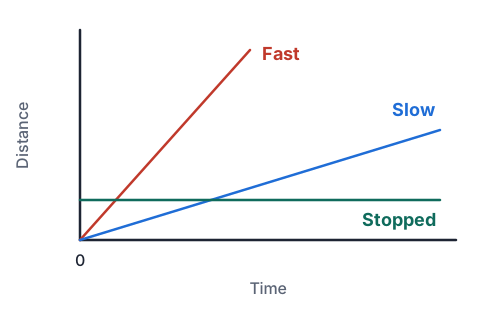
- A distance-time graph shows how far an object has gone (up the side) at each time (along the bottom).
- A straight sloping line means a constant speed. The steeper the line, the faster the object.
- A flat line means the distance is not changing: the object has stopped.
- A curved line means the speed is changing.
Try it: read the line
Example: reading a walk to school
- Riya walks to a crossing, waits for the lights, then walks on. Her friend records her distance every 10 seconds.
- Find her speed in each part of the trip, and her average speed overall.
| Time (s) | 0 | 10 | 20 | 30 | 40 |
|---|---|---|---|---|---|
| Distance (m) | 0 | 15 | 30 | 30 | 50 |
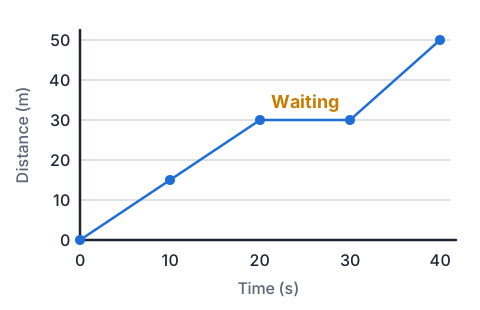
- 0 to 20 s: 30 m ÷ 20 s = 1.5 m/ssteady slope
- 20 to 30 s: 0 m ÷ 10 s = 0 m/sflat line: waiting
- 30 to 40 s: 20 m ÷ 10 s = 2 m/ssteeper slope: faster
- Average: 50 m ÷ 40 s = 1.25 m/s
Try it: build a distance-time graph
Speed and kinetic energy
- Every moving object has kinetic energy, the energy of motion.
- The faster an object moves, the more kinetic energy it has. A heavier object at the same speed also has more.
- Kinetic energy grows quickly with speed: doubling the speed gives four times the kinetic energy.
- That is why a car crash at 50 km/h does far more damage than one at 30 km/h, and why school zones have lower limits.
Common mistakes
- Speed = time ÷ distance, so 100 m in 20 s is 0.2 m/s.Speed is distance ÷ time: 100 m ÷ 20 s = 5 m/s.
- A flat line on a distance-time graph means moving at a steady speed.A flat line means the distance is not changing, so the object is stopped; a steady speed is a straight sloping line.
- Dividing 3 km by 20 minutes gives a speed of 0.15 km/h.Change the time to hours first: 20 min = 1/3 h, so 3 km ÷ 1/3 h = 9 km/h.
- If I measure once very carefully, I do not need repeats.Repeats show whether results agree and let you take a mean, which reduces the effect of reaction-time errors.
How fast do you walk?
You need: a tape measure, 2 markers such as shoes or chalk, a stopwatch or phone timer, a helper, paper and pencil
- Measure 20 m along a footpath, driveway or hallway and mark the start and finish.
- Start walking well before the start line, so you are already at your normal pace when you cross it.
- Your helper starts the timer as you pass the start and stops it at the finish. Do this three times.
- Find the mean of your three times, then divide 20 m by it to get your walking speed in m/s.
- Look for the pattern: your three times should be close; try again walking fast and compare the speeds.
Safety: Walk on a footpath or at home, never on a road or driveway where a car could be moving, and ask an adult before you start.
Your turn
A tūī flies 120 m in 8 s. What is its speed?
Convert 5 m/s into km/h.
A ferry travels at 30 km/h for 2 hours. How far does it go?
On a distance-time graph, line A is steeper than line B. Which object is faster?
Three timings of a falling ball are 0.6 s, 0.9 s and 0.6 s. Why should the class be careful about trusting these?
Show answer
1. 120 ÷ 8 = 15 m/s. 2. 5 × 3.6 = 18 km/h. 3. 30 × 2 = 60 km. 4. A, because a steeper line means more distance in each second. 5. The times are very short and do not agree, so reaction time causes large errors; drop from higher or film it.
Forces and Motion: Basics
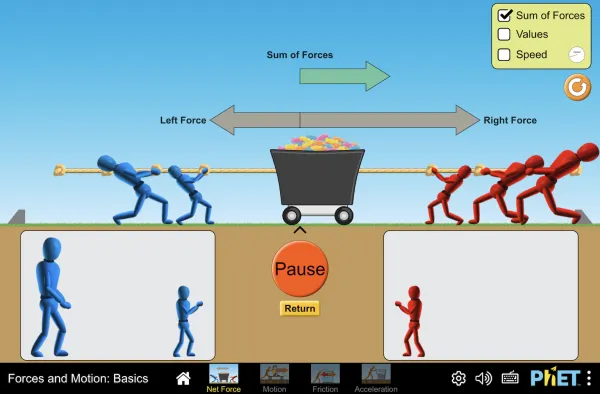
Full screen · PhET Interactive Simulations, University of Colorado Boulder, CC BY 4.0
Recap
- Speed is distance travelled per unit of time: speed = distance ÷ time.
- Units are usually m/s or km/h; multiply by 3.6 to go from m/s to km/h.
- Speed can be constant or changing; average speed is total distance ÷ total time.
- Repeat measurements and take the mean; longer distances reduce reaction-time error.
- On a distance-time graph, steeper means faster and flat means stopped.
- Faster objects have more kinetic energy.
The maths behind it
Report a mistake
How is Year 7 maths going?
See the Year 7 maths guide