Time, timetables and elapsed time
What this lesson covers
- Vertically opposite angles are equal.
- Time and duration arise in a range of situations including solar calendars (e.g. Roman, Gregorian) and lunar calendars (e.g. maramataka Māori, Chinese).
- Timetables can be used to record the time and duration of events.
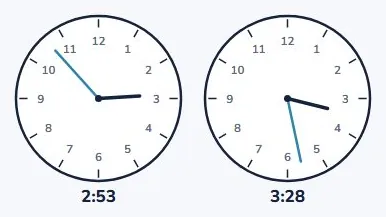
How long from 2:53 pm to 3:28 pm?
- Two clock faces, thirty-something minutes apart.
- Try subtracting: 28 minutes take 53 minutes.
- That goes negative, which cannot be right.
Because time is not base ten
- Last lesson everything divided by 10, 100 or 1000.
- Time does not. It counts in sixties.
- So 3.28 minus 2.53 is not a time calculation at all.
- Doing it that way gives 75 minutes, which is over an hour.
| Method | Gives | Sensible? |
|---|---|---|
| 28 − 53 | negative | no |
| 3.28 − 2.53 as decimals | 75 min | no |
| Bridge the hour | 35 min | yes |
Count up to the hour first
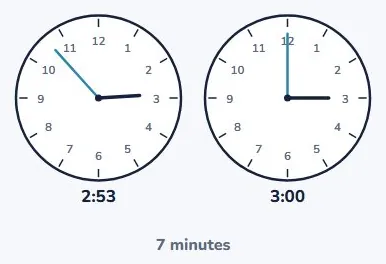
- From 2:53, how far to 3:00?
- 53 and 7 make 60, so 7 minutes.
- That gets you to a round hour, where counting is easy.
Then carry on from the hour
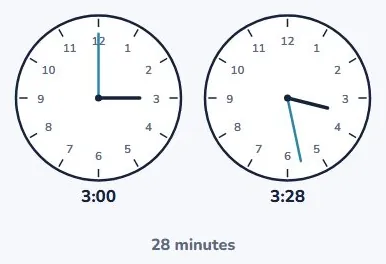
- From 3:00 to 3:28 is just 28 minutes.
- No borrowing, no sixties: you read it straight off.
Add the two pieces
- 7 minutes up to the hour, then 28 minutes after it.
- 7 + 28 = 35.
- So 2:53 pm to 3:28 pm is 35 minutes.
- Two easy steps instead of one impossible subtraction.
| Piece | How | Minutes |
|---|---|---|
| 2:53 pm to 3:00 pm | up to the hour | 7 min |
| 3:00 pm to 3:28 pm | then onwards | 28 min |
| Total | 7 + 28 | 35 min |
This works every time
- Up to the next hour, then on to the finish.
- If both times are in the same hour, you do not need it.
- If they cross an hour, always bridge it.
Sixties all the way up
- 60 seconds in a minute. 60 minutes in an hour.
- Which makes 3600 seconds in an hour.
- Nothing here is a ten, a hundred or a thousand.
| One | Is |
|---|---|
| 1 minute | 60 seconds |
| 1 hour | 60 minutes |
| 1 hour | 3600 seconds |
Minutes into hours and minutes
- 150 minutes. How many whole hours fit?
- 150 ÷ 60 = 2, with 30 left over.
- So 150 minutes is 2 hours 30 minutes.
- A division with a remainder, exactly as in the division lesson.
| Convert | Working | Answer |
|---|---|---|
| 150 min | 150 ÷ 60 | 2 h 30 min |
| 2.5 hours | half of 60 is 30 | 2 h 30 min |
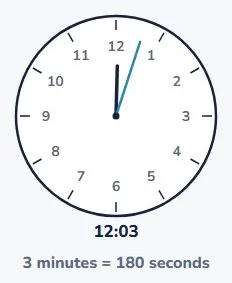
| 3 min | 3 × 60 | 180 s |
| 90 s | 90 − 60 | 1 min 30 s |
2.5 hours is not 2 hours 50
- Half of an hour is half of 60, which is 30.
- So 2.5 hours is 2 hours 30 minutes.
- The 5 after the point means half, not fifty.
- Same for 1.25 hours: a quarter of 60 is 15 minutes.
| Written | Means | Not |
|---|---|---|
| 2.5 h | 2 h 30 min | 2 h 50 min |
| 1.25 h | 1 h 15 min | 1 h 25 min |
And down to seconds
- 3 minutes into seconds: 3 × 60 = 180 s.
- 90 seconds back into minutes: 60 and 30 left, so 1 min 30 s.
- Multiply going down, divide going up. Always by 60.
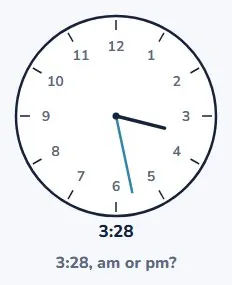
12-hour time needs am or pm
- A clock face only goes up to 12, so each number happens twice a day.
- am is before midday. pm is after it.
- Leave them off and 3:28 could be either.
24-hour time does not
- The hours run 00 to 23, so every one is different.
- Morning hours look the same: 09:15 is 9:15 am.
- Afternoon ones have 12 added: 15:28 is 3:28 pm.
- No am, no pm, no confusion.
| 12-hour | 24-hour | When |
|---|---|---|
| 9:15 am | 09:15 | morning |
| 12:00 pm | 12:00 | midday |
| 3:28 pm | 15:28 | afternoon |
| 11:40 pm | 23:40 | night |
Swapping between them
- Afternoon into 24-hour: add 12 to the hour. 3:28 pm → 15:28.
- 24-hour into afternoon: subtract 12. 19:45 → 7:45 pm.
- Morning times need no change at all.
- Watch midnight: that is 00:00, not 24:00.
| From | Do this | To |
|---|---|---|
| 3:28 pm | add 12 | 15:28 |
| 19:45 | subtract 12 | 7:45 pm |
| 9:15 am | nothing | 09:15 |
Which is why timetables use it
- A bus at 7:30 is very different from a bus at 19:30.
- Timetables cannot afford that kind of doubt.
- So schedules, hospitals and the army all use 24-hour time.
Reading a timetable
- Each row is a stop. Each column is one bus.
- Read down a column to follow one bus along the route.
- Read across a row to see when each bus reaches that stop.
- These times are made up, but the stops are real.
| Stop | Bus 1 | Bus 2 |
|---|---|---|
| Avondale | 8:15 | 8:45 |
| Mount Albert | 8:32 | 9:02 |
| Kingsland | 8:49 | 9:19 |
| Britomart | 9:05 | 9:35 |
How long is the whole trip?
- Bus 1 leaves Avondale at 8:15 and reaches Britomart at 9:05.
- Bridge the hour: 45 minutes to 9:00, then 5 more.
- 45 + 5 = 50 minutes.
- Check Bus 2: 8:45 to 9:35 is also 50. Same trip, same time.
| Stop | Bus 1 | Bus 2 |
|---|---|---|
| Avondale | 8:15 | 8:45 |
| Mount Albert | 8:32 | 9:02 |
| Kingsland | 8:49 | 9:19 |
| Britomart | 9:05 | 9:35 |
And part of the trip
- Mount Albert to Britomart on Bus 1: 8:32 to 9:05.
- 8:32 to 9:00 is 28 minutes.
- Then 9:00 to 9:05 is 5 more.
- 33 minutes. The bridge again.
| Piece | How | Minutes |
|---|---|---|
| 8:32 to 9:00 | up to the hour | 28 min |
| 9:00 to 9:05 | then onwards | 5 min |
| Total | 28 + 5 | 33 min |
And how long you would wait
- Miss Bus 1 at Avondale (8:15) and the next is 8:45.
- Both times are in the same hour, so no bridging needed.
- 45 − 15 = 30 minutes of waiting.
- Every stop is 30 minutes apart, because the buses are.
| Stop | Bus 1 | Bus 2 |
|---|---|---|
| Avondale | 8:15 | 8:45 |
| Mount Albert | 8:32 | 9:02 |
| Kingsland | 8:49 | 9:19 |
| Britomart | 9:05 | 9:35 |
Bigger units of time
- A solar calendar counts a year by the sun (the Gregorian one).
- A lunar calendar counts months by the moon.
- Maramataka Māori follows the moon’s phases.
- It has long guided the best times for planting and fishing.
| Calendar | Kind | Counts by |
|---|---|---|
| Gregorian | solar | the 365-day year most of the world uses |
| Maramataka Māori | lunar | follows the phases of the moon |
| Chinese | lunar | months set by the moon, year by the sun |
Four to try
- 1. How long from 4:47 pm to 5:12 pm?
- 2. Write 21:05 as 12-hour time.
- 3. How many minutes is 3.5 hours?
- 4. On the timetable, how long is Kingsland to Britomart?
Show answer
Answers: 1. 25 minutes: 13 up to 5:00, then 12. An answer of 35 means they subtracted 47 from 12 and flipped the sign. 2. 9:05 pm. 3. 210 minutes: 3 × 60 is 180, plus half an hour. An answer of 350 is the decimal trap. 4. 8:49 to 9:05; 11 minutes up to the hour, then 5, so 16 minutes.
Bridge the hour, and count in sixties
- Crossing an hour? Go up to it, then on from it.
- Everything is 60s, never 10s, 100s or 1000s.
- And 24-hour time exists so nobody has to guess.
| Piece | How | Minutes |
|---|---|---|
| 2:53 pm to 3:00 pm | up to the hour | 7 min |
| 3:00 pm to 3:28 pm | then onwards | 28 min |
| Total | 7 + 28 | 35 min |
Is your child on track?
Take the free placement test