 Vertex Learn
How we see: light sources, reflection and refraction
What this lesson covers
- Light sources, and why we see objects that give out no light
- How Ibn al-Haytham challenged Plato's idea of sight
- Drawing light as rays that travel in straight lines
- Reflection, the normal, and equal angles at a mirror
- How we see a reflection
- Refraction when light passes between air, water and glass
Two ways light reaches your eyes
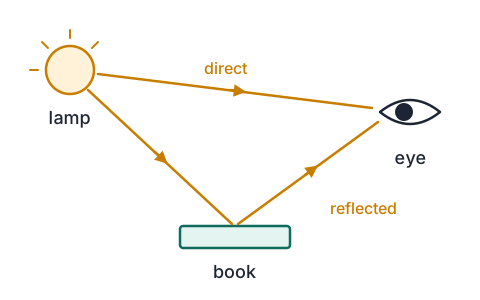
- A light source gives out its own light: the Sun, a lamp, a fire, a phone screen, even a glow-worm in the Waitomo caves.
- Most things are not sources. A book, a tree or the Moon only send light to us because light from a source bounces off them.
- So you see a source when its light travels straight into your eyes.
- You see every other object when light goes from a source to the object, reflects off it, and then enters your eyes.
- In a totally dark room you see nothing, even with your eyes wide open, because no light is arriving at them.
Try it: source or reflector?
Ibn al-Haytham and Plato
- The Greek philosopher Plato, around 2400 years ago, taught that sight works by a kind of fire or ray streaming out of the eyes towards objects.
- Ideas like this were widely accepted for well over a thousand years.
- Ibn al-Haytham, a scientist born in Basra (in modern Iraq) who worked in Cairo about 1000 years ago, argued the opposite: light travels from objects into the eye.
- He pointed to evidence, such as the pain of looking at the bright Sun, and tested his ideas with experiments in darkened rooms where light came through a small hole.
- His Book of Optics showed how careful experiments can overturn an idea, even a very old one held by famous thinkers.
Light travels in straight lines
- In air, light travels in straight lines, which is why shadows have sharp edges and you cannot see round a corner.
- Scientists draw light as rays: straight lines drawn with a ruler, with an arrow showing which way the light is going.
- Arrows always point away from the source and towards the eye, never out of the eye.
- A ray diagram shows the path of light, not what the objects look like.
Reflection off a mirror
- Reflection is light bouncing off a surface.
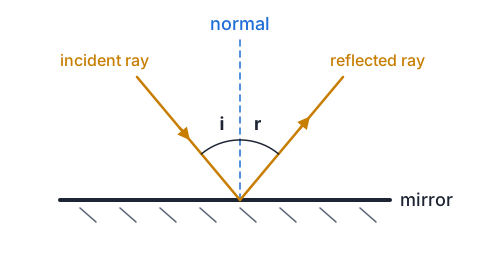
- To measure angles at a mirror, draw the normal: a dashed line at right angles (90°) to the mirror where the ray hits it.
- The angle between the incoming ray and the normal is the angle of incidence. The angle between the reflected ray and the normal is the angle of reflection.
- For any flat mirror, these two angles are always equal.
- A smooth surface such as a mirror or still water reflects rays neatly, so you see an image. A rough surface such as paper scatters them in all directions, so you just see the paper.
How you see a reflection
- On a calm morning Lake Matheson on the West Coast mirrors the Southern Alps.
- The light has made a journey in three legs: from the Sun to the mountains, from the mountains down to the lake surface, then off the water and up into your eyes.
- Your brain assumes light always travels in straight lines, so it traces the rays back and the mountains seem to sit upside down under the water.
- The same thing happens with a bathroom mirror: the image seems to be behind the glass, as far behind it as you are in front.
Working out a reflected angle
- A torch beam hits a flat mirror. The beam makes an angle of 50° with the mirror surface. What is the angle of reflection?
- Angles are measured from the normal, not the mirrorthe normal is at 90° to the mirror
- Angle of incidence = 90° − 50° = 40°the two angles make a right angle
- Angle of reflection = angle of incidencetrue for every flat mirror
- Angle of reflection = 40°
Try it: a plane mirror
Refraction: light changing direction
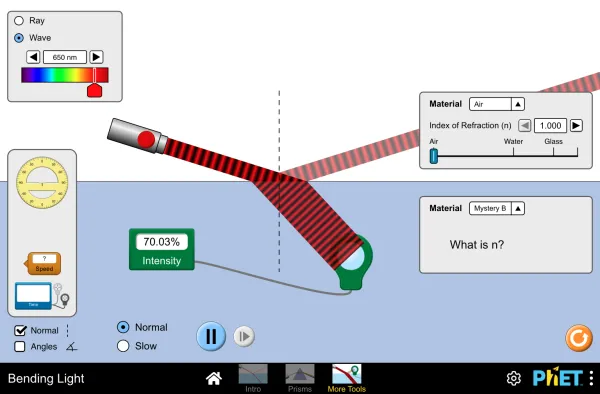
- Light travels at different speeds in different materials. It is slower in water than in air, and slower still in glass.
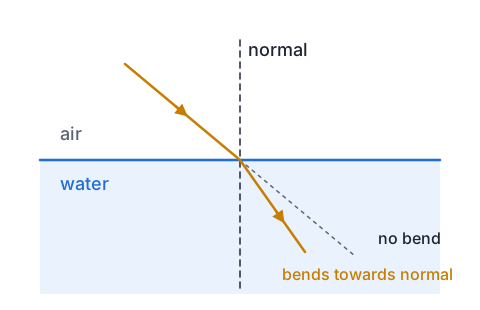
- When light crosses at an angle from one material into another, the change of speed makes it change direction. This is called refraction.
- Going from air into water or glass, the ray bends towards the normal. Coming back out into air, it bends away from the normal.
- A ray that meets the surface straight on, along the normal, slows down but does not change direction.
Try it: bend a ray
Why the pool looks shallow
- Someone standing beside a pool sees a coin on the bottom. Explain why the coin seems higher up than it really is.
- Light from the coin travels up through the waterthe coin reflects light from the sky
- At the surface it passes into air and bends away from the normalit speeds up as it leaves the water
- The brain traces the bent ray back in a straight lineit assumes light never bends
- That line ends above the real coin, so the pool seems shallower than it is
Room 8 tests angle and refraction
- Room 8 shone a ray box at the flat side of a clear plastic half-disc block, changing the angle of incidence and measuring the angle of the ray inside the block with a protractor.
- They kept the same block, the same ray box and the same narrow slit for every reading, and traced each ray in pencil before measuring.
| Angle in air | Angle in block |
|---|---|
| 0° | 0° |
| 20° | 13° |
| 40° | 26° |
| 60° | 35° |
- At 0° the ray goes straight throughit travels along the normal
- Each angle in the block is smaller than in airthe ray bends towards the normal
- The bigger the angle in air, the more it bends: 7° at 20°, 25° at 60°compare the differences
- Light bends towards the normal entering plastic, and bends more at larger angles
Common mistakes
- We see a book because light comes out of our eyes and hits it.Light from a source reflects off the book and travels into our eyes; arrows on a ray diagram point towards the eye.
- The angle of incidence is measured between the ray and the mirror.Both angles are measured from the normal, the line at 90° to the mirror.
- Refraction is when light bounces off water.Bouncing off is reflection; refraction is light changing direction as it passes into a new material.
- A ray going into glass always bends.A ray that hits the surface along the normal slows down but carries straight on.
Make a hidden coin appear
You need: an opaque mug or bowl, a coin, a jug of water, a helper, a piece of Blu Tack
- Stick the coin to the middle of the bottom of the empty mug with a small piece of Blu Tack.
- Look at the coin over the rim, then slowly move your head back and down until the rim just hides it. Keep your head there.
- Ask your helper to pour water slowly into the mug without moving the coin.
- Keep still and see what happens to the coin as the water level rises.
- Look for the coin coming back into view: light from the coin now bends as it leaves the water, so it reaches your eye over the rim.
Safety: Do this at a table or bench, not near a phone or charger, and wipe up spilt water straight away so nobody slips on a wet floor.
Your turn
Is the Moon a light source? Explain how we see it.
A ray hits a mirror with an angle of incidence of 25°. What is the angle of reflection?
A ray makes an angle of 70° with a mirror surface. What is the angle of reflection?
A ray of light passes from air into a glass block at an angle. Does it bend towards or away from the normal?
What evidence did Ibn al-Haytham use against the idea that sight comes from rays leaving the eye?
Show answer
1. No; sunlight reflects off the Moon and travels to our eyes. 2. 25°, because the angle of reflection always equals the angle of incidence. 3. 20°: the angle of incidence is 90° − 70° = 20°, and reflection matches it. 4. Towards the normal, because light slows down in glass. 5. Looking at the bright Sun hurts the eyes, which makes sense only if light is entering them; he also tested ideas with experiments in darkened rooms.
Bending Light
Full screen · PhET Interactive Simulations, University of Colorado Boulder, CC BY 4.0
Recap
- We see sources by their own light and everything else by light that reflects off it into our eyes.
- Ibn al-Haytham used evidence and experiments to show light enters the eye, overturning Plato's idea of rays leaving it.
- Light travels in straight lines, drawn as ruled rays with arrows pointing towards the eye.
- At a mirror, the angles of incidence and reflection are equal, both measured from the normal.
- Refraction is light changing direction as it crosses into a new material: towards the normal going into water or glass, away from it coming out.
The maths behind it
Report a mistake
How is Year 8 maths going?
See the Year 8 maths guide