 Vertex Learn
Balanced and unbalanced forces, and free body diagrams
What this lesson covers
- Forces as pushes and pulls with a size and a direction
- Balanced forces and a net force of zero
- Unbalanced forces and the three ways motion can change
- Drawing free body diagrams to predict motion
- Recording a fair test in a table or tally chart
Forces have size and direction
- A force is a push or a pull. Gravity pulling you down, the floor pushing you up and wind pushing a sail are all forces.
- Forces are measured in newtons (N). Holding a 100 g block of butter on your hand takes a force of about 1 N.
- Every force acts in a particular direction, so on a diagram it is shown by an arrow.
- The arrow points the way the force acts, and a longer arrow stands for a bigger force.
Balanced forces cancel
- When forces on an object are equal in size and act in opposite directions, they cancel. The forces are balanced.
- The net force (the overall force once you combine them all) is then zero.
- With balanced forces, the motion stays the same. A book resting on a desk stays still.
- It also works for moving things: a car cruising at a steady 50 km/h on a straight road has balanced forces, because the engine's push exactly matches the drag and friction holding it back.
- So balanced does not mean stopped. It means no change in speed and no change in direction.
Unbalanced forces change motion
- If the forces do not cancel, they are unbalanced and the net force is not zero.
- An unbalanced force always changes the motion of the object.
- That change can be a change of speed, a change of direction, or both at once.
| Net force | Change in motion | Example |
|---|---|---|
| Same way as the motion | Speeds up | A cyclist pedals hard downhill |
| Against the motion | Slows down | A rugby player is tackled from the front |
| Sideways to the motion | Changes direction | A netball is batted sideways |
| At an angle to the motion | Speed and direction both change | A cricket ball is hit back towards the bowler |
Try it: unbalanced forces
Free body diagrams
- A free body diagram shows one object and every force acting on it, and nothing else.
- Draw the object as a simple box or dot. Draw each force as an arrow starting from the object, pointing the way the force acts.
- Make the arrows' lengths match the sizes of the forces, and label each with its name and its size in newtons.
- Then compare the arrows: if opposite arrows match, the forces are balanced; if not, the longer side wins and the motion changes that way.
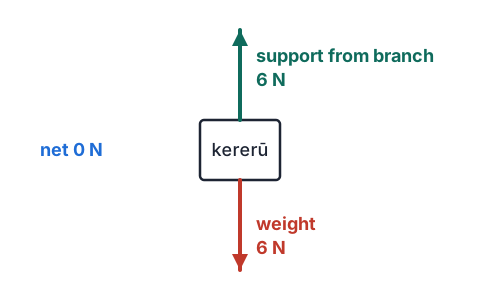
Try it: balanced or unbalanced?
Predicting the motion of a kayak
- A kayaker on Lake Taupō paddles with a forward force of 120 N. Water drag pushes back with 80 N. The kayak and paddler weigh 900 N, and the water pushes up with 900 N.
- Is the kayak's motion changing? If so, how?
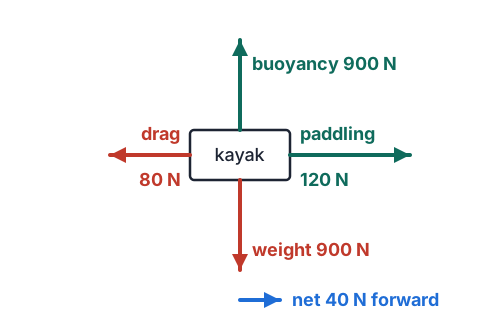
- Up and down: 900 N up, 900 N downthese cancel, so no vertical change
- Forward and back: 120 N − 80 N = 40 Nopposite directions, so subtract
- Net force = 40 N forwardthe forward arrow is longer
- Unbalanced, 40 N forward: the kayak speeds up
A change of direction counts
- A ball rolls straight across a court at a steady speed. A player taps it from the side with a 5 N push. What happens?
- Before the tap: forces along the court are balancedits speed and direction were not changing
- During the tap: a 5 N force sideways, with nothing to cancel itunbalanced
- The push is at right angles to the motionso it turns the ball's path
- The ball changes direction: its motion has changed even if its speed barely has
Gathering data systematically
- Question: does a bigger pull make a trolley speed up more?
- Change one thing only: the pulling force, read on a force meter. Measure one thing: the time to cover 2 m from rest.
- Keep everything else the same: the trolley, its load, the floor surface, the start line and the person timing.
- Plan the results table before starting, with a column for each trial, and do every trial three times.
| Pulling force | Trial 1 | Trial 2 | Trial 3 | Mean time for 2 m |
|---|---|---|---|---|
| 2 N | 3.1 s | 3.3 s | 3.2 s | 3.2 s |
| 4 N | 2.3 s | 2.2 s | 2.4 s | 2.3 s |
| 6 N | 1.9 s | 1.8 s | 1.7 s | 1.8 s |
Using a tally chart
- Room 14 observed one minute of a junior football game and recorded each time the ball's motion changed, sorting each change into one of three groups.
- A tally chart is quick to fill in while things are happening: one stroke per event, written in groups of five so the strokes are easy to count.
| Change in motion | Tally | Total |
|---|---|---|
| Speed only | ||||| |||| | 9 |
| Direction only | ||||| ||||| | | 11 |
| Speed and direction | |||| | 4 |
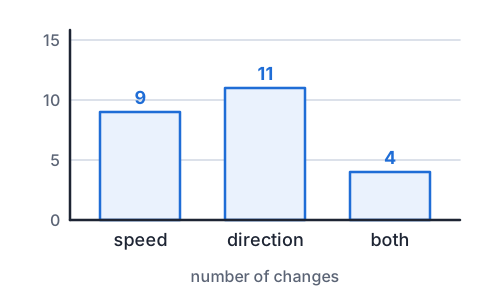
- 9 + 11 + 4 = 24 changes in one minuteadd the totals
- Direction only was the most common11 is the biggest total
- Each of the 24 changes was caused by an unbalanced force, such as a kick, a header or friction from the grass
Try it: graph the tally
Common mistakes
- If something is moving, there must be an unbalanced force pushing it along.A steady speed in a straight line needs balanced forces; an unbalanced force is only needed to change the motion.
- Balanced forces means the object is not moving.Balanced forces mean the motion does not change, so a moving object keeps moving at the same speed and direction.
- If the speed stays the same, the motion has not changed.Turning is a change in motion too, so a change of direction also needs an unbalanced force.
- On a free body diagram, draw all the arrows the same length.Arrow length shows the size of each force, so a 120 N force needs a longer arrow than an 80 N one.
A rubber band tug of war
You need: a hardback book, 2 identical rubber bands, a ruler, a smooth table, a helper
- Loop one rubber band round each end of the book so they stick out on opposite sides.
- You and your helper each hook a finger in one band and pull gently in opposite directions until both bands stretch to the same length. Measure the stretch with the ruler.
- Hold steady and note what the book does.
- Now pull a little harder on your side so your band stretches further than your helper's.
- Look for the difference: equal stretches (balanced forces) leave the book still, and unequal stretches (unbalanced forces) make it slide towards the longer band.
Safety: Rubber bands can snap or slip off and flick into an eye, so pull gently, keep your faces back from the bands and do not stretch them to their limit.
Your turn
A skateboarder rolls along at a steady speed in a straight line. Are the forces on her balanced or unbalanced?
A tug of war team pulls left with 500 N and the other pulls right with 450 N. What is the net force, and which way will the rope move?
A free body diagram of a falling apple shows weight 2 N down and air resistance 0.5 N up. What is the net force, and what happens to the apple's speed?
A car goes round a roundabout at a steady 30 km/h. Is there an unbalanced force on it?
Why should each trial in a fair test be repeated three times?
Show answer
1. Balanced, because her speed and direction are not changing. 2. 50 N to the left, so the rope moves left. 3. 1.5 N down, so the apple speeds up. 4. Yes; its direction is changing, so the forces on it are unbalanced even though its speed is steady. 5. Repeats show whether results are consistent and let you spot a trial that went wrong, and the mean is more trustworthy than one reading.
Forces and Motion: Basics
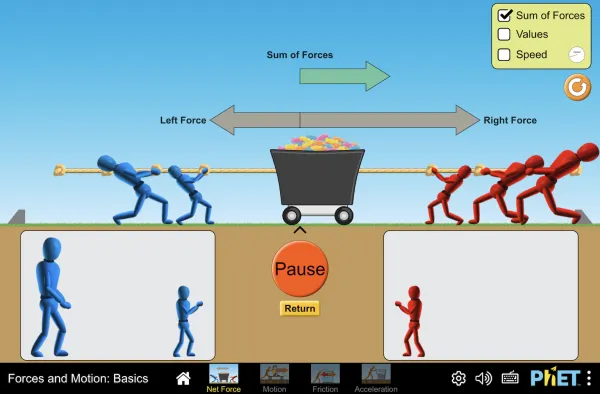
Full screen · PhET Interactive Simulations, University of Colorado Boulder, CC BY 4.0
Recap
- A force has a size, in newtons, and a direction, shown by an arrow.
- Balanced forces cancel, giving a net force of zero, so the object's motion stays exactly the same.
- Unbalanced forces change motion: the object speeds up, slows down, turns, or does more than one of these.
- A free body diagram shows every force on one object, so you can compare arrows and predict its motion.
- Plan a results table or tally chart before a test, change one thing, and repeat each trial.
The maths behind it
Report a mistake
How is Year 8 maths going?
See the Year 8 maths guide