Angle rules, parallel lines and directions
What this lesson covers
- The interior angle sum of a triangle is 180°; for a quadrilateral, it is 360°.
- The interior angle sum of any polygon can be found using the formula 180(n−2)°, where n represents the total number of sides.
Eight angle rules, or two?
- Supplementary, complementary, vertically opposite...
- Corresponding, alternate, co-interior.
- They all come out of two facts.
| This | Makes |
|---|---|
| Along a straight line | 180° |
| All the way round a point | 360° |
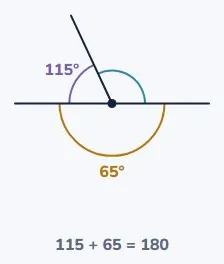
One: a straight line is 180°
- Half a full turn.
- So two angles sitting on a line add to 180.
- They are called supplementary.
Two: all the way round is 360°
- A full turn.
- So angles meeting at a point add to 360.
- That is the whole list of facts.
| This | Makes |
|---|---|
| Along a straight line | 180° |
| All the way round a point | 360° |
Everything else is one of those two
- Complementary is 90, half a straight line.
- Angles at a point is the full turn.
- And vertically opposite comes from the straight line.
| Name | Says | Comes from |
|---|---|---|
| Supplementary | add to 180° | straight line |
| Complementary | add to 90° | half a straight line |
| Vertically opposite | equal | both on a straight line with a third |
| Angles at a point | add to 360° | full turn |
Why vertically opposite angles are equal
- a and b sit on a line, so a + b = 180.
- b and c sit on a line, so b + c = 180.
- Both a and c equal 180 − b. So a = c.
| Because | Which means | |
|---|---|---|
| a and b | on a straight line | a + b = 180 |
| b and c | on a straight line | b + c = 180 |
| So | a and c both equal 180 − b | a = c |
So you do not have to remember it
- You can rebuild it in three lines.
- The same is true of every rule coming up.
- Which is why there are only two to learn.
| Name | Says | Comes from |
|---|---|---|
| Supplementary | add to 180° | straight line |
| Complementary | add to 90° | half a straight line |
| Vertically opposite | equal | both on a straight line with a third |
| Angles at a point | add to 360° | full turn |
The triangle sum
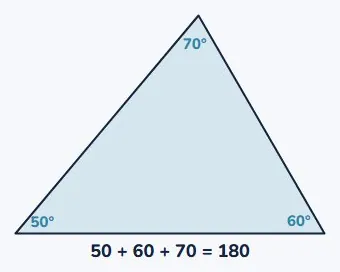
- Every triangle, however it is shaped, has angles adding to 180.
- You have used this since Year 6.
- Now it is going to build something.
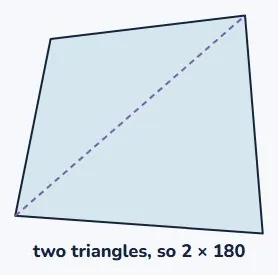
A quadrilateral is two triangles
- Draw one diagonal from a corner.
- Two triangles, 180 each.
- So a quadrilateral is 360.
And any polygon at all
- A pentagon splits into three triangles. 540.
- A hexagon into four. 720.
- n sides gives n − 2 triangles: 180(n − 2).
| Shape | Splits into | Angle sum |
|---|---|---|
| Triangle | 1 triangle | 180° |
| Quadrilateral | 2 triangles | 360° |
| Pentagon | 3 triangles | 540° |
| Hexagon | 4 triangles | 720° |
| n sides | n − 2 triangles | 180(n − 2) |
Check it against last lesson
- A regular pentagon: 540 ÷ 5 = 108° each.
- Last lesson we got 180 − 72 = 108.
- Two different routes, one answer.
| Route | Working | Answer |
|---|---|---|
| Angle sum | 540 ÷ 5 | 108° |
| Exterior | 180 − 72 | 108° |
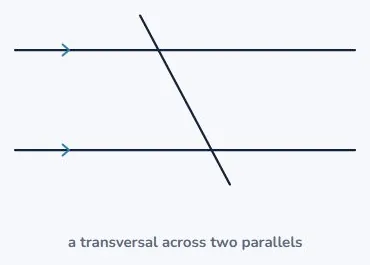
Two parallel lines, and one crossing them
- The crossing line is called a transversal.
- It makes eight angles.
- And there are only two different sizes among them.
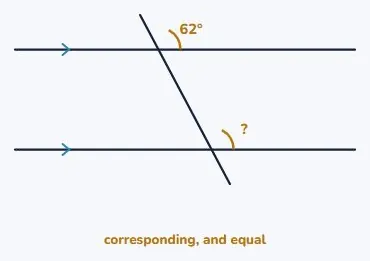
Corresponding angles are equal
- Matching positions at each crossing.
- Because the two lines are parallel...
- ...the second crossing is a copy of the first.
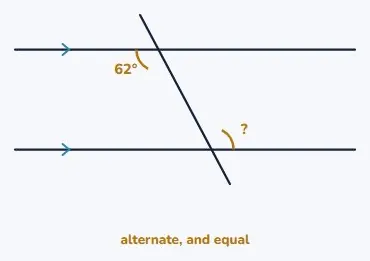
Alternate angles are equal
- Opposite sides of the transversal, both inside.
- Also equal, and you can get there two ways.
- Corresponding, then vertically opposite.
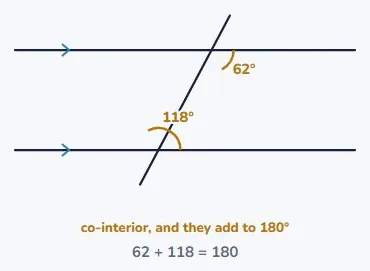
Co-interior angles add to 180
- Same side of the transversal, both inside.
- These two are NOT equal.
- They sit on a straight line, so 180.
The three names, in one place
- Corresponding and alternate: equal.
- Co-interior: add to 180.
- If you forget which, work it out from the straight line.
| Name | Where | Relationship |
|---|---|---|
| Corresponding | matching positions | equal |
| Alternate | opposite sides, inside | equal |
| Co-interior | same side, inside | add to 180° |
Setting up an equation
- Two angles on a straight line: x + x + 40 and nothing else.
- So 2x + 40 = 180.
- Take 40 off, divide by 2. x = 70.
| Step | Working | Why |
|---|---|---|
| Set it up | 2x + 40 = 180 | a straight line |
| Take 40 off both | 2x = 140 | |
| Divide both by 2 | x = 70 | 70° |
| Check | 140 + 40 = 180 | true |
Eight directions, 45° apart
- North, east, south, west: 90° apart.
- Then the halfway ones between them.
- NE is 45° east of north.
| Point | Clockwise from N |
|---|---|
| N | 0° |
| NE | 45° |
| E | 90° |
| SE | 135° |
| S | 180° |
| SW | 225° |
| W | 270° |
| NW | 315° |
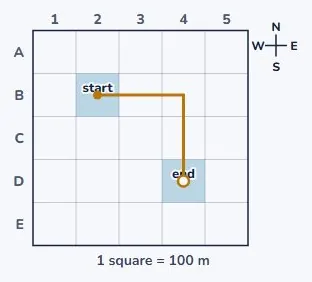
Describing a route
- Start at B2. Go 2 squares east to B4.
- Then 2 squares north to D4.
- Squares, and a direction, for each leg.
Your turn: four questions
- Pause here and try all four.
- On question 1, count the triangles.
- On question 3, remember co-interior is the 180 one.
| Question | |
|---|---|
| 1 | Find the interior angle sum of a heptagon (7 sides). |
| 2 | Two angles lie on a straight line. One is 115°. Find the other. |
| 3 | Parallel lines are cut by a transversal. One angle is 73°. Find its co-interior partner. |
| 4 | Which compass direction is 135° clockwise from north? |
Show answer
1. 900°. 180 × (7 − 2) = 180 × 5. 2. 65°. They are supplementary, so 180 − 115. 3. 107°. Co-interior angles add to 180, so 180 − 73. 4. South-east. Each of the eight points is 45° apart, and 135 is three of those from north.
The answers
- A heptagon is 5 triangles: 900°.
- 180 − 115 = 65°. And 180 − 73 = 107°.
- 135° clockwise from north is south-east.
| Answer | |
|---|---|
| 1 | 900° |
| 2 | 65° |
| 3 | 107° |
| 4 | south-east |
What to take away
- Two facts: a straight line is 180, a full turn is 360.
- Every other angle rule is one of those, applied.
- A polygon splits into n − 2 triangles, so 180(n − 2).
| Remember | |
|---|---|
| Straight line | 180°: this is half of everything |
| Round a point | 360°: this is the other half |
| Polygon sum | 180(n − 2), because n − 2 triangles fit |
| Parallel lines | corresponding and alternate equal, co-interior 180 |
| Compass | eight points, 45° apart |
Is your child on track?
Take the free placement test