 Vertex Learn
Mixtures, solutions, concentration and separating
What this lesson covers
- What a mixture is, and why its parts keep their own properties
- Mixtures of solids, liquids and gases
- Solutes, solvents, solutions and suspensions
- Concentration, and what saturated means
- Separating mixtures by settling, sieving, filtering, evaporating and chromatography
- Judging how well a separation worked
What makes something a mixture
- A mixture is two or more substances mingled together without any chemical reaction joining them.
- Because nothing reacts, each substance keeps its own properties. Stir iron filings into sand and the iron is still magnetic and the sand is still gritty.
- The amounts in a mixture can vary. A handful of scroggin can have more raisins or more peanuts and it is still scroggin.
- The parts can be in the same state or in different states, as the table shows.
| States mixed | Example |
|---|---|
| Solid in solid | Sand and gravel, scroggin |
| Solid in liquid | Salt water, muddy river water |
| Liquid in liquid | Salad dressing of oil and vinegar |
| Gas in liquid | Fizzy drink, with carbon dioxide in water |
| Gas in gas | Air: nitrogen, oxygen, argon and others |
Solutions: solute, solvent and dissolving
- When sugar disappears into hot tea, it has dissolved: its particles have spread out evenly between the water particles.
- The substance that dissolves is the solute. The liquid it dissolves in is the solvent. Together they make a solution.
- A substance that dissolves is soluble; one that does not, such as sand in water, is insoluble.
- A solution is clear (you can see through it), even if it is coloured, and the solute never settles out on its own.
- Water dissolves so many substances that it is often called the universal solvent.
Suspensions: cloudy and settling
- If you stir flour or fine sand into water, the solid does not dissolve. Its tiny bits just spread through the liquid for a while.
- A mixture like this, with insoluble solid bits scattered through a liquid, is a suspension.
- Suspensions look cloudy, because the bits block light, and if you leave them standing the solid slowly sinks to the bottom.
- Rivers after heavy rain are brown suspensions of soil, which is why the water clears again in calm weather.
Try it: solution or suspension?
Concentration: how much solute in how much liquid
- Concentration tells you how much solute is dissolved in a set volume of solution.
- It is often given in grams per litre (g/L): the mass of solute in every 1 L.
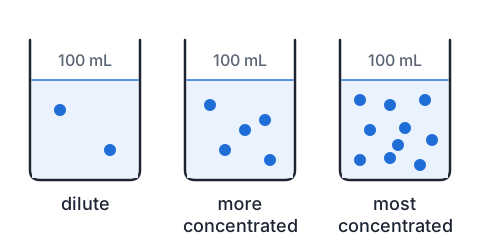
- A solution with only a little solute is dilute. Adding more solute to the same volume makes it more concentrated.
- Adding more water dilutes a solution: the amount of solute stays the same, but it is spread through more liquid.
- As a coloured solution gets more concentrated it usually looks darker, and a sugar solution also gets thicker and slower to pour.
Which drink is stronger?
- Mere makes a drink with 20 g of sugar in 250 mL of water. Tama uses 30 g of sugar in 500 mL. Whose drink is more concentrated?
- Mere: 250 mL × 4 = 1000 mL, so 20 g × 4 = 80 g in 1 Lscale up to one litre
- Tama: 500 mL × 2 = 1000 mL, so 30 g × 2 = 60 g in 1 Lsame again
- 80 g/L is more than 60 g/Lcompare like with like
- Mere's drink is more concentrated, even though Tama used more sugar
Saturated solutions
- Keep stirring spoonfuls of salt into a glass of water and you reach a point where no more will dissolve.
- The solution now holds as much solute as it can at that temperature, so it is saturated. Any extra salt just sits on the bottom as a solid.
- For most solids, warmer water can hold more before it is saturated, which is why sugar dissolves so well in hot tea.
- So when you say a solution is saturated, also say the temperature.
Room 12's sugar solutions
- Room 12 dissolved 0, 20, 40 and 60 g of sugar in 100 mL of water at room temperature, added one drop of food colouring to each, and timed 10 mL running out of a syringe.
- Describe the pattern and explain it.
| Sugar in 100 mL | Colour | Clear or cloudy? | Time for 10 mL to run out |
|---|---|---|---|
| 0 g | Pale blue | Clear | 3 s |
| 20 g | Pale blue | Clear | 4 s |
| 40 g | Pale blue | Clear | 5 s |
| 60 g | Pale blue | Clear | 7 s |
- All four stay clearthe sugar has dissolved, so they are solutions, not suspensions
- Colour does not changethe food colouring is the same in each; sugar has no colour
- Time rises from 3 s to 7 sthe liquid gets thicker as concentration goes up
- More concentrated sugar solutions are more viscous (thicker), so they flow more slowly
Ways to separate a mixture
- Because the parts of a mixture are not chemically joined, you can separate them by a physical difference between them.
- Choose the method that uses a difference the parts really have: size, density, solubility or magnetism.
| Method | Difference it uses | Example |
|---|---|---|
| Settling and decanting | Density: heavy solid sinks, liquid is poured off | Pouring water off sand |
| Sieving | Particle size, both pieces solid | Gravel from sand |
| Filtering | Particle size: solid stays on paper, liquid passes through | Sand from salt water |
| Evaporating | Solubility: water leaves as vapour, solute stays | Salt from salt water |
| Using a magnet | Magnetism | Iron filings from sand |
| Chromatography | How well each dissolves and how strongly it clings to paper | Dyes in an ink |
Planning a separation
- A jar holds a dry mixture of sand, salt and iron filings. Plan how to get all three back separately.
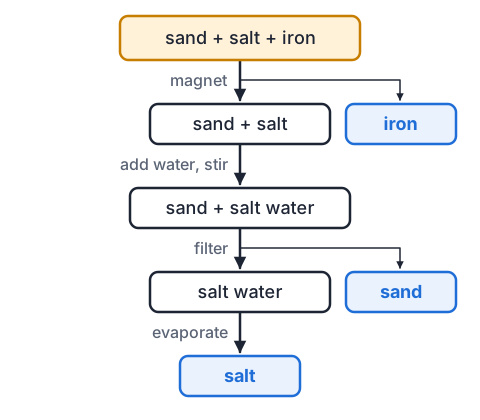
- 1: Pass a magnet in a plastic bag over the mixtureonly iron is magnetic
- 2: Add warm water and stirsalt dissolves, sand does not
- 3: Filtersand stays on the filter paper; salt water (the filtrate) passes through
- 4: Leave the filtrate in a warm place to evaporatewater leaves, salt crystals stay
- Magnet, dissolve, filter, evaporate: iron, sand and salt each collected
Try it: pick the separation method
Chromatography
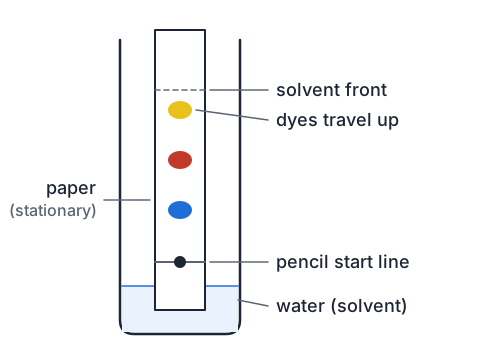
- Chromatography separates several dissolved substances, such as the dyes in a black felt pen.
- Put a spot of ink on a pencil line near the bottom of a paper strip, then stand the strip in a little water so the water level is below the spot.
- The water (the solvent) soaks up the paper and carries the dyes with it.
- A dye that dissolves well in the solvent and clings only weakly to the paper travels far. One that clings strongly to the paper is left behind lower down.
- The paper stays put, so it is called the stationary phase; the moving solvent is the mobile phase. The finished, dried strip is a chromatogram.
How well did it work?
- A group mixed 10.0 g of salt into sand, then separated it as in the plan above. They got back 8.5 g of dry salt.
- Judge how effective the method was and suggest an improvement.
- 8.5 ÷ 10.0 × 100 = 85%percentage of the salt recovered
- 15% of the salt was lost100% − 85%
- Salt water left soaked in the sand and filter papera likely cause
- 85% recovered; rinse the sand with a little extra water and filter that too
Common mistakes
- When salt dissolves in water it disappears, so the salt is gone.The salt is still there as tiny particles spread through the water; evaporating the water gets it back.
- A solution with more grams of solute is always more concentrated.Concentration depends on the volume too, so compare grams per litre, not just grams.
- Flour stirred into water is a solution.Flour does not dissolve, so it makes a cloudy suspension that settles if left.
- In chromatography, draw the start line in pen and put it under the water.Use pencil, which does not run, and keep the line above the water so the spot is carried up, not washed away.
Split a black felt pen
You need: a paper towel or coffee filter, washable black and brown felt pens, a pencil, scissors, a clear glass, water, a peg or sticky tape
- Cut a strip of paper towel about 3 cm wide and long enough to reach from the top of the glass almost to the bottom.
- Draw a pencil line 2 cm from the bottom of the strip and put a strong dot of black felt pen on the line.
- Pour water into the glass to about 1 cm deep, then hang the strip from a pencil laid across the top so the end dips in but the dot stays above the water.
- Leave it for 10 to 15 minutes, then lift the strip out and let it dry. Repeat with the brown pen.
- Look for coloured bands: black and brown inks are mixtures of several dyes, and the ones that travel highest dissolve best and cling least to the paper.
Safety: Wet felt-pen dyes stain clothes and benches, so work on a tray or old newspaper and use washable pens.
Your turn
Muddy water from a creek is left in a jar overnight and a layer of soil forms on the bottom. Was it a solution or a suspension?
Drink A has 15 g of sugar in 500 mL. Drink B has 12 g in 250 mL. Which is more concentrated?
You stir sugar into cold water until some stays at the bottom however long you stir. What word describes the solution, and what could you change so more dissolves?
Which method would you use to separate gravel from sand?
In a chromatogram of a green food colouring, a yellow spot is near the top and a blue spot is lower. Which dye clings more strongly to the paper?
Show answer
1. A suspension, because the solid settled out; a solution never does. 2. Drink B: it has 48 g/L, while A has 30 g/L. 3. Saturated; warm the water so it can hold more sugar. 4. Sieving, because the pieces of gravel are bigger than the sand grains. 5. The blue dye, because it was left lower down the paper.
Concentration
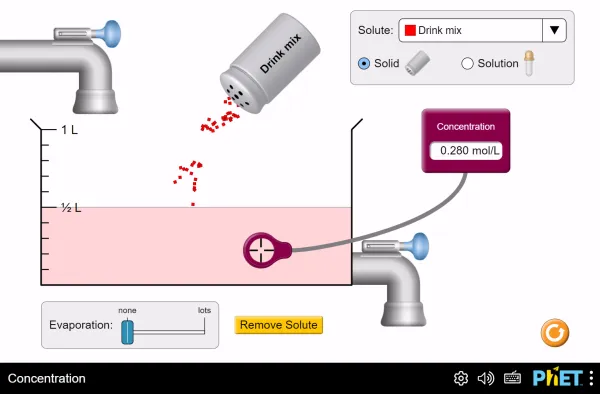
Full screen · PhET Interactive Simulations, University of Colorado Boulder, CC BY 4.0
Recap
- A mixture is substances mingled without reacting, so each keeps its own properties, and the parts can be any state.
- In a solution the solute dissolves evenly in the solvent; in a suspension insoluble bits float about and settle.
- Concentration is the amount of solute in a set volume; a saturated solution holds all it can at that temperature.
- Settling, sieving, filtering, evaporating, magnets and chromatography each use a physical difference between the parts.
- Judge a separation by how much you got back and how pure it was, then improve the method.
The maths behind it
Report a mistake
How is Year 8 maths going?
See the Year 8 maths guide