Fractions, decimals and percentages
What this lesson covers
- The product of two fractions can be found by multiplying the numerators and multiplying the denominators.
- Percentages can be used to proportionally increase or decrease a quantity.
One amount, written three ways
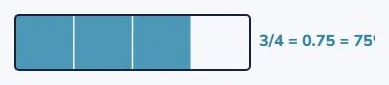
- Three quarters. Nought point seven five. Seventy-five percent.
- Those are not three related quantities.
- They are one quantity in three notations.
The ones to know on sight
- A half, a quarter, three quarters, a fifth, three fifths.
- These come up constantly, in all three forms.
- Knowing them saves you converting the same five all year.
| Fraction | Decimal | Percentage |
|---|---|---|
| 1/2 | 0.5 | 50% |
| 1/4 | 0.25 | 25% |
| 3/4 | 0.75 | 75% |
| 1/5 | 0.2 | 20% |
| 3/5 | 0.6 | 60% |
Fraction to decimal: just divide
- A fraction bar is a division sign. That is all it ever was.
- 7/8 means 7 ÷ 8.
- Which is 0.875. No rule to remember, just the division.
| Going from | Do this | Example |
|---|---|---|
| Fraction to decimal | divide top by bottom | 7 ÷ 8 = 0.875 |
Decimal to percentage: times 100
- Percent means "per hundred". Out of a hundred.
- So 0.875 becomes 87.5 percent.
- Going back the other way, divide by 100.
| Going from | Do this | Example |
|---|---|---|
| Fraction to decimal | divide top by bottom | 7 ÷ 8 = 0.875 |
| Decimal to percentage | multiply by 100 | 0.875 = 87.5% |
| Percentage to decimal | divide by 100 | 87.5% = 0.875 |
| Decimal to fraction | read the place value | 0.875 = 875/1000 |
Decimal to fraction: read the columns
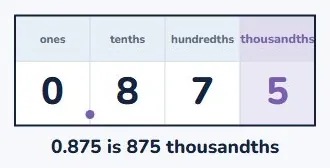
- 0.875 is 875 thousandths, because the last digit is thousandths.
- So it is 875/1000.
- Then simplify. Both divide by 125, giving 7/8.
When it does not come out evenly
- 2/3 means 2 ÷ 3, which never stops. 0.666 and on.
- So the decimal and the percentage are rounded.
- Only the fraction is exact. Sometimes it is the right form.
| Form | Note | Value |
|---|---|---|
| 2 ÷ 3 | never stops | 0.666... |
| As a decimal | rounded to 1 dp | 0.7 |
| As a percentage | rounded to 1 dp | 66.7% |
| Exactly | only the fraction is exact | 2/3 |
Comparing across the three
- Which is largest: 3/5, 0.56, or 58%?
- You cannot compare them as they stand. Pick one form.
- As decimals: 0.6, 0.56, 0.58. So 3/5 wins.
| Value | Converted | As a decimal |
|---|---|---|
| 3/5 | as a decimal | 0.6 |
| 0.56 | already one | 0.56 |
| 58% | as a decimal | 0.58 |
| Largest | 3/5 |
Multiplying by 10, 100, 1000
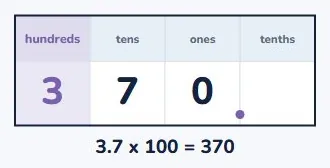
- 3.7 × 10 is 37. Every digit moves one column left.
- × 100 moves them two columns. 3.7 becomes 370.
- The number of zeros tells you how many columns.
| Calculation | What happens | Answer |
|---|---|---|
| 3.7 × 10 | digits move 1 left | 37 |
| 3.7 × 100 | digits move 2 left | 370 |
| 3.7 × 1000 | digits move 3 left | 3700 |
And dividing goes the other way
- 45 ÷ 10 is 4.5. Digits move one column right.
- 45 ÷ 1000 moves them three. That gives 0.045.
- Zeros appear to fill the columns nothing landed in.
| Calculation | What happens | Answer |
|---|---|---|
| 45 ÷ 10 | digits move 1 right | 4.5 |
| 45 ÷ 100 | digits move 2 right | 0.45 |
| 45 ÷ 1000 | digits move 3 right | 0.045 |
The digits move, not the point
- You may have been told to move the decimal point.
- Same answers, but the columns are a fixed ladder.
- The digits slide along it. The point marks the ones, always.
Multiplying two fractions
- Tops times tops. Bottoms times bottoms. That is the whole rule.
- 2/3 × 3/4: the tops give 6, the bottoms give 12.
- So 6/12. No common denominator needed anywhere.
| Part | Working | Gives |
|---|---|---|
| Numerators | 2 × 3 | 6 |
| Denominators | 3 × 4 | 12 |
| So | 6/12 |
But 6/12 is not the answer yet
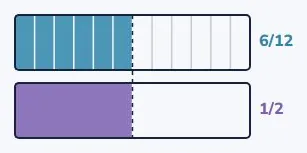
- 6/12 is correct and unfinished.
- Both numbers divide by 6, giving 1/2.
- Simplest form is part of the question, not an extra.
Why the answer got smaller
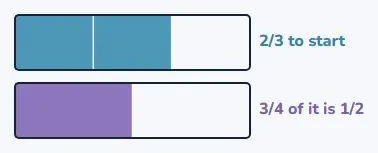
- Multiplying by 3/4 means taking three quarters of something.
- Three quarters of anything is less than you started with.
- Multiplying only makes things bigger when you multiply by more than 1.
A fraction of a whole number
- 2/5 of 20. Write the 20 as 20/1.
- Then it is an ordinary fraction multiplication: 40/5.
- Which is 8. "Of" has always meant multiply.
| Step | Working | Gives |
|---|---|---|
| 2/5 of 20 | write 20 as 20/1 | 2/5 × 20/1 |
| Multiply | 2 × 20 over 5 × 1 | 40/5 |
| Simplify | 40 ÷ 5 | 8 |
Mixed numbers: convert first
- 1 1/2 × 8. Do not multiply the 1 and the half separately.
- Turn 1 1/2 into halves first: that is 3/2.
- Then 3/2 × 8/1 is 24/2, which is 12.
| Step | Working | Gives |
|---|---|---|
| 1 1/2 | two halves in the 1, plus 1 | 3/2 |
| 3/2 × 8 | as 3/2 × 8/1 | 24/2 |
| Simplify | 24 ÷ 2 | 12 |
Percentages that increase or decrease
- Increase 40 by 25%: you end up with 125% of it.
- So 40 × 1.25 = 50. One multiplication, not two steps.
- Decrease 80 by 15%: you keep 85%. 80 × 0.85 = 68.
| Change | What you end with | Working |
|---|---|---|
| Increase 40 by 25% | you end with 125% | 40 × 1.25 = 50 |
| Decrease 80 by 15% | you end with 85% | 80 × 0.85 = 68 |
| Either way | one multiplication, not two steps |
Your turn: four questions
- Pause here and try all four.
- Questions 1 and 2 both want simplest form. Check before you stop.
- Question 4 has two good methods. Either is fine.
| Question | |
|---|---|
| 1 | Work out 2/3 × 6/7, in simplest form. |
| 2 | Write 0.35 as a fraction in simplest form. |
| 3 | What is 2.4 × 1000? |
| 4 | What is 3/4 of 24? |
Show answer
1. 4/7. Multiplying gives 12/21, and both divide by 3. Stopping at 12/21 is the commonest lost mark in the topic. 2. 7/20. 0.35 is 35 hundredths, so 35/100, and both divide by 5. 3. 2400. The digits move three places left. 4. 18. Either 3/4 × 24/1 = 72/4 = 18, or find a quarter of 24 first, which is 6, and take three of them.
The answers
- 2/3 × 6/7 gives 12/21, which simplifies to 4/7.
- 0.35 is 35/100, which is 7/20. And 2.4 × 1000 is 2400.
- 3/4 of 24 is 18.
| Answer | |
|---|---|
| 1 | 4/7 |
| 2 | 7/20 |
| 3 | 2400 |
| 4 | 18 |
What to take away
- One amount, three notations. Swap to whichever is easiest.
- Multiplying fractions: tops times tops, bottoms times bottoms.
- Then simplify, every time, before you call it done.
| Remember | |
|---|---|
| One amount | three notations, swap freely |
| Fraction to decimal | divide the top by the bottom |
| Times 100 | digits move two places left |
| Multiplying fractions | tops times tops, bottoms times bottoms |
| Always | simplify before you call it finished |
Is your child on track?
Take the free placement test