Straight-line graphs, and how many answers
What this lesson covers
- Multiplying or dividing by a negative number reverses an inequality.
- The constant rate of change of a linear graph is the vertical change (how far it goes up or down) divided by the horizontal change (how far it moves sideways).
- Finding square roots of numbers and solving quadratic equations are related but have some differences. Any positive real number has two square roots: one positive (the principal square root) and one negative (e.g. for 16, 4 and −4). The square root operation √ refers specifically to the principal square root (e.g. √16 = 4). There are 0, 1, or 2 real-number solutions to x² = a, where a is a number.
- The zero product property states that if two expressions multiply to be zero, then at least one expression must be zero (e.g. if ab = 0 then either a or b is 0, or if (x − a)(x − b) = 0 then either (x − a) = 0 or (x − b) = 0).
A line only has two properties
- Where it crosses the y-axis, and how steep it is.
- There is nothing else a straight line can be.
- y = mx + c is those two facts written down.
| Part | What it is | Meaning |
|---|---|---|
| y = mx + c | the whole line | |
| c | where it crosses y | the starting height |
| m | the gradient | how steep, and which way |
| That is all | a straight line has | nothing else to know |
Gradient is rise over run
- Pick any two points on the line. How far up, how far across.
- Up four and across two gives a gradient of two.
- Any other pair of points gives the same answer. That is what straight means.
| Idea | Working | Gives |
|---|---|---|
| Gradient | rise ÷ run | |
| From (1,3) to (3,7) | up 4, across 2 | 4 ÷ 2 = 2 |
| Any two points | give the same answer | that is straightness |
| So m = 2 | up 2 for every 1 across |
Reading a line off a graph
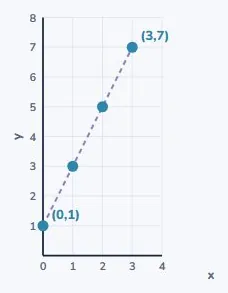
- This line crosses the y-axis at one, so c is one.
- From there it goes up two for every one across.
- So m is two, and the equation is y equals two x plus one.
Drawing one without a table
- Start at c. That is your first point, on the y-axis.
- Then use m as an instruction: up two, across one.
- Do it twice more and join them. No table of values.
| Step | Doing | Point |
|---|---|---|
| y = 2x + 1 | c is 1 | start at (0,1) |
| m is 2 | up 2, across 1 | (1,3) |
| Again | up 2, across 1 | (2,5) |
| Join them | no table needed |
Comparing steepness
- y equals x climbs one for every one across.
- y equals two x climbs twice as fast. y equals four x, faster again.
- The bigger the size of m, the steeper the line.
| Line | Gradient | What it does |
|---|---|---|
| y = x | m = 1 | up 1 each step |
| y = 2x | m = 2 | twice as steep |
| y = 4x | m = 4 | steeper again |
| Bigger size of m | steeper line | sign is direction |
When the gradient is negative
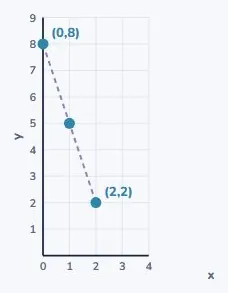
- y equals minus three x plus eight starts at eight.
- Then it falls three for every one across.
- A negative gradient always means a falling line.
Same gradient, parallel lines
- Two lines with the same m climb at the same rate.
- So they never meet, however far you draw them.
- Different c just moves one of them up or down the page.
Where gradients come from outside maths
- A tradesperson charges sixty dollars to turn up.
- Then forty-five dollars an hour. That rate is the gradient.
- y equals forty-five x plus sixty, and three hours is 195 dollars.
| In the job | In the equation | Value |
|---|---|---|
| Call-out fee $60 | that is c | cost at zero hours |
| $45 an hour | that is m | the rate |
| y = 45x + 60 | the whole job | |
| Three hours | 135 + 60 | $195 |
Sixteen has two square roots
- Four squared is sixteen. And minus four squared is also sixteen.
- So both of them are square roots of sixteen.
- But the root sign means the positive one only.
| Statement | Why |
|---|---|
| 16 has two square roots | 4 and −4 |
| Because | 4² = 16 and (−4)² = 16 |
| But √16 means 4 | the sign means the positive one |
| So x² = 16 has two answers | while √16 is one number |
How many answers does x squared equal a have?
- If a is positive, two answers, one of each sign.
- If a is zero, exactly one answer.
- If a is negative, none at all.
| Equation | Answers | Which |
|---|---|---|
| x² = 25 | two | 5 and −5 |
| x² = 0 | one | 0 |
| x² = −4 | none | nothing squares negative |
| Check the sign of a | before you solve |
Multiplying to zero
- If two numbers multiply to zero, one of them is zero.
- There is no other way to do it. No near misses.
- That fact is what makes a factorised quadratic solvable.
| If | Then | |
|---|---|---|
| ab = 0 | then a = 0 or b = 0 | |
| No other way | to multiply to zero | |
| (x − 3)(x + 5) = 0 | so one bracket is 0 | |
| Giving | x = 3 or x = −5 |
Using it
- x minus three, times x plus five, equals zero.
- So either the first bracket is zero or the second one is.
- x is three, or x is minus five.
Why a negative reverses an inequality
- Two is less than three. Nobody disputes that.
- Multiply both by minus one: minus two and minus three.
- Minus two is bigger. The order flipped, so the sign must.
| Step | Result |
|---|---|
| 2 < 3 | plainly true |
| Times both by −1 | −2 and −3 |
| Now −2 > −3 | the order swapped |
| So the sign must turn | every time you do that |
What to take away
- Seven lines: four about lines, three about answers.
| A straight line has two properties | where it crosses, how steep |
| c | the y-intercept |
| m | the gradient, rise over run |
| Bigger size of m | steeper line |
| x² = a | two answers, one, or none |
| √ means the positive root | only |
| If two things give 0 | one of them is 0 |
Your turn: four questions
- Pause here and do all four.
- Question 1 gives you a point that is already on the y-axis.
- Question 4 wants how many, and what they are.
| Question | |
|---|---|
| 1 | Gradient 3, through (0, −2). Equation? |
| 2 | Gradient through (1, 4) and (5, 16)? |
| 3 | Solve (x − 7)(x + 2) = 0. |
| 4 | How many answers has x² = 49? |
Show answer
1. y = 3x − 2. The point given is on the y-axis, so its y-value is c directly, and the gradient is m. 2. 3. The rise is 16 − 4, which is 12, and the run is 5 − 1, which is 4. Twelve over four is three. Subtract in the same order on the top and the bottom or the sign comes out wrong. 3. x = 7 or x = −2. One of the two brackets has to be zero. 4. Two: 7 and −7. Both square to 49. Writing only 7 is the standard slip, and it happens because √49 is 7, but the question asked which numbers square to 49, which is a different question.
The answers
- y equals three x minus two.
- Twelve over four, so the gradient is three.
- x is seven, or x is minus two.
- Two answers: seven and minus seven.
Is your child on track?
Take the free placement test