Factorising patterns, finding a line, moving a curve
What this lesson covers
- There are specific factorising relationships that are useful to recognise: x(x + a) = x² + ax difference of two squares: (x + a)(x − a) = x² − a² square of a sum: (x + a)² = x² + 2ax + a² square of a difference: (x − a)² = x² − 2ax + a².
- The solution to a linear inequality is a set of values which may be represented with a number line.
- For a specific straight line, the gradient, m, and y-intercept, c, are fixed, and x varies with y according to the rule y = mx + c.
- The y-intercept touches the y-axis and has coordinates (0,c).
- The gradient m of a straight line can be determined with the formula m = rise/run = Δy/Δx .
- A vertical line has an infinite gradient. This cannot be expressed in the formula m = rise/run as it becomes m = rise/0, which cannot be evaluated.
- The equation of a vertical line is x = b, where the x-intercept is (b,0).
Four shapes worth knowing on sight
- Last time, factorising was a search through pairs of numbers.
- Four cases do not need searching, because you can recognise them.
- Knowing them turns thirty seconds of work into about one.
| This | Is this |
|---|---|
| x(x + a) | x² + ax |
| (x + a)(x − a) | x² − a² |
| (x + a)² | x² + 2ax + a² |
| (x − a)² | x² − 2ax + a² |
A square take away a square
- x plus five, times x minus five. Expand it and watch the middle.
- Minus five x and plus five x cancel each other out completely.
- So it is x squared minus twenty-five, with no middle term at all.
| Step | Working | Note |
|---|---|---|
| (x + 5)(x − 5) | expand it | |
| x² − 5x + 5x − 25 | the middle cancels | |
| x² − 25 | a square take a square | |
| So x² − 49 | is (x + 7)(x − 7) | on sight |
Squaring a bracket
- x plus three, squared, means that bracket times itself.
- Expanding gives x squared, three x, three x, and nine.
- The two middle terms add. Six x, and that is the one people lose.
| Step | Gives | |
|---|---|---|
| (x + 3)² | means (x + 3)(x + 3) | |
| Expand | x² + 3x + 3x + 9 | |
| Collect | x² + 6x + 9 | |
| The 6x | is the part people lose |
Testing the mistake
- Is x plus three, squared, the same as x squared plus nine?
- Do not argue about it. Put a number in and see.
- At x equals one: sixteen against ten. So no, they are different.
| Test | Working | Value |
|---|---|---|
| Is (x + 3)² = x² + 9? | try x = 1 | |
| (1 + 3)² | 4² | 16 |
| 1² + 9 | 1 + 9 | 10 |
| 16 is not 10 | so no, they differ |
And with a minus in the bracket
- x minus four, squared, gives x squared minus eight x plus sixteen.
- The middle term is negative. The last one is still positive.
- Minus four times minus four is plus sixteen, every time.
An inequality answers with a set
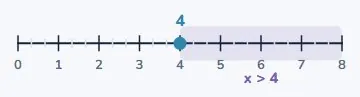
- Two x plus three is greater than eleven, so x is greater than four.
- That is not one answer. It is every number above four.
- Four itself does not work, so the circle is open.
The gradient formula
- It is rise over run, written for two named points.
- The y difference on top, the x difference underneath.
- Subtract in the same order top and bottom, or the sign flips.
| Rule | Meaning |
|---|---|
| m = rise / run | the same as before |
| Between two points | the y difference over the x difference |
| (2,5) to (6,17) | 12 over 4, which is 3 |
| Subtract the same way round | on top and bottom |
Finding a line from two points
- Gradient first: twelve up, four across, so m is three.
- Now put one of the points back in to find c.
- Five equals three times two, plus c. So c is minus one.
| Step | Working | Result |
|---|---|---|
| Points (2,5) and (6,17) | ||
| Gradient | 12 ÷ 4 | m = 3 |
| Put (2,5) in | 5 = 3×2 + c | c = −1 |
| So | y = 3x − 1 | check: 3×6 − 1 = 17 |
From a gradient and one point
- You already have m, so skip straight to the second half.
- Ten equals four times three, plus c.
- c is minus two. Same method, one step shorter.
| Step | Working | Result |
|---|---|---|
| Gradient 4, through (3,10) | ||
| Put it in | 10 = 4×3 + c | |
| So c | 10 − 12 | −2 |
| Answer | y = 4x − 2 |
The line that does not fit
- A vertical line goes up but never across. Its run is zero.
- So its gradient would be rise divided by zero, which has no value.
- It cannot be written y equals m x plus c. It is x equals four.
| Fact | Because | So |
|---|---|---|
| A vertical line | goes up, never across | |
| So the run is 0 | m = rise ÷ 0 | cannot be done |
| It has no m at all | so no y = mx + c | |
| Its equation | x = 4 | and nothing else |
Changing the number in front of x squared
- y equals x squared is 1 when x is 1.
- y equals two x squared is 2 there, and four x squared is 4.
- A bigger a climbs faster, so the curve is narrower.
| Curve | Where | Height |
|---|---|---|
| y = x² | at x = 1 | y = 1 |
| y = 2x² | at x = 1 | y = 2 |
| y = 4x² | at x = 1 | y = 4 |
| Bigger a | climbs faster | narrower curve |
And changing the number on the end
- Adding three lifts every single point by three.
- The bottom of the curve moves from the origin up to nought, three.
- The shape does not change at all. It has moved, not stretched.
| Curve | What happens | Bottom at |
|---|---|---|
| y = x² | bottom at (0,0) | |
| y = x² + 3 | every point up 3 | bottom at (0,3) |
| y = x² − 5 | every point down 5 | bottom at (0,−5) |
| Same shape | moved, not stretched |
Two numbers, two different jobs
- a changes the width of the curve.
- c slides the whole thing up or down.
- Neither one does the other’s job, which is what makes it readable.
What to take away
- Seven lines, and the second one is the exam favourite.
| x² − a² | factorises to (x + a)(x − a) |
| (x + a)² | is x² + 2ax + a², never x² + a² |
| An inequality | has a set of answers |
| m | the y difference over the x difference |
| To find a line | get m, then put a point in for c |
| A vertical line | is x = b, and has no gradient |
| In y = ax² + c | a changes the width, c moves it |
Your turn: four questions
- Pause here and work all four out.
- Question 1 has a middle term. Do not lose it.
- Question 3 is gradient first, then put a point in.
| Question | |
|---|---|
| 1 | Expand (x − 6)². |
| 2 | Factorise x² − 49. |
| 3 | Find the line through (1, 2) and (4, 11). |
| 4 | What does y = x² − 5 do to y = x²? |
Show answer
1. x² − 12x + 36. It means x minus six, times x minus six, so the middle term is two lots of minus six x. 2. (x + 7)(x − 7). A square take away a square, which is the difference of two squares every time. 3. y = 3x − 1. The gradient is 11 − 2 over 4 − 1, which is 9 over 3, so 3. Then put the point (1,2) in: 2 = 3 + c, so c is −1. Check with the other point: 3 × 4 − 1 = 11. 4. It moves the whole curve down five. The shape is unchanged, and the bottom of it sits at (0, −5) instead of at the origin.
The answers
- x squared minus twelve x plus thirty-six.
- x plus seven, x minus seven.
- y equals three x minus one.
- It moves the whole curve down five. Same shape.
Is your child on track?
Take the free placement test