Circles, surface area, and where the formulae come from
What this lesson covers
- The area of a circle is given by A = πr².
- The surface area of a solid object is a measure of the total area that the surface of the object occupies.
Six formulae, and none of them handed over
- A formula you were given is one you can forget.
- A formula you worked out is one you can rebuild.
- So everything in this lesson gets built in front of you.
The area of a circle
- Everything about a circle comes from the radius.
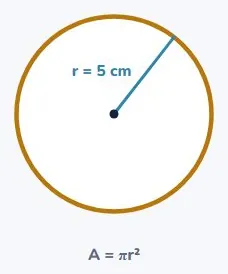
- The area is π times the radius squared.
- One measurement in, and the whole circle comes out.
Square the radius first
- π r squared means π times r squared.
- Not π times r, and then that squared.
- Five squared is 25, then times π. Not 15.7, squared.
| Step | Doing | Result |
|---|---|---|
| A = πr² | square the radius first | |
| r = 5 | 5² = 25 | then × π |
| Area | 25π | 78.5 cm² |
| Not (π × 5)² | that gives 246.7 | π times too big |
Half a circle, and a quarter
- There is no separate formula to learn here.
- Half a circle has half the area. Work out the circle, halve it.
- A quarter circle is the same idea divided by four.
| Shape | Reasoning | Area |
|---|---|---|
| Half a circle | half of πr² | πr² ÷ 2 |
| r = 6 | 36π ÷ 2 | 18π = 56.5 |
| A quarter circle | a quarter of πr² | πr² ÷ 4 |
| r = 4 | 16π ÷ 4 | 4π = 12.6 |
A shape made of two shapes
- A rectangle with a semicircle sitting on top of it.
- Work out each piece separately, then add them.
- Sixty, plus fourteen point one, is seventy-four point one.
| Part | Working | Area |
|---|---|---|
| Rectangle 10 by 6 | 10 × 6 | 60 |
| Semicircle on top | radius 3 | 9π ÷ 2 = 14.1 |
| Add them | 60 + 14.1 | 74.1 cm² |
| Break it up | then add | every time |
What surface area actually is
- It is the total area of every face of a solid.
- Which is exactly the area of its net, cut open and laid flat.
- So if you can draw the net, you can find the surface area.
| Idea | Meaning |
|---|---|
| Surface area | the total area of every face |
| Which is | the area of its net |
| So cut it open | and measure what is flat |
| Units | always squared |
A cube, by counting
- How many faces does a cube have? Six.
- How big is each one? s by s, so s squared.
- So the surface area is six s squared. Nothing memorised.
A box, by pairing
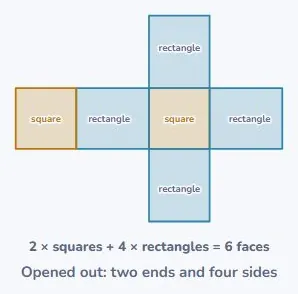
- Opposite faces of a box are identical, so they come in pairs.
- Front and back, top and bottom, and the two ends.
- Three different areas, each counted twice.
| Pair | Each one | Working |
|---|---|---|
| Front and back | l × w, twice | |
| Top and bottom | l × h, twice | |
| The two ends | w × h, twice | |
| 5 by 3 by 2 | 2(15 + 10 + 6) | 62 cm² |
Now unroll a cylinder
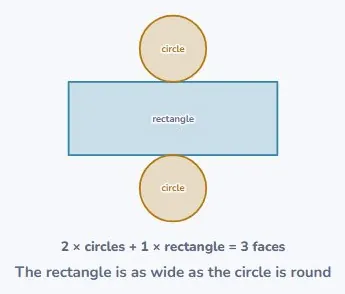
- Two circles, one at each end. That part is easy.
- And the curved side flattens out into a rectangle.
- How wide is that rectangle? It was wrapped around a circle.
Which is where 2πrh comes from
- That rectangle edge used to be the circle itself.
- So its width is the circumference, two π r.
- Times the height, and the curved side is two π r h.
| Part | Why | Area |
|---|---|---|
| Unroll a cylinder | two circles and a rectangle | |
| The two circles | 2 × πr² | 2πr² |
| The rectangle is as wide | as the circle is round | 2πr |
| So the body is | 2πr × h | 2πrh |
A cylinder with numbers in it
- Radius three, height ten. Two circles first: eighteen π.
- Then the body: two π times three times ten, sixty π.
- Seventy-eight π altogether, about 245 square centimetres.
| Part | Working | Area |
|---|---|---|
| r = 3, h = 10 | ||
| Two circles | 2 × 9π | 18π |
| The body | 2π × 3 × 10 | 60π |
| Total | 78π | 245 cm² |
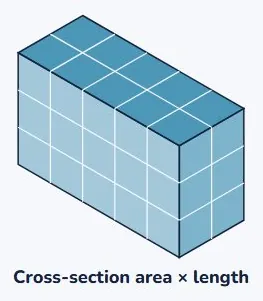
Volume, from what a prism is
- A prism has the same cross-section all the way through.
- So the volume is that area, times how long it is.
- A cylinder is a prism whose cross-section is a circle.
And a pyramid holds a third
- Same base, same height, a third of the volume.
- So it is base area times height, divided by three.
- That one is told to you. Proving it is a later year.
| Fact | Detail | |
|---|---|---|
| A pyramid | on the same base | and the same height |
| Holds exactly | a third of the prism | |
| So | base area × height ÷ 3 | |
| Proving that | is a later year |
What to take away
- Seven lines, and none of them needs memorising.
| A = πr² | square the radius first |
| Half a circle | is half of that |
| Composite shapes | break up, then add |
| Surface area | is the area of the net |
| A cube | six faces, so 6s² |
| A cylinder | 2πr² + 2πrh, from its net |
| A prism | cross-section area × length |
Your turn: four questions
- Pause here and work all four.
- Leave your answers in terms of π until the last step.
- Question 4 does not tell you the shape, and does not need to.
| Question | |
|---|---|
| 1 | Area of a circle, radius 7, to 3 s.f. |
| 2 | Area of a semicircle of radius 10. |
| 3 | Surface area of a cylinder, r 2, h 5. |
| 4 | Volume: cross-section 12 cm², length 9 cm. |
Show answer
1. 154 square centimetres. Seven squared is 49, so the exact area is 49π, and to three significant figures that is 154. 2. 50π, which is about 157 square centimetres. Ten squared is a hundred, times π, halved. 3. 28π, about 87.9 square centimetres. Two circles give 2 × 4π, which is 8π, and the body is 2π × 2 × 5, which is 20π. 4. 108 cubic centimetres. The cross-section area times the length, and notice you were never told what shape the cross-section was, because for a prism it does not matter.
The answers
- Forty-nine π, which is 154 square centimetres.
- Fifty π, about 157.
- Eight π plus twenty π is twenty-eight π, about 87.9.
- A hundred and eight cubic centimetres.
Is your child on track?
Take the free placement test