Scale factors, and converting area and volume
What this lesson covers
- The general formula for the volume of a prism is V = Al, where A is the consistent cross-sectional area and l is perpendicular to the plane of the cross-sectional area.
- Resizing (enlarging or reducing) a shape changes its perimeter, area, or volume proportionally according to the dimensions of the units; linear metric conversions must be squared to convert area and cubed to convert volume.
Double a shape and the area does not double
- Make every length twice as long. Sounds like everything doubles.
- The perimeter does. The area goes up four times.
- And the volume goes up eight. That is the whole lesson.
Watch it happen
- A rectangle two by three. Perimeter ten, area six.
- Double both sides: four by six. Perimeter twenty.
- But the area is twenty-four. Four times, not two.
| Shape | Perimeter | Area |
|---|---|---|
| Rectangle 2 by 3 | perimeter 10 | area 6 |
| Double every length | now 4 by 6 | |
| Perimeter | 20 | doubled |
| Area | 24 | four times |
Why four and not two
- Area is length times width, and both of them doubled.
- So the area was multiplied by two, and then by two again.
- Perimeter only adds up lengths, so it only doubles.
| Measurement | What happens |
|---|---|
| Area is length × width | both of them doubled |
| So area gets × 2 × 2 | which is × 4 |
| Perimeter is only lengths | so it just doubles |
| The dimensions decide | how the factor is used |
And in three dimensions
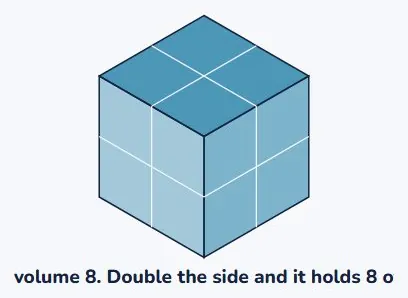
- A cube of side two has a volume of eight.
- Double the side to four and the volume is sixty-four.
- Eight times bigger, because three lengths all doubled.
The rule, in one line
- Scale every length by k.
- Areas are multiplied by k squared.
- Volumes are multiplied by k cubed. One line, every question.
| Measurement | Scales by |
|---|---|
| Lengths | × k |
| Areas | × k² |
| Volumes | × k³ |
| Going back | a k² on area means k on length |
Going the other way
- An area is nine times bigger. What happened to the lengths?
- k squared is nine, so k is three. They tripled.
- That backwards direction is what gets asked in exams.
| Given | Working | Answer |
|---|---|---|
| Area is 9 times bigger | so k² = 9 | k = 3 |
| Lengths tripled | and volume | × 27 |
| Volume is 8 times | so k³ = 8 | k = 2 |
| Undo the power | to get the length factor |
Which explains a conversion everyone gets wrong
- A metre is a hundred centimetres, so k is a hundred.
- A square metre is therefore a hundred squared square centimetres.
- Ten thousand. Not a hundred, which is the usual answer.
| Step | Working | Result |
|---|---|---|
| 1 m is 100 cm | so k = 100 | |
| 1 m² is | 100 × 100 | 10 000 cm² |
| Not 100 cm² | that is the common error | |
| Square the conversion | for a squared unit |
And a cubic metre
- Same idea, cubed: a hundred times a hundred times a hundred.
- A million cubic centimetres in one cubic metre.
- So 2.5 square metres is twenty-five thousand square centimetres.
| Conversion | Working | Result |
|---|---|---|
| 1 m³ | 100 × 100 × 100 | 1 000 000 cm³ |
| 2.5 m² | 2.5 × 10 000 | 25 000 cm² |
| 3 m² | 3 × 10 000 | 30 000 cm² |
| Cube it | for a cubic unit |
That is not a new rule
- It is the k squared rule with k equal to a hundred.
- Squared units square the conversion. Cubic units cube it.
- One idea, whether it is a model boat or a metre.
Surface area of a triangular prism
- Two triangular ends, and three rectangles around the sides.
- The ends are twelve each. The sides are the perimeter times the length.
- Sixteen around, times ten long, is a hundred and sixty.
| Part | Working | Area |
|---|---|---|
| Triangle, base 6, height 4 | area | 12 cm² |
| Two ends | 2 × 12 | 24 |
| Sides: perimeter 16 | × length 10 | 160 |
| Surface area | 24 + 160 | 184 cm² |
The shortcut hiding in that
- All the side faces together are one long rectangle.
- Its width is the perimeter of the end, its length is the prism’s.
- So any prism: two ends, plus perimeter times length.
Volume when the shape is awkward
- A prism is anything with the same cross-section throughout.
- So the volume is that area times the length, whatever the shape.
- Thirty-five square centimetres, twelve long, is 420 cubic centimetres.
| Rule | Detail | Result |
|---|---|---|
| V = Al | cross-section × length | |
| Cross-section 35 cm² | length 12 cm | 420 cm³ |
| The shape | does not matter | |
| Only that it | stays the same along |
And a cylinder is one of those
- Its cross-section is a circle, so the area is π r squared.
- Radius four gives sixteen π, times a height of seven.
- A hundred and twelve π, about 352 cubic centimetres.
| Step | Working | Result |
|---|---|---|
| Cross-section | a circle, πr² | |
| r = 4 | 16π | |
| Times the height 7 | 112π | |
| Which is | 352 cm³ | to 3 figures |
What to take away
- Seven lines, and the first one explains the next four.
| Scale lengths by k | areas go × k², volumes × k³ |
| Perimeter | scales like a length |
| Working backwards | undo the power |
| 1 m² = 10 000 cm² | because 100 squared |
| 1 m³ = 1 000 000 cm³ | because 100 cubed |
| Surface area of a prism | two ends plus the sides |
| Volume of any prism | cross-section × length |
Your turn: four questions
- Pause here and work all four out.
- Question 2 needs the conversion squared.
- Question 4 is the one this lesson was built for.
| Question | |
|---|---|
| 1 | A shape’s sides are tripled. The area? |
| 2 | Convert 3 m² to square centimetres. |
| 3 | Volume of a cylinder, r 4, h 7, to 3 s.f. |
| 4 | A 1:50 model is 8 cm². The real area? |
Show answer
1. Nine times bigger. Tripling the lengths means k is 3, and area goes up by k squared, which is 9. 2. 30 000 cm². One square metre is 10 000 square centimetres, because the conversion of 100 has to be squared. 3. 112π, which is 352 cubic centimetres to three figures. The cross-section is 16π, and the height is 7. 4. 20 000 cm², which is 2 square metres. The lengths scale by 50, so the areas scale by 50 squared, which is 2 500. Multiplying by 50 instead of 2 500 is the mistake this whole lesson exists to prevent.
The answers
- Nine times, because three squared is nine.
- Thirty thousand square centimetres.
- A hundred and twelve π, about 352 cubic centimetres.
- Twenty thousand square centimetres, which is two square metres.
Is your child on track?
Take the free placement test