Experimental and theoretical probability
What this lesson covers
- Some chance-based situations, such as tossing a non-regular 3D shape, can only be explored through probability experiments.
- Results from sets of repeated trials for the same experiment may vary.
- The Law of Large Numbers states that as the number of trials in a chance experiment increases, the experimental probability will approach the experiment’s theoretical probability.
- Lists, tables, two-way tables, and tree diagrams are useful systematic methods for generating all possible outcomes.
Two ways to find a probability
- Count the possible outcomes and work out the fraction.
- Or do it a lot of times and count what happened.
- Theoretical and experimental. They are not rivals.
| Kind | Method | Needs |
|---|---|---|
| Theoretical | count the possible outcomes | needs symmetry |
| Experimental | count what actually happened | needs trials |
| A fair die | both work | and should agree |
| A drawing pin | only the second |
Counting outcomes
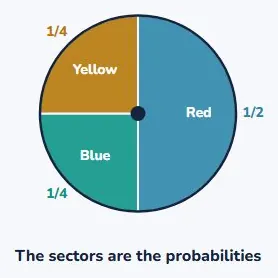
- A spinner: half red, a quarter blue, a quarter yellow.
- The probabilities are the fractions of the circle.
- This works because the sectors are what they are measured on.
But counting needs the outcomes to be equal
- A die has six faces and no face is favoured. Fine.
- A spinner is measured in degrees. Also fine.
- Take that away and counting stops working.
A drawing pin
- Drop one. It lands point up, or point down. Two outcomes.
- So the probability is a half? No. Look at the shape of it.
- There is no theoretical answer here. Nobody knows it.
| Reasoning | Problem |
|---|---|
| A drawing pin | lands point up or point down |
| Two outcomes | so is it a half? |
| No: the shape is not symmetric | nothing says they are equal |
| The only way to find out | is to drop a lot of pins |
Which makes the experiment the whole answer
- Drop a lot of pins and count. That is the probability.
- Not an estimate of some real value hidden somewhere.
- For a pin, the experiment is the only route there is.
Do it twice and you get two answers
- Roll a die thirty times. You expect five sixes.
- You get three. Do it again, you get eight.
- Neither set is wrong. Repeated trials vary.
| Trial set | Sixes | Proportion |
|---|---|---|
| 30 rolls of a die | expect 5 sixes | |
| First set | 3 sixes | 0.10 |
| Second set | 8 sixes | 0.27 |
| Neither is wrong | that is variation |
The Law of Large Numbers
- The more trials you do, the closer the proportion gets.
- Thirty rolls can be well off. Three thousand will be close.
- It is a statement about the proportion, and nothing else.
| Trials | What happens |
|---|---|
| More trials | the proportion settles down |
| 30 trials | can be well off |
| 3 000 trials | will be close |
| It is about the proportion | never about the next roll |
What it definitely does not say
- Five tails in a row does not make heads due.
- The coin has no memory. The next toss is still a half.
- Early results get swamped by later ones. Nothing corrects them.
| Belief | Reality |
|---|---|
| "Five tails, so heads is due" | no |
| The coin has no memory | the next toss is still a half |
| The proportion settles | by being swamped, not corrected |
| That belief | is how people lose money |
Listing every outcome
- To count outcomes you have to find all of them first.
- Missing one, or counting one twice, ruins everything after.
- So do it systematically, not by thinking hard.
Two dice, in a table
- Six outcomes on the first, six on the second. Thirty-six pairs.
- A table with the first die down and the second across finds them all.
- A total of seven happens six ways out of thirty-six.
| Part | Count | Result |
|---|---|---|
| First die | 6 outcomes | |
| Second die | 6 outcomes | |
| Together | 6 × 6 | 36 |
| Total of 7 | 1+6 2+5 3+4 and back | 6 of them |
Two coins, in a tree
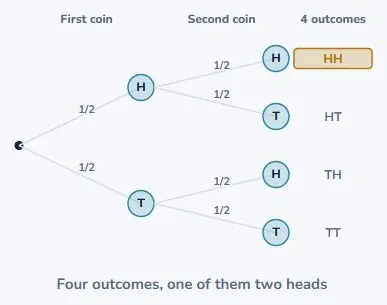
- A tree does the stages in order, branching at each one.
- Two branches, then two more from each. Four outcomes.
- Reading down a path gives you one complete outcome.
Why the numbers multiply
- Every outcome of the first stage meets every one of the second.
- So three shirts and four trousers is twelve outfits, not seven.
- Multiply the stages together. Never add them.
| Situation | Working | Outcomes |
|---|---|---|
| 3 shirts, 4 trousers | 3 × 4 | 12 outfits |
| 2 coins | 2 × 2 | 4 outcomes |
| 3 coins | 2 × 2 × 2 | 8 outcomes |
| Multiply the stages | never add them |
Which tool to reach for
- Few outcomes and one stage: a plain list is fine.
- Exactly two things at once: a two-way table.
- Several stages in order: a tree. All three do the same job.
| Tool | When |
|---|---|
| A short list | few outcomes, one stage |
| A two-way table | exactly two things at once |
| A tree diagram | several stages in order |
| All three do one job | every outcome, exactly once |
Putting the two kinds side by side
- Theoretical probability of a six: one sixth, or 0.167.
- Thirty rolls gave 0.267, which is a long way off.
- Three thousand rolls gave 0.171. Closer, because there were more.
| Source | Result | Value |
|---|---|---|
| Theoretical P(six) | 1 ÷ 6 | 0.167 |
| After 30 rolls | 8 sixes | 0.267 |
| After 3 000 rolls | 512 sixes | 0.171 |
| Closer | because there were more |
What to take away
- Seven lines, and the sixth costs people money.
| Theoretical probability | counts outcomes, needs symmetry |
| Experimental probability | counts results, works on anything |
| Some things | have no theoretical value at all |
| Sets of trials vary | and that is expected |
| More trials | brings the proportion closer |
| Nothing is ever "due" | the die has no memory |
| Count stages | by multiplying them |
Your turn: four questions
- Pause here and answer all four.
- Question 1 wants both numbers.
- Question 3 wants a reason, not just a yes or no.
| Question | |
|---|---|
| 1 | Two dice. How many outcomes give 7? |
| 2 | Why has a drawing pin no theoretical value? |
| 3 | 8 sixes in 30 rolls. Is the die biased? |
| 4 | Half red, quarter blue, quarter yellow. P(not red)? |
Show answer
1. Thirty-six outcomes altogether, and six of them total seven: one and six, two and five, three and four, and those three again the other way round. So the probability is six over thirty-six, which is one sixth. 2. Because its two outcomes are not equally likely and nothing about its shape tells you how unequal they are. Counting outcomes only works when they are symmetric, so the pin has to be dropped. 3. Not necessarily. You would expect five, and eight is within the ordinary variation of thirty trials. To find out, roll it a few thousand times. 4. One half. Blue and yellow are a quarter each and they cannot both happen, so they add.
The answers
- Thirty-six outcomes, six of which total seven.
- Its outcomes are not equally likely and nothing says by how much.
- Not necessarily. Thirty rolls is far too few to tell.
- A half: a quarter and a quarter, added.
Is your child on track?
Take the free placement test