Naming compounds and balancing chemical equations
What this lesson covers
- Why a molecular formula gives the real atom count but an ionic formula gives a ratio
- Naming ionic compounds from their ions
- Using prefixes such as mono, di and tri to name covalent compounds
- Writing word equations and symbol equations for the same reaction
- Balancing equations, because atoms are rearranged but never created or destroyed
- Testing the claim that mass is conserved in a reaction
- How Alan MacDiarmid used bonding to make plastics that conduct electricity
Two kinds of formula
- Part 1 showed two ways atoms bond: ionic (electrons transferred between a metal and a non-metal) and covalent (electrons shared between non-metals).
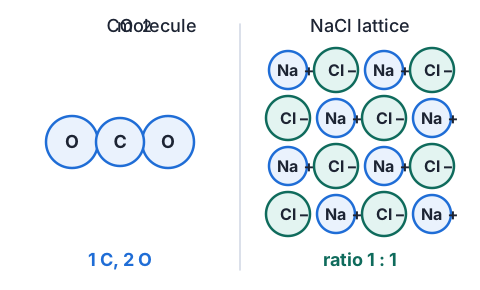
- A covalent compound is built from separate molecules, so its formula tells you exactly what is in one molecule. Every water molecule really has two H atoms and one O atom.
- An ionic compound has no molecules, only a huge lattice of ions. Its formula only gives the ratio of ions.
- So CO₂ describes one real particle with three atoms, while NaCl means 'equal numbers of Na⁺ and Cl⁻ ions'.
| Substance | Bonding | What the formula tells you |
|---|---|---|
| H₂O | covalent | one molecule: 2 H, 1 O |
| CO₂ | covalent | one molecule: 1 C, 2 O |
| NaCl | ionic | ratio Na⁺ : Cl⁻ is 1 : 1 |
| MgCl₂ | ionic | ratio Mg²⁺ : Cl⁻ is 1 : 2 |
Naming ionic compounds
- Say the positive ion first, then the negative ion.
- A metal ion keeps the metal's name: sodium stays sodium.
- A single non-metal ion changes its ending to 'ide': chlorine becomes chloride, oxygen becomes oxide.
- Polyatomic ions keep their own names, such as carbonate, nitrate, sulfate and hydroxide.
- You never say how many ions there are, because the charges already fix the ratio. Na₂O is just sodium oxide.
| Formula | Positive ion | Negative ion | Name |
|---|---|---|---|
| NaCl | Na⁺ | Cl⁻ | sodium chloride |
| MgO | Mg²⁺ | O²⁻ | magnesium oxide |
| CaCO₃ | Ca²⁺ | CO₃²⁻ | calcium carbonate |
| K₂SO₄ | K⁺ | SO₄²⁻ | potassium sulfate |
| NH₄NO₃ | NH₄⁺ | NO₃⁻ | ammonium nitrate |
Naming covalent compounds with prefixes
- Two non-metals can join in more than one ratio, so the name has to say how many atoms there are.
- Carbon monoxide (CO) has one oxygen and is deadly; carbon dioxide (CO₂) has two and is what you breathe out. The prefix matters.
- Put a prefix on the second element and give it the 'ide' ending.
- Only use a prefix on the first element when it has two or more atoms, so CO₂ is carbon dioxide, not monocarbon dioxide.
- A few molecules keep everyday names: H₂O is water, NH₃ is ammonia and CH₄ is methane.
| Prefix | Number | Example |
|---|---|---|
| mono | 1 | CO, carbon monoxide |
| di | 2 | SO₂, sulfur dioxide |
| tri | 3 | SO₃, sulfur trioxide |
| tetra | 4 | CCl₄, carbon tetrachloride |
| penta | 5 | PCl₅, phosphorus pentachloride |
Worked example: naming four compounds
- First decide whether each compound is ionic (metal or NH₄ present) or covalent (only non-metals).
- That decision tells you whether prefixes are needed.
- MgCl₂: metal + non-metal, ionicno prefixes
- magnesium chloride
- N₂O: two non-metals, covalent2 N, 1 O
- dinitrogen monoxide
- Na₂CO₃: metal + polyatomic ion, ioniccarbonate keeps its name
- sodium carbonate
- SiO₂: two non-metals, covalent1 Si, so no prefix on silicon
- silicon dioxide
From a word equation to a symbol equation
- A word equation names each reactant and product: sodium hydroxide + hydrochloric acid → sodium chloride + water.
- To turn it into a symbol equation, replace every name with its correct formula.
- Use the charge rule for ionic substances and the prefixes for covalent ones.
- Here every formula has one of each atom on both sides already, so this equation is balanced as written.
| Name | Formula | State |
|---|---|---|
| sodium hydroxide | NaOH | (aq) |
| hydrochloric acid | HCl | (aq) |
| sodium chloride | NaCl | (aq) |
| water | H₂O | (l) |
Atoms are rearranged, never made or destroyed
- In a reaction, bonds break and new bonds form, but the atoms themselves survive.
- So every atom on the reactant side must turn up somewhere on the product side.
- Because the atoms are the same, their total mass is the same too. This is the law of conservation of mass.
- A balanced equation shows this: count each element on the left and on the right, and the numbers match.
How to balance an equation
- Write the correct formulas first, and never change them afterwards.
- Count the atoms of each element on both sides.
- Fix a mismatch by writing a whole number in front of a formula. That number multiplies every atom in the formula.
- Changing a subscript is not allowed: turning H₂O into H₂O₂ would make hydrogen peroxide, a different substance.
- Leave elements that appear on their own, such as O₂ or Al, until last, since changing them affects nothing else.
- Finish by recounting everything.
Worked example: hydrogen burning in oxygen
- hydrogen + oxygen → water
- Start with the formulas H₂ + O₂ → H₂O and count.
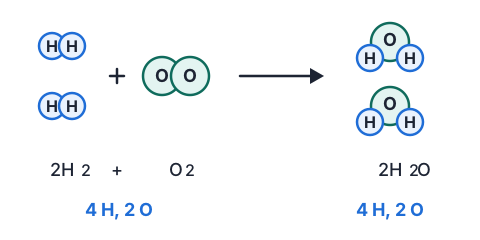
- H₂ + O₂ → H₂OO: 2 on the left, 1 on the right
- H₂ + O₂ → 2H₂Onow O is 2 and 2, but H is 2 and 4
- 2H₂ + O₂ → 2H₂OH is now 4 and 4
- left: 4 H, 2 O; right: 4 H, 2 O
- 2H₂(g) + O₂(g) → 2H₂O(l)
Worked example: aluminium reacting with oxygen
- aluminium + oxygen → aluminium oxide
- This is the reaction that puts a thin protective oxide coat on aluminium window frames.
- Al + O₂ → Al₂O₃Al₂O₃ from part 1's charge rule
- O: 2 on the left, 3 on the rightlowest common multiple is 6
- Al + 3O₂ → 2Al₂O₃6 oxygen atoms on each side
- Al: 1 on the left, 4 on the rightbalance the element last
- 4Al + 3O₂ → 2Al₂O₃
- left: 4 Al, 6 O; right: 4 Al, 6 O
Testing the claim that mass stays the same
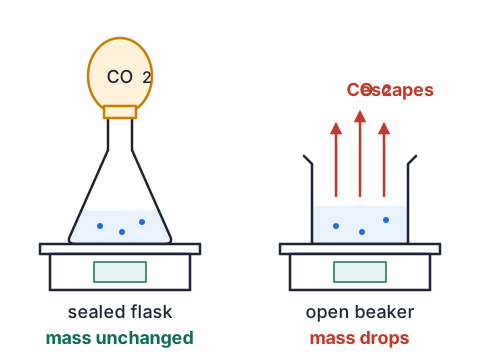
- Put dilute vinegar in a conical flask, a spoon of baking soda in a balloon, and fit the balloon over the neck. Weigh the whole set-up.
- Tip the powder in. The mixture fizzes and the balloon inflates with carbon dioxide. Weigh again.
- Repeat in an open beaker. The reading drops because the gas escapes into the room.
- The changed variable is open or sealed; the measured variable is the mass before and after; keep the same amounts of vinegar and baking soda and the same balance.
- If the sealed flask's mass is unchanged (within the balance's precision) while the open one falls, the 'lost' mass was gas that left, not atoms destroyed.
- Burning steel wool on a balance tests it the other way: the mass goes up, because oxygen from the air joins the iron.
Alan MacDiarmid: plastics that conduct
- Alan MacDiarmid was born in Masterton in 1927 and studied chemistry at Victoria University of Wellington.
- Plastics are long covalent molecules, and normally they are insulators, which is why they coat electrical wires.
- MacDiarmid, working with Alan Heeger and Hideki Shirakawa, studied polyacetylene, a chain of carbon atoms joined by alternating single and double bonds.
- Adding a small amount of iodine removed some electrons from the chain, and the remaining electrons could then move along it. The plastic's conductivity rose millions of times.
- The three shared the 2000 Nobel Prize in Chemistry. Conducting polymers are now used in flexible screens, OLED displays, sensors and antistatic coatings.
Common mistakes
- To balance H₂ + O₂ → H₂O, I can change the water to H₂O₂.Only the numbers in front may change, because a new subscript makes a different substance (H₂O₂ is hydrogen peroxide), so the answer is 2H₂ + O₂ → 2H₂O.
- MgCl₂ is magnesium dichloride.It is magnesium chloride, because ionic names never use prefixes: the charges of Mg²⁺ and Cl⁻ already fix the 1 : 2 ratio.
- CO₂ is monocarbon dioxide.It is carbon dioxide, because mono is never put on the first element; a prefix goes there only for two or more atoms, as in dinitrogen monoxide.
- The open beaker got lighter, so some mass was destroyed in the reaction.The carbon dioxide gas escaped into the room, so its atoms left the beaker; in a sealed flask the mass stays the same.
Weigh a reaction in a sealed bottle
You need: an empty 1.5 litre soft drink bottle with its cap, vinegar, baking soda, a tissue, kitchen scales, a measuring jug
- Pour 100 mL of vinegar into the bottle.
- Put one level teaspoon of baking soda in the middle of a tissue square and twist it into a small parcel.
- Put the bottle, its cap and the parcel on the scales together and write down the mass.
- Drop the parcel in, screw the cap on tight straight away, and swirl gently until the fizzing stops. Weigh the bottle and cap again.
- Point the bottle away from your face, undo the cap slowly to let the gas out, and weigh the bottle and cap a third time.
- Look for the mass staying the same while the cap is on, then dropping by 1 to 2 g once the carbon dioxide escapes: no atoms were lost, the gas simply left.
Safety: The gas builds pressure inside the bottle, so use a fizzy-drink bottle (not a thin water bottle), and open the cap slowly pointing away from faces so it does not spray vinegar into anyone's eyes.
Your turn
- 1. Name K₂O, CaSO₄ and N₂O₄.
- 2. Write the formula for sulfur trioxide and for calcium chloride.
- 3. Balance: Mg + HCl → MgCl₂ + H₂
- 4. Balance: Na + Cl₂ → NaCl
- 5. A student heats magnesium ribbon in an open crucible and finds the mass increases. Does this disprove conservation of mass? Explain.
Show answer
1. Potassium oxide (ionic, no prefixes); calcium sulfate (sulfate keeps its name); dinitrogen tetroxide (covalent: 2 N, 4 O). 2. SO₃; CaCl₂, because one Ca²⁺ needs two Cl⁻. 3. Mg + 2HCl → MgCl₂ + H₂: two Cl on the right means two HCl, which also gives 2 H to match H₂. 4. 2Na + Cl₂ → 2NaCl: Cl₂ forces 2NaCl, then 2Na balances sodium. 5. No. Oxygen atoms from the air combined with the magnesium to form magnesium oxide, so atoms were added from outside the system, none were created.
Balancing Chemical Equations
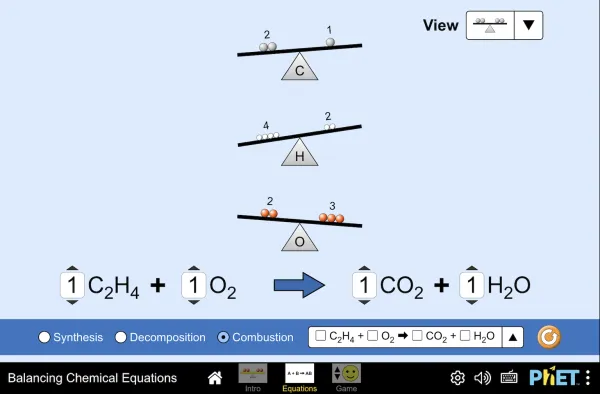
Full screen · PhET Interactive Simulations, University of Colorado Boulder, CC BY 4.0
Recap
- Molecular formulas give the real atoms in a molecule; ionic formulas give the ratio of ions.
- Ionic names: positive ion, then negative ion, with 'ide' for single non-metal ions and no prefixes.
- Covalent names use prefixes such as mono, di, tri and tetra to show the atom counts.
- Word equations name substances; symbol equations use their formulas, balanced by changing the numbers in front, never the subscripts, until every element matches.
- Atoms are conserved, so mass is conserved; any 'missing' mass escaped as gas or was added from the air.
- Alan MacDiarmid used knowledge of carbon bonding to make conducting plastics, earning a Nobel Prize.
How is Year 10 maths going?
See the Year 10 maths guide