Combination reactions and combustion
What this lesson covers
- Combination reactions, where reactants join into one product
- Why metal plus non-metal gives an ionic compound and non-metal plus non-metal gives a covalent one
- Combustion of hydrocarbons, and the heat and light it gives out
- The products of complete and incomplete combustion, and why carbon monoxide is dangerous
- Metals burning in oxygen
- Lab tests that identify carbon dioxide, water, oxygen and hydrogen
Combination: two or more reactants, one product
- In a combination reaction, the reactants join up to make a single new substance.
- The general pattern is A + B → AB.
- You can spot one from the equation: several things on the left, exactly one formula on the right.
- Many combination reactions start from elements, so they are the main way compounds are made from scratch.
What kind of compound forms
- When a metal combines with a non-metal, the metal hands electrons to the non-metal, so the product is ionic.
- When two non-metals combine, they share electrons, so the product is covalent.
- This means the elements you start with predict how the product is bonded, and therefore how to write and name it.
- At Kapuni in Taranaki, nitrogen from the air is combined with hydrogen to make ammonia, the first step in making urea fertiliser for NZ farms.
| Reactants | Balanced equation | Product bonding |
|---|---|---|
| sodium + chlorine | 2Na + Cl₂ → 2NaCl | ionic |
| iron + sulfur | Fe + S → FeS | ionic |
| carbon + oxygen | C + O₂ → CO₂ | covalent |
| sulfur + oxygen | S + O₂ → SO₂ | covalent |
| nitrogen + hydrogen | N₂ + 3H₂ → 2NH₃ | covalent |
Worked example: magnesium and oxygen
- Predict the product of magnesium reacting with oxygen, then write a balanced equation.
- metal + non-metalso the product is ionic
- Mg²⁺ and O²⁻, so MgO+2 and −2 cancel one to one
- Mg + O₂ → MgOO: 2 on the left, 1 on the right
- Mg + O₂ → 2MgOO balanced; now Mg is 1 and 2
- 2Mg + O₂ → 2MgO
- left: 2 Mg, 2 O; right: 2 Mg, 2 O
Combustion: burning with oxygen
- Combustion is a fast reaction between a fuel and oxygen that releases energy as heat and usually light.
- Many fuels are hydrocarbons: compounds made only of hydrogen and carbon, such as methane (CH₄) in natural gas and propane (C₃H₈) in BBQ bottles.
- Natural gas from Taranaki fields heats homes and has been burned at Huntly power station to generate electricity.
- The energy comes from forming new, strong bonds in the products, which releases more energy than was needed to break the bonds in the reactants.
- Because energy flows out to the surroundings, combustion is exothermic.
Complete combustion
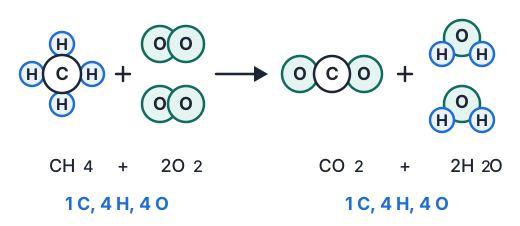
- With plenty of oxygen, every carbon atom ends up in carbon dioxide and every hydrogen atom in water.
- The flame is blue and clean, with no soot.
- Complete combustion releases the most energy from the fuel.
- For methane: CH₄ + 2O₂ → CO₂ + 2H₂O.
| Element in fuel | Ends up in |
|---|---|
| carbon | carbon dioxide, CO₂ |
| hydrogen | water, H₂O |
Worked example: propane burning completely
- propane + oxygen → carbon dioxide + water
- Balance carbon first, then hydrogen, and oxygen last because O₂ appears on its own.
- C₃H₈ + O₂ → CO₂ + H₂Ounbalanced skeleton
- C₃H₈ + O₂ → 3CO₂ + H₂O3 carbon atoms in propane
- C₃H₈ + O₂ → 3CO₂ + 4H₂O8 hydrogen atoms make 4 water molecules
- oxygen on the right: 3 × 2 + 4 × 1 = 10so 5 O₂ molecules are needed
- C₃H₈ + 5O₂ → 3CO₂ + 4H₂O
- left: 3 C, 8 H, 10 O; right: 3 C, 8 H, 10 O
Incomplete combustion
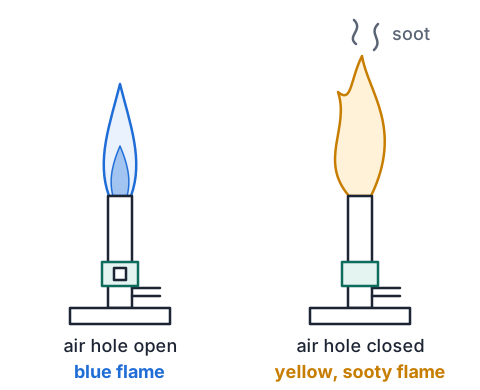
- When oxygen runs short, some carbon cannot reach CO₂. You still get water, but the carbon ends up spread across soot (solid carbon), carbon monoxide and some CO₂.
- The flame turns yellow and smoky, and soot blackens anything held in it.
- Less energy is released, so the fuel is wasted.
- Carbon monoxide has no colour or smell and stops blood carrying oxygen. This is why gas heaters, BBQs and generators must never be used in closed rooms.
- One possible equation for methane: 2CH₄ + 3O₂ → 2CO + 4H₂O.
| Complete | Incomplete | |
|---|---|---|
| Oxygen supply | plenty | limited |
| Bunsen air hole | open | closed |
| Flame | blue, hard to see | yellow, smoky |
| Products | CO₂ + H₂O | H₂O + C, CO and CO₂ |
| Energy released | more | less |
Metals can burn too
- Combustion is not only for fuels. Some metals burn fiercely once heated in oxygen.
- Magnesium ribbon burns with a blinding white light and leaves white magnesium oxide powder. Never look straight at it.
- Fine steel wool burns with orange sparks and turns into iron oxide, the reason sparklers spark.
- These are combination reactions as well as combustion: a metal and oxygen join into one product, an oxide.
- Because there is no carbon or hydrogen, no CO₂ or water forms.
How to identify the products
- You cannot see most gases, so chemists use tests that give a clear, visible result.
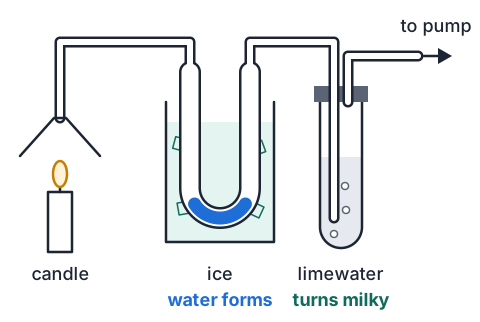
- Limewater is the standard test for carbon dioxide: bubble the gas through it and it turns milky.
- Water condensing on a cold surface can be confirmed with cobalt chloride paper or anhydrous copper sulfate.
- Indicators such as universal indicator show whether a product is acidic, neutral or basic.
| Product | Test | Positive result |
|---|---|---|
| carbon dioxide | bubble through limewater | clear to milky |
| water | blue cobalt chloride paper | blue to pink |
| water | white anhydrous copper sulfate | white to blue |
| oxygen | glowing splint | splint relights |
| hydrogen | lit splint | squeaky pop |
A controlled test: does air supply change combustion?
- Question: does closing the Bunsen burner's air hole change how well the gas burns?
- Change one variable: the air hole, fully open or fully closed.
- Measure: the time to heat 100 mL of water from 20 °C to 60 °C, and whether soot appears on the bottom of the beaker.
- Keep the same: the gas tap setting, the beaker, the volume and starting temperature of the water, and the height of the beaker above the burner.
- Repeat each condition three times. A faster heating time and a clean beaker with the hole open would show complete combustion releases more energy and makes no soot.
Spotting these reactions in everyday life
- Look for the pattern, not the setting: one product from several reactants means combination, a fuel reacting with oxygen means combustion.
- Some reactions fit both labels, such as charcoal or magnesium burning.
| Everyday example | Reaction type | Products |
|---|---|---|
| Gas hob or BBQ with a blue flame | complete combustion | CO₂ + H₂O |
| Candle with a smoky yellow flame | incomplete combustion | soot, CO, CO₂, H₂O |
| Car engine running on petrol | combustion | CO₂, H₂O, some CO |
| Sparklers on Guy Fawkes night | combustion and combination | metal oxides |
| Iron gate slowly rusting | combination (slow, with oxygen and water) | hydrated iron oxide |
Common mistakes
- Methane burns to make carbon dioxide and hydrogen.The hydrogen atoms combine with oxygen, so burning methane fully gives carbon dioxide and water.
- Incomplete combustion makes carbon monoxide instead of water.Water still forms, because the hydrogen burns easily; only the carbon ends up as soot and carbon monoxide as well as some carbon dioxide.
- Burning magnesium gives off carbon dioxide and water like any fuel.Magnesium contains no carbon or hydrogen, so the only product is magnesium oxide.
- Balancing propane, I wrote C₃H₈ + 5O → 3CO₂ + 4H₂O.Oxygen gas is always O₂, so the oxygen count of 10 atoms means 5O₂.
Steel wool combining with oxygen
You need: a plain steel wool pad, vinegar, a tall, narrow drinking glass, a shallow bowl of water, a few drops of food colouring, a marker pen or tape, kitchen gloves
- Wearing gloves, soak a small ball of steel wool in vinegar for one minute, then squeeze it out. The vinegar strips the protective coating off the iron.
- Push the ball right to the bottom of the dry glass so it stays wedged there when the glass is turned over.
- Add food colouring to the bowl of water, turn the glass upside down and stand it in the water, then mark the water level on the side.
- Leave it undisturbed and mark the level again after one hour, a few hours and the next day.
- Look for the steel wool turning orange-brown and the water rising about one fifth of the way up the air space: oxygen from the air has combined with the iron to make iron oxide, so that much gas is gone.
Safety: Steel wool breaks into fine splinters that cut skin and can get into eyes, so wear gloves, keep your hands away from your face, and wash your hands when you finish.
Your turn
- 1. Write a balanced equation for calcium combining with oxygen, and say whether the product is ionic or covalent.
- 2. Balance the complete combustion of ethane: C₂H₆ + O₂ → CO₂ + H₂O
- 3. A camping stove has a yellow, sooty flame. Name two products besides water and explain the cause.
- 4. Gas from a burning candle is bubbled through limewater, which turns milky. What does this show?
- 5. Why is burning magnesium classed as both combustion and combination?
Show answer
1. 2Ca + O₂ → 2CaO; ionic, because calcium is a metal and oxygen a non-metal. 2. 2C₂H₆ + 7O₂ → 4CO₂ + 6H₂O: 4 C, 12 H and 14 O on each side (doubling avoids a half O₂). 3. Any two of soot (carbon), CO and CO₂; the burner is short of oxygen, so combustion is incomplete. 4. Carbon dioxide is a product, so the candle wax contains carbon. 5. It reacts with oxygen and releases heat and light (combustion), and two reactants form one product, magnesium oxide (combination).
Reactants, Products and Leftovers
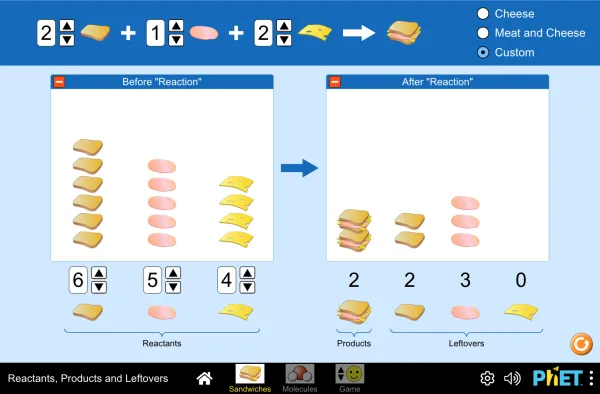
Full screen · PhET Interactive Simulations, University of Colorado Boulder, CC BY 4.0
Recap
- Combination: several reactants form one product, A + B → AB.
- Metal with non-metal gives an ionic product; non-metal with non-metal gives a covalent one.
- Combustion is a fuel reacting with oxygen, releasing heat and often light.
- Complete combustion of a hydrocarbon gives only CO₂ and H₂O; incomplete combustion also gives soot and toxic CO.
- Metals such as magnesium and iron can burn, forming oxides.
- Limewater detects CO₂; cobalt chloride paper detects water.
How is Year 10 maths going?
See the Year 10 maths guide