Decomposers, nutrient run-off and protecting waterways
What this lesson covers
- How microorganisms break down dead material and waste
- How decomposition makes nutrients available again
- How drought, drainage and pollution reduce stability and biodiversity
- Eutrophication: how too many nutrients can starve a lake of oxygen
- How forests, wetlands and soils slow run-off and reduce erosion
- How people restore ecosystems, including through kaitiakitanga
Closing the loop
- Part 1 showed water and nutrients moving from soil into plants and back into the air.
- This part looks at how nutrients get back into the soil and water, and what happens when people upset the flow of water.
- Without the step that returns nutrients, soil would run out of them and plants would stop growing.
Microorganisms recycle the dead
- Decomposers are organisms that feed on dead plants, dead animals and waste such as dung and fallen leaves.
- The main decomposers are microorganisms, bacteria and fungi, in the soil and in water; a single teaspoon of healthy soil holds many millions of bacteria.
- They release enzymes onto the dead material that break it down into simpler substances, which they absorb for energy.
- Detritivores such as earthworms and slaters help by shredding dead material into small pieces that microorganisms can break down faster.
- Decomposition is fastest when it is warm, moist and there is plenty of oxygen, which is why a compost heap is kept damp and turned.
Decomposition returns nutrients
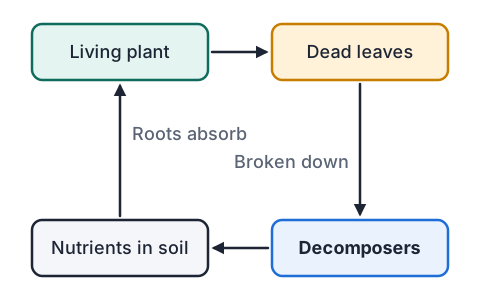
- As microorganisms break down dead matter, nutrients such as nitrogen and phosphorus are released into the soil or water in simple dissolved forms.
- Plant roots absorb these nutrients and use them to build proteins and DNA, and animals get them by eating plants.
- Decomposers also release carbon dioxide as they respire, returning carbon to the air for photosynthesis.
- So nothing is wasted: the same atoms of nitrogen in a dead leaf can end up in a new leaf the following spring.
| Stage | What happens to the nutrient |
|---|---|
| In a living plant | Built into proteins and DNA |
| Leaf falls and dies | Nutrients are locked in dead material |
| Decomposers feed | Nutrients released into soil water |
| Roots absorb | Nutrients used again to grow |
When the water supply is disrupted
- Drought dries out streams and soil, so plants wilt, decomposition slows and animals that need water die or leave.
- Drainage turns wetlands into farmland, and New Zealand has lost about 90 percent of the wetlands it once had, along with many of the birds, fish and plants that lived in them.
- Pollution, such as sediment, sewage and farm run-off, can make water cloudy, low in oxygen or harmful to drink.
- An ecosystem with many species is usually more stable, because if one species is lost others can fill its role; losing water and species makes it more fragile.
Too much of a good thing: eutrophication
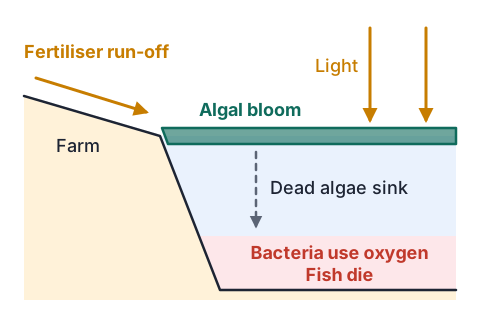
- Fertiliser and animal dung from farms contain nitrogen and phosphorus, and rain washes some of them into streams and lakes as run-off.
- Extra nutrients make algae grow very fast, forming a green bloom on the surface that blocks light from plants below.
- When the algae die, decomposer bacteria break them down and use up the dissolved oxygen in the water as they respire.
- Fish, tuna and insect larvae suffocate in the low-oxygen water, and some blooms also produce toxins.
- This chain is called eutrophication, and it has affected Lake Rotorua, where nutrients from the farmed catchment have caused algal blooms.
| Step | What happens |
|---|---|
| 1 | Nitrogen and phosphorus wash into the lake |
| 2 | Algae grow rapidly into a bloom |
| 3 | Plants below die from lack of light |
| 4 | Algae and plants die; bacteria decompose them |
| 5 | Bacteria use up dissolved oxygen |
| 6 | Fish and invertebrates die |
Reading water-quality data from a river
- Regional councils test rivers regularly, and LAWA publishes the results. Here are two sites on the Pātea River in Taranaki: Barclay Road, high up where the river runs through native forest, and Skinner Road, further down, after farmland and the town of Stratford.
- MCI scores the small animals living on the riverbed: 130 or more is the top band (A) and under 90 the bottom band (D). EPT animals are mayfly, stonefly and caddisfly larvae, which need clean, cool water with plenty of oxygen.
- Use the data to decide whether the land the river flows through is affecting it.
| Measurement | Barclay Road (native forest) | Skinner Road (farmland) |
|---|---|---|
| Nitrate-nitrogen (mg/L) | 0.015 | 0.865 |
| Water clarity (m) | 3.5 | 1.65 |
| MCI score (band) | 143 (A) | 106 (C) |
| EPT share of animal types (%) | 70 | 45 |
- 0.865 ÷ 0.015 ≈ 58about 58 times more nitrate downstream
- Clarity falls from 3.5 m to 1.65 mless than half as clear: sediment or algae
- MCI falls from 143 (A) to 106 (C)the riverbed animals change too
- EPT share falls from 70% to 45%fewer of the pollution-sensitive insects
- The river is much less healthy after it flows through farmland and past the town, most likely from run-off
- Two sites cannot prove the cause: Skinner Road is also below Stratford, so the town could add to it
Forests, wetlands and soils slow water down
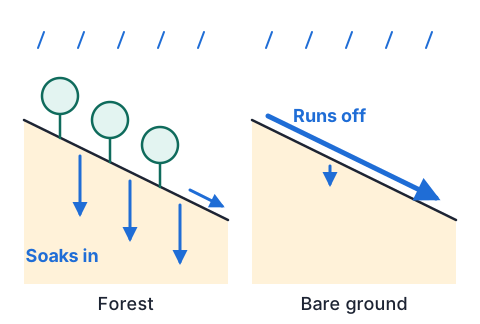
- When rain hits bare ground it runs off quickly over the surface, carrying soil and nutrients into streams.
- A forest canopy and leaf litter break the force of the rain, and roots hold soil together, so less soil is washed away (less erosion).
- Healthy soil with many pores lets water soak in (infiltration) and seep slowly into streams over days instead of minutes.
- Wetlands act like sponges, storing floodwater and releasing it slowly, and like filters, as plants and microorganisms remove nutrients and trap sediment.
- This is why steep land cleared of forest often slips in heavy rain, and why towns downstream of drained wetlands flood more often.
Comparing run-off from three catchments
- At Purukohukohu, in the central North Island, scientists measured three small neighbouring catchments: one in pasture, one in pine forest and one in native forest.
- In October 1983 a storm dropped 152 mm of rain on all three. The table shows how much ran straight off into the stream as stormflow, and how fast each soil soaks up water.
| Catchment | Stormflow (mm) | Share of the rain (%) | Soil soaks up (mm per hour) |
|---|---|---|---|
| Pasture | 103 | 68 | 52 |
| Pine forest | 54 | 36 | 225 |
| Native forest | 18 | 12 | 600 |
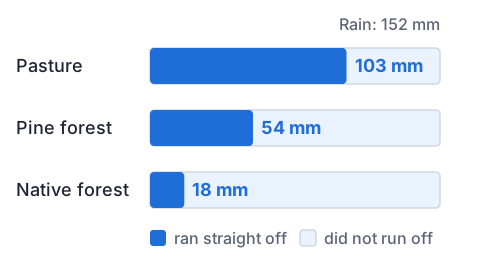
- Pasture: 103 ÷ 152 ≈ 0.68, so 68% ran offstormflow as a share of the rain
- Native forest: 18 ÷ 152 ≈ 0.12, so 12% ran offthe same for the forest
- 103 ÷ 18 ≈ 5.7compare the two
- 600 ÷ 52 ≈ 12the forest soil soaks up water about 12 times faster
- Nearly six times as much water rushed off the pasture as off the native forest, because the forest soil lets the rain soak in
- This was the biggest storm in the study. Across all 69 storms measured, typical run-off was 3.6%, 1.3% and 0.25%: smaller numbers, same order
Helping ecosystems recover
- Conservation protects what is left, such as setting aside reserves and keeping stock out of wetlands.
- Restoration rebuilds what was lost: fencing streams, planting native trees and flax along their banks (riparian planting), and re-wetting drained land.
- Long-term management keeps things healthy over decades, for example limiting how much nitrogen farms in a lake's catchment can lose, as has been done around Lake Rotorua.
- Kaitiakitanga is the Māori idea of guardianship: caring for land, water and living things as a responsibility handed down through generations.
- In 2017 the Whanganui River was recognised in law as Te Awa Tupua, a living whole with its own rights, reflecting the iwi view of the river as an ancestor.
| Action | What it does for water |
|---|---|
| Fencing stock out of streams | Less dung and trampled banks, cleaner water |
| Riparian planting | Roots hold banks, plants filter run-off, shade cools the stream |
| Restoring wetlands | Stores floodwater and filters nutrients |
| Nutrient limits on farms | Less nitrogen and phosphorus reaching lakes |
Common mistakes
- Worms are the main decomposers.Bacteria and fungi are the main decomposers; worms and slaters are detritivores that shred dead material so microorganisms can break it down faster.
- In eutrophication the algae use up all the oxygen in the lake.Decomposer bacteria use up the oxygen as they respire while breaking down the dead algae; living algae release oxygen in daylight.
- Fertiliser run-off kills fish because it is poisonous.The main harm is that the extra nutrients feed an algal bloom, and decomposing that bloom strips the dissolved oxygen fish need.
- Forests stop rain water from reaching rivers.Forests slow the water so it soaks into the soil and reaches streams over days, which cuts floods and erosion, but the water still arrives.
Bare soil against covered soil
You need: 2 shallow plastic takeaway containers, garden soil, grass clippings or fallen leaves, 2 clear glasses, a cup, scissors, a thick book
- Cut a V-shaped notch in one short end of each container, then fill both with the same amount of garden soil and press it flat.
- Cover the soil in one container with a thick layer of grass clippings or leaves, and leave the other bare.
- Over the sink or outside, rest the end without the notch of each container on the book so both slope the same way, with a glass under each notch.
- Slowly sprinkle one cup of water through your fingers onto the high end of each container, the same way both times.
- Look for: water runs off the bare soil sooner, and its glass fills with browner, muddier water, while the covered soil lets more water soak in and sends less, clearer water out, just as a forest floor slows run-off and erosion.
Safety: Garden soil can carry tetanus and other germs, so cover any cuts and wash your hands afterwards, and do not use bagged potting mix, which can carry Legionella bacteria.
Your turn
- 1. Name two kinds of microorganism that decompose dead material.
- 2. Why would plants in a forest eventually stop growing if all decomposers disappeared?
- 3. Explain why a lake can run out of oxygen after an algal bloom.
- 4. A farmer plants flax and native shrubs along a stream on her farm. Give two ways this helps the stream.
- 5. A survey finds many mayfly larvae at one site and almost none at another. What does this suggest about the two sites?
Show answer
1. Bacteria and fungi. 2. Nutrients would stay locked in dead leaves and bodies instead of returning to the soil, so the soil would run out of nutrients. 3. When the algae die, bacteria decompose them and use up dissolved oxygen as they respire. 4. Any two: roots hold the banks and reduce erosion, plants trap sediment and take up nutrients from run-off, shade keeps the water cool, and it gives habitat. 5. Mayfly larvae are sensitive to pollution and low oxygen, so the site with many is likely cleaner, and the site with almost none is likely polluted.
What to take away
- Bacteria and fungi in soil and water break down dead matter and waste.
- Decomposition releases nutrients for plants to use again, so materials keep cycling.
- Drought, drainage and pollution make ecosystems less stable and reduce the number of species.
- Nutrient run-off causes algal blooms, and their decomposition strips oxygen from the water.
- Forests, wetlands and healthy soils slow run-off, let water soak in and reduce erosion.
- Conservation, restoration, long-term management and kaitiakitanga help ecosystems recover.
How is Year 10 maths going?
See the Year 10 maths guide