Water in ecosystems: soil, plants and transpiration
What this lesson covers
- How water and nutrients keep moving between living things and their surroundings
- How the amount of freshwater affects where organisms live, how they behave and whether they survive
- Soil as a store of water and dissolved nutrients
- How plants take in water and use it
- Transpiration and its effect on humidity and rain
- How wetlands, forests and grasslands differ in water and in life
- Ways people have harmed and helped ecosystems
Materials go round and round
- An ecosystem is all the living things in an area together with their non-living surroundings: soil, water, air and rock.
- Energy flows through an ecosystem and is eventually lost as heat, but materials such as water, carbon and nitrogen are reused again and again.
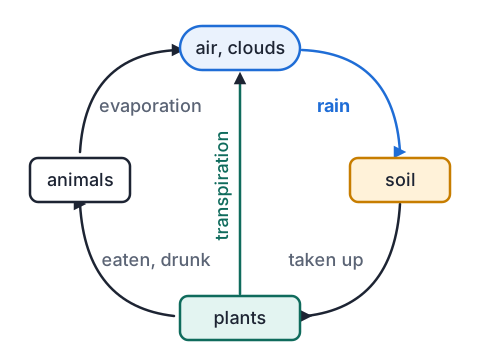
- Water falls as rain, soaks into soil, is taken up by plants, passes to animals that eat them or drink, and returns to the air by evaporation and transpiration.
- Nutrients travel the same loop: dissolved in soil water, taken up by roots, built into living things, then returned to the soil when they die and rot.
- If any part of the loop is blocked, for example by drought, the whole ecosystem feels it.
Freshwater decides who lives where
- Every living thing needs water, so how much freshwater is available limits which organisms can live in a place.
- It affects distribution: kahikatea grows in swampy ground where many other trees would drown, while mānuka copes with drier, poorer soils.
- It affects behaviour: tuna (eels) can travel short distances over wet grass at night to reach new waterways, and many animals feed at dawn and dusk to avoid drying out.
- It affects survival: in a drought, small streams dry up and fish and kōura (freshwater crayfish) trapped in shrinking pools can die.
Soil is a sponge and a pantry
- Soil is a mix of rock particles, decaying organic matter, air, water and countless living things.
- Water clings in the small spaces between soil particles, so soil holds water long after rain has stopped.
- Nutrients such as nitrogen, phosphorus and potassium are dissolved in that soil water, which is how plants get them.
- Soil rich in organic matter holds more water and nutrients, so more plants can grow, which supports more animals: the ecosystem is more productive.
- Sandy soil drains fast and dries out, while clay soil holds a lot of water but can become waterlogged.
| Soil type | Water holding | Effect on plants |
|---|---|---|
| Sandy | Low: drains quickly | Dries out; suits drought-tolerant plants |
| Clay | High: drains slowly | Can waterlog and starve roots of air |
| Loam rich in organic matter | Good, and drains well | Best for most plant growth and crops |
How plants take in and use water
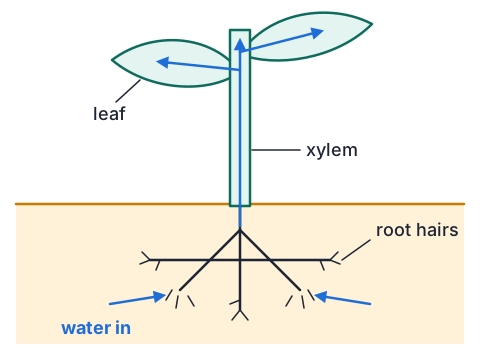
- Roots are covered in tiny root hairs that give a huge surface area for water to enter by osmosis.
- Water travels up the plant in narrow tubes called xylem, all the way to the leaves.
- In the leaves, water is a raw material for photosynthesis: carbon dioxide and water, using light energy, make glucose and oxygen.
- Water also carries dissolved nutrients around the plant, and it keeps cells firm so soft stems and leaves stand up; a plant that runs short wilts.
| Use of water | What it does |
|---|---|
| Photosynthesis | Raw material for making glucose |
| Transport | Carries dissolved minerals up the xylem |
| Support | Keeps cells firm so the plant does not wilt |
| Cooling | Evaporating from leaves cools the plant |
Transpiration: plants put water back in the air
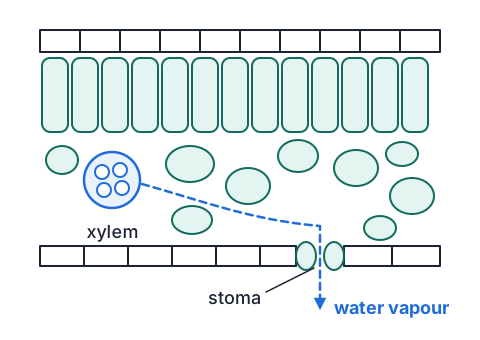
- Most of the water a plant takes up is not kept; it evaporates from inside the leaves and escapes as water vapour through tiny pores called stomata.
- This loss of water vapour from leaves is called transpiration, and it pulls more water up through the plant from the roots.
- Transpiration is faster when it is hot, sunny, dry and windy.
- A large forest releases so much water vapour that it raises the humidity of the air and can help clouds form, and much of the rain over the Amazon comes from water the forest itself transpired.
- Clearing forest can therefore make a region drier, not just lose the trees.
Measuring transpiration with plastic bags
- A student ties clear plastic bags over leafy branches of the same plant, one in the sun and one in the shade, and collects the water after 24 hours.
| Branch | Water collected (mL) |
|---|---|
| In sun | 12 |
| In shade | 5 |
- Changed: sun or shadeindependent variable
- Measured: water collected in the bagdependent variable
- Same: plant, number of leaves, bag size, timecontrolled variables
- 12 ÷ 5 = 2.4sun branch lost about 2.4 times as much water
- Warmth and light speed up transpiration
Different ecosystems, different water
- A wetland is land that is waterlogged or flooded for much of the year; plants such as raupō and harakeke have roots that cope with little air in the soil.
- A forest catches rain in its canopy and leaf litter, keeps the ground moist and shaded, and supports many layers of life from mosses to tall trees.
- A tussock grassland gets less rain or drains quickly, so plants grow in tough clumps that lose little water, and fewer trees can grow.
- Because each ecosystem has a different water supply, each has a different mix of organisms.
| Ecosystem | Water | Typical NZ organisms |
|---|---|---|
| Wetland | Waterlogged or flooded | Raupō, harakeke, kahikatea, pūkeko, tuna |
| Forest | Moist, shaded, steady | Tree ferns, rimu, mosses, kererū |
| Tussock grassland | Drier, often windy and cold | Tussock grasses, skinks, grasshoppers |
Wet versus dry: a transect along a stream
- A class lays a tape from the edge of a stream up the bank and places a square frame (quadrat) every 2 metres.
- In each quadrat they measure soil moisture and count the plant species, and they note signs from the land such as which plants are flowering, where pūkeko feed and how fast the stream is flowing, the kind of observation called ngā tohu o te taiao.
| Distance from stream (m) | Soil moisture (%) | Plant species | Main plants |
|---|---|---|---|
| 0 | 62 | 3 | Raupō, sedges |
| 2 | 48 | 6 | Harakeke, sedges, grasses |
| 4 | 30 | 8 | Grasses, mānuka seedlings |
| 6 | 18 | 5 | Grasses, gorse |
- Moisture falls steadily from 62% to 18% moving away from the streamread down the moisture column
- Plant types change from wetland plants to dry-ground plantsdifferent species suit different water
- Species peak at 4 m, where neither flooding nor drying is extrememiddle conditions suit the most species
- Prediction: in a dry summer the raupō zone would shrink towards the stream
People change ecosystems, for worse and better
- Kina barrens: where snapper and crayfish were overfished, kina had fewer predators, multiplied and grazed kelp forests down to bare rock.
- At Goat Island marine reserve near Leigh, NZ's first marine reserve, fishing stopped, the predators returned, kina numbers fell and the kelp grew back.
- Rainforests are cleared for farming and timber, and coral reefs bleach when seas warm, harming huge numbers of species.
- Predator-free sanctuaries such as Zealandia in Wellington fence out rats, stoats and possums, and native birds have recovered inside and spread beyond the fence.
| Example | Impact | Effect |
|---|---|---|
| Kina barrens | Negative | Overfishing removed kina predators, so kelp forests were lost |
| Marine reserves | Positive | Predators return and kelp forests regrow |
| Rainforest clearing | Negative | Habitat loss and a drier local climate |
| Predator-free sanctuaries | Positive | Native birds and insects recover |
Common mistakes
- Plants keep most of the water their roots take in and use it for photosynthesis.Most of it is lost as water vapour through the stomata by transpiration; only a small fraction is used in photosynthesis.
- Transpiration is the plant sweating out water through its roots.Transpiration is water evaporating from inside the leaves and escaping through the stomata, which pulls more water up the xylem from the roots.
- Clay soil is the best soil because it holds the most water.Clay can become waterlogged and starve roots of air, so loam rich in organic matter, which holds water and still drains, suits most plants best.
- Water and nutrients flow through an ecosystem and are lost, the same as energy.Energy is eventually lost as heat, but water and nutrients are recycled again and again between living things and their surroundings.
Which soil holds the most water?
You need: 3 same-size plant pots with drainage holes, paper towels, a cup each of sand, garden soil and potting mix or compost, 3 glasses or jars, a measuring jug, water
- Put a square of paper towel in the bottom of each pot so the soil does not fall out, then fill each pot with one cup of a different soil. If any sample is bone dry, mix in a little water first so all three start just damp.
- Stand each pot on top of a glass or jar so water can drain into it.
- Slowly pour 250 mL of water evenly over each pot.
- After 10 minutes, pour the water from each glass into the measuring jug and record it.
- Work out the water each soil held: 250 mL minus the water that drained through.
- Look for the sand letting most of the water through and the soil richest in organic matter holding the most: that stored water is what plant roots draw on long after rain has stopped.
Safety: Potting mix and compost can carry Legionella bacteria, which causes a serious lung infection in NZ every year, so open bags away from your face, keep the mix damp so it does not make dust, wear gloves and wash your hands afterwards.
Your turn
- 1. Give three ways a plant uses the water its roots take up.
- 2. Why does a plant on a hot, windy day need more water from the soil?
- 3. Why can soil rich in organic matter support more life than sandy soil?
- 4. In the stream transect, which reading would you expect to change most after two weeks of heavy rain, and why?
- 5. Explain how overfishing of snapper can lead to the loss of a kelp forest.
Show answer
1. Any three: photosynthesis, carrying dissolved minerals, keeping cells firm for support, cooling the leaves. 2. Transpiration is faster when it is hot and windy, so it loses more water from its leaves and must replace it through its roots. 3. Organic matter holds more water and nutrients, so more plants grow, which feeds more animals; sandy soil drains and dries quickly. 4. Soil moisture, especially further from the stream, because rain soaks the drier soil; the plant species take much longer to change. 5. Snapper eat kina; with fewer snapper, kina numbers rise and they graze the kelp until only bare rock is left.
What to take away
- Water and nutrients cycle continuously between organisms and their surroundings.
- How much freshwater there is affects where organisms live, how they behave and whether they survive.
- Soil stores water and dissolved nutrients, which makes ecosystems more productive.
- Plants take water in through root hairs and use it for photosynthesis, transport and support, then release it by transpiration through stomata.
- Transpiration raises humidity and can feed rain, so forests help make their own weather.
- Wetlands, forests and grasslands have different water supplies and so different organisms, and human choices can damage or restore them.
How is Year 10 maths going?
See the Year 10 maths guide