The nervous system: brain, spinal cord and nerves
What this lesson covers
- The central nervous system: the brain and the spinal cord
- The cerebrum, cerebellum and brainstem, and the job of each
- The peripheral nervous system of nerves running through the body
- The difference between voluntary actions and automatic responses
- How receptors detect stimuli
- Planning a safe, fair reaction time experiment
Why you need a nervous system
- Your body has to notice changes around it and inside it, then respond in time, often in a fraction of a second.
- The nervous system does this by sending electrical signals along nerve cells, called neurons.
- The fastest neurons carry signals at up to about 100 metres per second, so a message from your toe reaches your spinal cord in about one hundredth of a second.
Central and peripheral
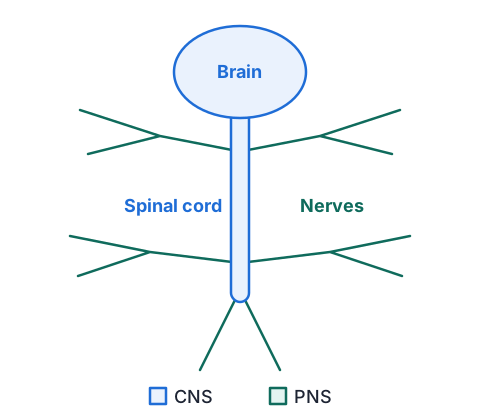
- The central nervous system (CNS) is made of the brain and the spinal cord. It takes in information, decides what it means and sends out instructions.
- The brain is protected by the skull, and the spinal cord runs down inside the backbone, protected by the vertebrae.
- The peripheral nervous system is every nerve outside the brain and spinal cord, branching out to your skin, muscles and organs.
- A nerve is a bundle of many neurons wrapped together, like a cable holding many wires.
| Part | Made of | Main job |
|---|---|---|
| Central nervous system | Brain and spinal cord | Receives information, processes it, sends instructions |
| Peripheral nervous system | Nerves throughout the body | Carries signals between the CNS and the rest of the body |
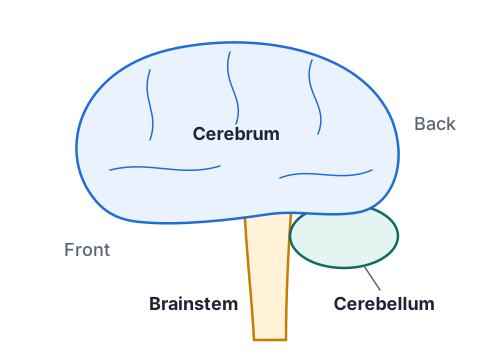
The brain and its three main regions
- The human brain contains about 86 billion neurons, each linked to thousands of others, which lets it take in, sort and send huge amounts of information.
- The cerebrum is the large, wrinkled top part. It handles conscious thinking, memory, language, the senses and the movements you choose to make.
- The cerebellum sits at the back, under the cerebrum. It coordinates your muscles so movement is smooth, and keeps you balanced.
- The brainstem joins the brain to the spinal cord. It runs life-support functions you never think about, such as breathing, heart rate and swallowing.
| Region | Where it is | Controls | Example |
|---|---|---|---|
| Cerebrum | Top, largest part | Thought, memory, senses, chosen movement | Solving a maths problem, deciding to wave |
| Cerebellum | Back, below the cerebrum | Coordination and balance | Riding a bike, walking along a beam |
| Brainstem | Base, joining the spinal cord | Automatic body functions | Breathing while asleep, heartbeat |
Which region is it?
- A rugby player is tackled and hits his head. Doctors check what he can still do to judge where the injury is.
- Match each problem to the brain region most likely affected.
- He cannot remember the score of the gamememory and thought: cerebrum
- He staggers and cannot walk in a straight linebalance and coordination: cerebellum
- His breathing becomes irregularautomatic function: brainstem, the most dangerous sign
- Memory: cerebrum. Balance: cerebellum. Breathing: brainstem
Voluntary or automatic
- A voluntary action is one you decide to do, such as kicking a ball or writing your name, and it starts in the cerebrum.
- An automatic response happens without you choosing it, such as your heartbeat, breathing while you sleep or blinking when something flies at your eye.
- A reflex is a fast automatic response that protects you, such as pulling your hand off a hot pan before you even feel the pain.
- Some actions can be both: you breathe automatically, but you can also choose to hold your breath for a while.
| Action | Voluntary or automatic | Reason |
|---|---|---|
| Catching a ball | Voluntary | You choose to reach for it |
| Heartbeat | Automatic | Controlled without thought by the brainstem |
| Knee jerk when tapped | Automatic (reflex) | Happens before you can decide |
| Pupils shrinking in bright light | Automatic (reflex) | Protects the eye without thought |
Receptors detect stimuli
- A stimulus is any change that the body can detect, inside or outside it, such as a flash of light, a loud noise or a drop in temperature.
- A receptor is a cell or group of cells that detects a particular kind of stimulus and starts a nerve signal.
- Your sense organs are packed with receptors, and each kind of receptor responds best to one kind of stimulus.
- There are also receptors inside you, for example ones that sense stretch in your muscles and others that sense the level of carbon dioxide in your blood.
| Sense organ | Receptors detect | Stimulus example |
|---|---|---|
| Eye | Light | A traffic light turning red |
| Ear | Sound, and head position for balance | Someone calling your name |
| Skin | Touch, pressure, pain, heat and cold | A mosquito landing on your arm |
| Nose | Chemicals in the air | The smell of a hāngī |
| Tongue | Chemicals in food | Sour taste of a lemon |
Testing reaction time: the ruler drop
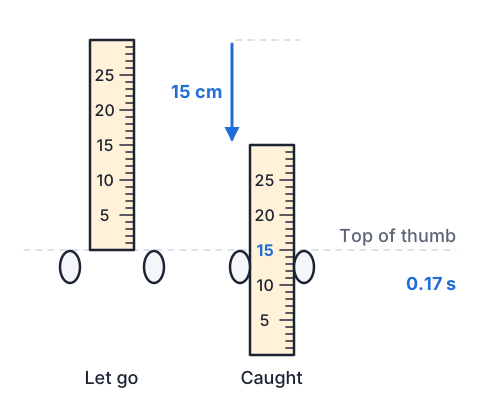
- A partner holds a 30 cm ruler vertically with the zero mark level with the top of your thumb. You hold your thumb and finger open around it without touching.
- Without warning they let go, and you catch it as fast as you can. Read the distance it fell at the top of your thumb.
- A shorter drop means a faster reaction, and the distance can be turned into a time using the table below.
- To test a question such as whether your dominant hand reacts faster, change only the hand, measure the drop distance, and keep everything else the same.
- Make it ethical and safe: everyone agrees to take part, nobody is pressured or teased about results, and a light ruler is used so a missed catch cannot hurt.
| Drop distance (cm) | Reaction time (s) |
|---|---|
| 5 | 0.10 |
| 10 | 0.14 |
| 15 | 0.17 |
| 20 | 0.20 |
| 25 | 0.23 |
Planning the dominant-hand test
- Aroha wants to know whether her right hand (her writing hand) reacts faster than her left.
- Lay out her variables and decide what result would answer the question.
- Change: which hand catchesindependent variable
- Measure: drop distance in cm, converted to secondsdependent variable
- Keep the same: ruler, dropper, starting gap, sitting position, time of daycontrolled variables
- Five catches with each hand, alternating handsrepeats reduce chance effects; alternating stops one hand getting all the practice
- Right hand average 0.17 s, left hand 0.20 sexample result
- A consistently smaller right-hand time supports the idea that the dominant hand is faster
Common mistakes
- The brainstem controls balance.The cerebellum coordinates movement and balance; the brainstem runs automatic functions such as breathing and heart rate.
- The spinal cord is part of the peripheral nervous system, because it runs down the back.The spinal cord is part of the central nervous system with the brain; the peripheral nervous system is the nerves outside them.
- A nerve is one long nerve cell.A nerve is a bundle of many neurons wrapped together, like a cable holding many wires.
- In the ruler drop, the stimulus is the eye.The stimulus is the change, the ruler starting to fall; the eye is the sense organ whose receptors detect it.
Map your touch receptors
You need: a paper clip, a ruler, a partner, pen and paper
- Bend a paper clip into a U shape with its two ends side by side, and use the ruler to set the gap between the ends to 1 cm.
- Your partner closes their eyes. Touch their skin lightly, sometimes with both ends at once and sometimes with only one, and ask them to say one or two each time.
- Test the fingertip, the palm, the back of the hand and the forearm, with about five touches on each.
- On each place, make the gap smaller or bigger until you find the smallest gap that still feels like two points, and write it down.
- Look for: the fingertip can tell two points apart when they are only a few millimetres apart, while on the forearm two points 3 cm apart can still feel like one, because the fingertips have far more touch receptors packed into each square centimetre.
Safety: The ends of a paper clip can scratch, so touch lightly, stay on the hand and arm, and keep it well away from the face and eyes.
Your turn
- 1. Name the two parts of the central nervous system.
- 2. A gymnast keeps her balance on a narrow beam. Which brain region is mainly responsible?
- 3. Sort into voluntary or automatic: sneezing, texting a friend, your stomach churning food, choosing a lunch.
- 4. Name the stimulus and the sense organ that detects it when you hear a fire alarm.
- 5. In the ruler drop test, why should the dropper not count down before letting go?
Show answer
1. The brain and the spinal cord. 2. The cerebellum, which coordinates movement and balance. 3. Automatic: sneezing, stomach churning food. Voluntary: texting a friend, choosing a lunch. 4. The stimulus is sound; the ear detects it. 5. A countdown lets the catcher predict the moment, so you measure guessing rather than reaction; the drop must come without warning to measure the true reaction time.
What to take away
- The central nervous system is the brain and spinal cord; the peripheral nervous system is the nerves everywhere else.
- The cerebrum handles thought and chosen movement, the cerebellum coordination and balance, and the brainstem automatic functions like breathing.
- Some actions are voluntary and some, including reflexes and the heartbeat, are automatic.
- Receptors detect stimuli, which are changes inside or outside the body.
- A fair reaction time test changes one thing, measures one thing, keeps the rest the same, repeats, and is safe and willingly done.
How is Year 10 maths going?
See the Year 10 maths guide