How genes and environment shape traits and variation
What this lesson covers
- How a protein such as keratin produces a visible trait
- Traits controlled by one gene compared with traits controlled by many genes
- Switching genes on and off, and why different cells make different proteins
- How the environment changes traits, from human height to tuatara sex
- What variation in a population is, and how its causes show up in discrete and continuous data
- How our understanding of DNA was built and argued over by many scientists
From chromosome to trait
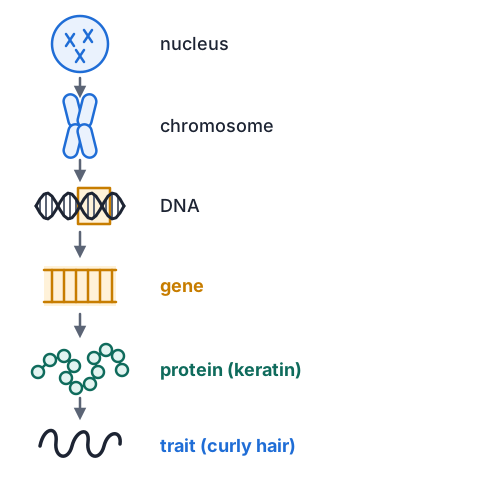
- Part 1 followed the chain from the nucleus down: chromosomes are coiled DNA, and a gene is a section of that DNA coding for a protein.
- This part follows the chain the other way, from the protein up to the trait you can see.
- Drawing the chain as one labelled diagram is the quickest way to get the order right in an exam.
| Label on your diagram | What to write beside it |
|---|---|
| Nucleus | Holds the chromosomes |
| Chromosome | One DNA molecule coiled around proteins; 46 in most human cells |
| DNA | Double helix; base order is the code |
| Gene | One section of the DNA, coding for one protein |
| Protein | Built from the gene's code; does a job in the cell |
| Trait | The result you can observe, such as hair texture |
Proteins make the trait
- Genes do not act on the body directly. Each one acts through the protein it codes for.
- Keratin is a tough structural protein that makes up hair, nails, the outer layer of skin, and the feathers and beaks of birds.
- Small differences in keratin genes, and in genes for the proteins around it, help decide whether hair grows straight or curly.
- Eye colour depends on how much of the brown pigment melanin the iris makes, and making melanin needs enzymes, which are proteins.
- So a different version of a gene gives a slightly different protein, or a different amount of it, and that gives a different trait.
One gene or many genes
- A few traits are controlled mainly by a single gene, and these usually fall into clear categories.
- The ABO blood group is set by one gene, so everyone is A, B, AB or O with nothing in between.
- Most traits are controlled by many genes, each adding a small effect, which is why they vary smoothly.
- Human height is influenced by hundreds of genes, and skin colour and eye colour each involve several.
| Single-gene trait | Many-gene trait | |
|---|---|---|
| Examples | ABO blood group, pea flower colour in Mendel's peas | Height, skin colour, milk yield in cows |
| Kind of data | Usually discrete | Usually continuous |
| Graph shape | A few separate bars | A smooth hump, most people near the middle |
Genes can be switched on and off
- Almost every cell in your body carries the same full set of genes.
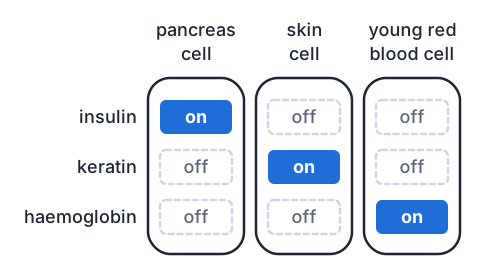
- When a gene is switched on, the cell reads it and makes its protein. When it is switched off, that protein is not made.
- The insulin gene is switched on only in certain cells of the pancreas, which is why insulin is made there and not in your skin.
- Keratin genes are switched on in skin and hair cells, while haemoglobin genes are switched on in cells that become red blood cells.
- Switching can also change over a lifetime: babies make lactase to digest milk sugar, and in many adults that gene is turned down so less lactase is made.
The environment changes traits too
- Genes set a range of possible outcomes, and the environment decides where in that range an organism ends up.
- Children with the genes to be tall will not reach that height if they are poorly fed, which is why average heights rose in many countries as diets improved.
- In tuatara there is no sex chromosome deciding male or female. The temperature of the nest does: warmer nests tend to hatch males and cooler nests tend to hatch females.
- That is why a warming climate worries tuatara keepers, because it could tip whole populations towards males.
- Farmers see the same thing: a lamb bred for fast growth only grows fast with good pasture.
| Organism | Trait | Environmental factor |
|---|---|---|
| Human | Height | Nutrition during childhood |
| Tuatara | Male or female | Temperature of the nest during incubation |
| Hydrangea | Flower colour | Acidity of the soil |
| Sheep | Growth rate and wool | Quality of pasture |
Variation in a population
- Variation means the differences in a trait between individuals of the same species.
- It has two sources: different versions of genes inherited from parents, and different environments.
- Variation matters because it gives a population a better chance that some individuals survive a change, such as a new disease or a hotter climate.
- The kākāpō population is small and descends from very few birds, so it has little genetic variation, which is one reason infertility and disease are serious risks for it.
Reading variation from two data sets
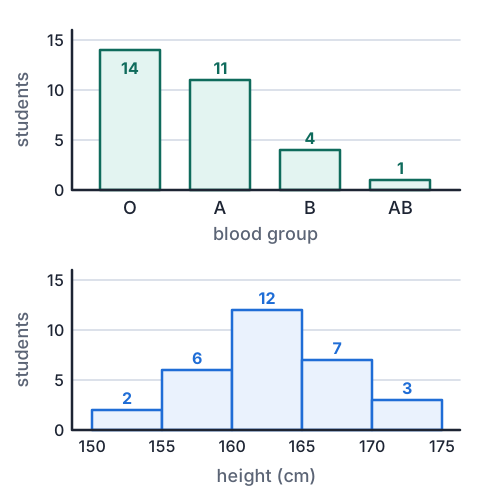
- A class of 30 records blood group and height.
- Use the shape of each data set to decide what is causing the variation.
| Blood group | Students | Height range (cm) | Students |
|---|---|---|---|
| O | 14 | 150 to 154 | 2 |
| A | 11 | 155 to 159 | 6 |
| B | 4 | 160 to 164 | 12 |
| AB | 1 | 165 to 169 | 7 |
| 170 to 174 | 3 |
What the two shapes tell you
- Compare the two columns of data from the class survey above.
- Blood group: 4 fixed categories, nobody in betweendiscrete data
- Totals 14 + 11 + 4 + 1 = 30every student fits one group
- Height: values spread across a range, most near 160 to 164continuous data, a hump shape
- Totals 2 + 6 + 12 + 7 + 3 = 30every student fits one range
- Blood group: one gene, no environmental effectexplains clean categories
- Height: many genes plus nutrition, so continuous variation
How DNA's story was built
- In 1869 Friedrich Miescher found a new substance in cell nuclei, but nobody knew what it did.
- For decades most scientists argued that proteins, not DNA, carried inherited information, because proteins seemed more varied.
- In 1944 Oswald Avery's team showed that DNA alone could pass a trait from one type of bacterium to another, and in 1952 virus experiments by Alfred Hershey and Martha Chase agreed.
- Erwin Chargaff found that the amount of A always matched T and C matched G, and Franklin's X-ray images showed a helix; Watson and Crick fitted these pieces into one model in 1953.
- Credit has been argued over ever since, especially Franklin's, which shows that science is built by many people, tested by evidence and sometimes contested.
| Year | Step | Kind of step |
|---|---|---|
| 1869 | Miescher finds DNA in nuclei | Exploration |
| 1944 | Avery shows DNA carries traits | Discovery that challenged the protein idea |
| 1950 to 1952 | Chargaff's base rules; Franklin's X-ray images | Evidence gathered |
| 1953 | Watson and Crick's double helix | Evidence brought together |
| 1953 to today | Debate over Franklin's credit | Contestation |
Common mistakes
- Each trait, like height or eye colour, is controlled by one gene.Most traits are controlled by many genes adding small effects, which is why height varies smoothly; only a few, such as ABO blood group, depend mainly on one gene.
- Skin cells make keratin because they have the keratin gene and other cells do not.Almost every cell has the same genes; skin cells make keratin because that gene is switched on in them and off in most other cells.
- Two cloned sheep have the same genes, so they must look exactly the same.Genes set a range, and differences in food, health and surroundings can still give the clones different traits such as body mass.
- A sheep that grew big on good pasture will pass its size on to its lambs.Changes caused by the environment are not written into the DNA in sperm and eggs, so the lambs inherit only the parent's genes.
Same seeds, light and dark
You need: 20 dried whole mung beans or whole brown lentils from the same packet, 2 clear cups or jars, paper towels, water, a ruler
- Line each cup with a folded paper towel, wet it until damp, and slide 10 seeds between the towel and the side of the cup so you can see them.
- Put one cup on a sunny windowsill and the other in a dark cupboard in the same room, so the temperature is similar.
- Keep both towels damp with a little water each day for a week.
- On day 7, measure the shoot of each seedling with the ruler and note its colour.
- Look for long, thin, pale yellow shoots in the dark and shorter, sturdier green shoots in the light: the seeds came from the same packet, so the difference is caused by the environment, with light switching on the genes for making chlorophyll.
Safety: Damp seeds can grow mould and bacteria, so do not eat the sprouts, throw out any mouldy cup, and wash your hands after handling them.
Your turn
- 1. Explain how a gene leads to hair being strong, using the word keratin.
- 2. Every cell in your body has the insulin gene. Why do only some cells make insulin?
- 3. A tuatara egg is incubated at a high temperature. Which sex is it most likely to hatch as, and is that caused by genes or environment?
- 4. Two cloned sheep have identical genes but different body mass. Suggest a reason.
- 5. Why did many scientists before 1944 think proteins, not DNA, carried inherited information?
Show answer
1. The gene holds the code for keratin; the cell reads it and builds keratin, a tough protein that forms hair, so the protein produces the trait. 2. The gene is switched on only in certain pancreas cells; in other cells it is switched off, so no insulin is made there. 3. Male, because warmer nests tend to produce males; it is the environment (temperature), not a sex chromosome. 4. A difference in environment, such as one had better pasture or more food, or one was sick. 5. Proteins come in many more forms than DNA's four bases suggested, so proteins seemed better able to carry complex information until experiments showed otherwise.
Natural Selection
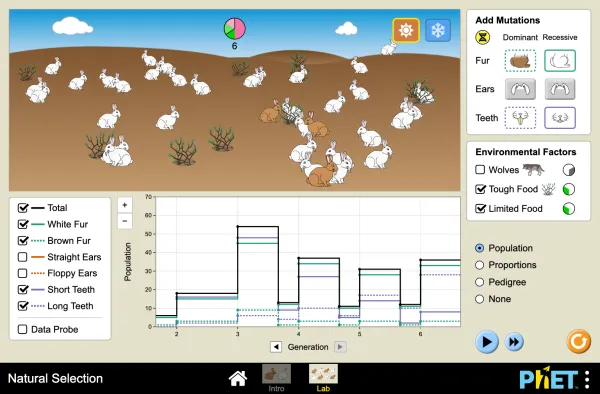
Full screen · PhET Interactive Simulations, University of Colorado Boulder, CC BY 4.0
What to take away
- A gene works through its protein, and the protein produces the trait, such as keratin in hair and feathers.
- A few traits depend on one gene; most depend on many.
- A gene that is switched on has its protein made; switched off, the protein is not made.
- The environment shapes traits too, from height and nutrition to tuatara sex and nest temperature.
- Variation comes from genes and environment: single-gene traits usually give discrete data and many-gene traits usually give continuous data.
- Our model of DNA grew from many scientists' evidence and arguments over almost a century.
How is Year 10 maths going?
See the Year 10 maths guide