Pressure in liquids and gases, depth and hydraulics
What this lesson covers
- Pressure is force spread over an area, P = F/A, measured in pascals.
- Fluids push on surfaces and within themselves, and the air above us causes atmospheric pressure.
- In a liquid or gas, pressure pushes equally in all directions.
- Pressure in a liquid gets bigger the deeper you go.
- Hydraulic systems pass pressure through a trapped liquid to multiply a force, giving mechanical advantage.
Pressure is force on each square metre
- Pressure tells you how concentrated a force is: P = F ÷ A.
- Force is in newtons (N), area in square metres (m²), and pressure in pascals (Pa), where 1 Pa = 1 N/m².
- The same force on a small area gives a big pressure, which is why a sharp knife cuts and a drawing pin goes into a board.
- The same force on a large area gives a small pressure, which is why snowshoes and wide tractor tyres do not sink in.
- Pressures are often large numbers, so kilopascals are common: 1 kPa = 1000 Pa.
| Quantity | Symbol | Unit |
|---|---|---|
| Pressure | P | pascal (Pa) = N/m² |
| Force | F | newton (N) |
| Area | A | square metre (m²) |
Example: boots or snowshoes?
- A tramper weighs 600 N.
- Standing in boots, the area touching the snow is 0.04 m². In snowshoes it is 0.2 m².
- Compare the pressure on the snow.
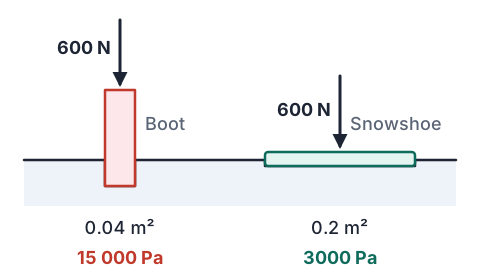
- boots: P = 600 ÷ 0.04 = 15 000 PaP = F ÷ A
- snowshoes: P = 600 ÷ 0.2 = 3000 Pasame force, 5 times the area
- 15 000 ÷ 3000 = 5compare the two
- snowshoes give one fifth of the pressure, so the tramper sinks far less
Fluids press on everything they touch
- Liquids and gases are both fluids: their particles move around and keep colliding with each other and with any surface.
- Each collision is a tiny push, and billions of them together make a steady pressure on the surface and inside the fluid itself.
- The air above you has weight, and that weight pressing down causes atmospheric pressure.
- At sea level it is about 101 kPa, so roughly 101 000 N pushes on every square metre of your body.
- You do not get crushed because the fluids inside your body push outwards just as hard.
- Higher up there is less air above you, so the pressure is lower: near the top of Aoraki it is only about 64 kPa.
Pressure in a fluid pushes in every direction
- At any point in a liquid or gas, the pressure pushes equally up, down and sideways.
- Water in a glass pushes down on the bottom and also outwards on the sides.
- Poke holes around a plastic bottle full of water at the same height, and water squirts out sideways from every hole with the same strength.
- A balloon taken underwater gets squashed evenly from all sides, not just from above.
- Air pressure works the same way, which is why a sealed empty drink bottle carried down from a mountain gets crushed from every side.
Pressure rises with depth
- The deeper you go in a liquid, the more liquid there is above you pressing down, so the pressure is greater.
- The extra pressure from a liquid is density × g × depth, or P = ρgh, with density in kg/m³, g = 9.8 N/kg and depth in metres.
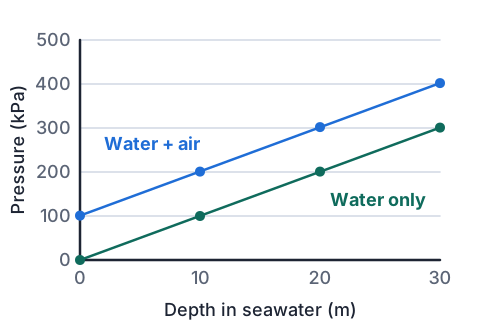
- Seawater has a density of about 1025 kg/m³, so every 10 m of depth adds about 100 kPa, roughly one extra atmosphere.
- A diver at the Poor Knights Islands feels this as pressure on the ears, which must be equalised on the way down.
- Dams such as the Clyde Dam are much thicker at the base because the water pushes hardest at the bottom.
| Depth in seawater | Pressure from water | Total pressure (water + air) |
|---|---|---|
| 0 m (surface) | 0 kPa | about 101 kPa |
| 10 m | about 100 kPa | about 201 kPa |
| 20 m | about 201 kPa | about 302 kPa |
| 30 m | about 301 kPa | about 402 kPa |
Example: pressure on a diver at 18 m
- A diver is 18 m down in seawater (density 1025 kg/m³). Use g = 9.8 N/kg and atmospheric pressure 101 kPa.
- Find the pressure from the water, and the total pressure on the diver.
- P = ρgh = 1025 × 9.8 × 18pressure from the water above
- P = 180 810 Pa ≈ 181 kPadivide by 1000 for kPa
- total = 181 + 101 = 282 kPathe air presses on the sea surface too
- about 282 kPa, nearly three times the pressure at the surface
Hydraulics: passing pressure through a liquid
- Liquids hardly squash at all, so a push on a trapped liquid raises the pressure everywhere in it by the same amount.
- A hydraulic system has a small piston and a large piston joined by a pipe full of oil.
- Pushing the small piston creates a pressure, and that same pressure acts on the large piston.
- Because the large piston has more area, the force on it is bigger: F = P × A.
- In a car's brakes, your foot pushes a small piston in the master cylinder, brake fluid carries the pressure to every wheel, and larger pistons there clamp the brake pads onto the discs.
- Car hoists, diggers and log loaders at a port use the same idea.
Mechanical advantage
- Mechanical advantage compares the force a machine gives out with the force you put in.
- Mechanical advantage = output force ÷ input force, and it has no units.
- A mechanical advantage of 50 means your push is multiplied 50 times.
- There is a catch: the small piston has to move much further than the large one, so you do not get extra energy for free.
| Small piston | Large piston | |
|---|---|---|
| Area | Small | Large |
| Pressure | Same | Same |
| Force | Small (input) | Large (output) |
| Distance moved | Long | Short |
Example: a hydraulic jack
- A jack has a small piston of area 0.002 m² and a large piston of area 0.1 m².
- A mechanic pushes the small piston with 50 N.
- Find the output force and the mechanical advantage.
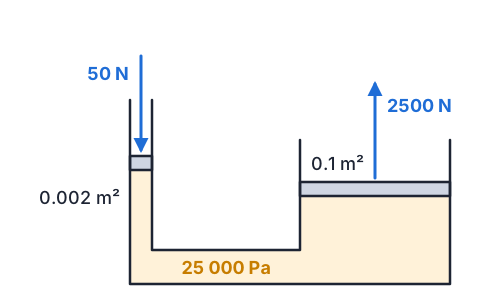
- P = 50 ÷ 0.002 = 25 000 Papressure made by the small piston
- F = 25 000 × 0.1 = 2500 Nsame pressure on the large piston
- MA = 2500 ÷ 50 = 50output ÷ input
- output 2500 N, mechanical advantage 50
- area ratio 0.1 ÷ 0.002 = 50the area ratio gives the same answer
Example: predicting how brakes change motion
- A 1500 kg car is travelling at 20 m/s. The hydraulic brakes produce a total backward friction force of 6000 N.
- Use Newton's laws to predict what happens.
- net force = 6000 N backwardsunbalanced, so the motion must change
- a = F ÷ m = 6000 ÷ 1500 = 4 m/s²Newton's second law
- time to stop = 20 ÷ 4 = 5 sloses 4 m/s each second
- the car slows by 4 m/s every second and stops in 5 s
- passengers lurch forwardinertia: their bodies keep moving until the seatbelts pull them back
Testing pressure and depth, and judging the method
- Change: the depth of a pressure sensor in a tall tube of water, in steps of 10 cm.
- Measure: the pressure reading at each depth, three times, taking the mean.
- Keep the same: the liquid, its temperature, the sensor and the way depth is measured (to the centre of the sensor).
- If the pressure goes up by the same amount for each extra 10 cm, that shows pressure rises steadily with depth.
- Accuracy is how close a result is to the true value; reliability is whether you get the same result when you repeat it.
- A cheaper version punches holes in a bottle at different heights and measures how far each jet reaches, but the water level drops as it drains, which makes it less accurate.
| Problem | Affects | Improvement |
|---|---|---|
| Reading a ruler at an angle | Accuracy | Read at eye level, or fix the ruler to the tube |
| Only one reading per depth | Reliability | Repeat three times and average |
| Water level falls as a bottle drains | Accuracy | Keep topping up so the level stays at the mark |
| Sensor reads only to the nearest kPa | Accuracy | Use a sensor with finer readings, or bigger depth steps |
Common mistakes
- P = 600 ÷ 400 cm² = 1.5 Pa.Area must be in m² for pascals, and 1 cm² is 0.0001 m², so 400 cm² is 0.04 m² and P = 15 000 Pa.
- Pressure in water only pushes down.At any point in a fluid the pressure pushes equally in all directions, which is why water squirts sideways out of a hole in a bottle.
- The water pressure on a dam is bigger when the lake behind it stretches back further, even at the same depth.Liquid pressure depends only on depth and density (P = ρgh), so how far the lake stretches back makes no difference.
- A hydraulic jack gives you more energy than you put in.It multiplies force, but the small piston has to move much further than the large one, so no extra energy is made.
Three jets from one bottle
You need: an empty 1.5 L plastic drink bottle, scissors, sticky tape, water
- With an adult, make three small holes in a line up one side of the bottle, near the bottom, in the middle and near the top, by twisting the point of the scissors into the plastic.
- Cover all three holes with one strip of sticky tape, take the cap off and fill the bottle to the top.
- Stand the bottle at the edge of the sink, or outside on a step, with the holes facing out over the drop.
- Pull the tape off quickly and see how far out each jet reaches, topping the bottle up so the water level stays near the top.
- Look for: the bottom jet shoots out hardest and furthest and the top one only dribbles out, because the deepest water has the most water above it pressing down, so its pressure is greatest.
Safety: The scissor point can slip off the curved plastic and stab a hand, so an adult makes the holes, pushing away from the hand holding the bottle.
Your turn
- 1. A box weighing 240 N rests on a face of area 0.6 m². What pressure does it put on the floor?
- 2. Find the pressure from the water 5 m down in Lake Taupō. Fresh water has density 1000 kg/m³; use g = 9.8 N/kg.
- 3. Explain why a dam wall is built thicker at the bottom than at the top.
- 4. A hydraulic lift has a small piston of 0.0005 m² and a large piston of 0.05 m². A 40 N push is applied to the small piston. Find the output force and the mechanical advantage.
- 5. A student measures each jet from a holed bottle once, with a ruler held by hand. Suggest two improvements, and say whether each improves accuracy or reliability.
Show answer
1. P = 240 ÷ 0.6 = 400 Pa. 2. P = 1000 × 9.8 × 5 = 49 000 Pa = 49 kPa from the water (about 150 kPa in total with the air above). 3. Pressure in a liquid increases with depth, so the water pushes hardest on the bottom of the wall, which needs to be strongest there. 4. Pressure = 40 ÷ 0.0005 = 80 000 Pa; output force = 80 000 × 0.05 = 4000 N; mechanical advantage = 4000 ÷ 40 = 100. 5. For example: repeat each measurement three times and average (reliability); clamp the ruler in place and keep the water topped up to the same level (accuracy).
Under Pressure
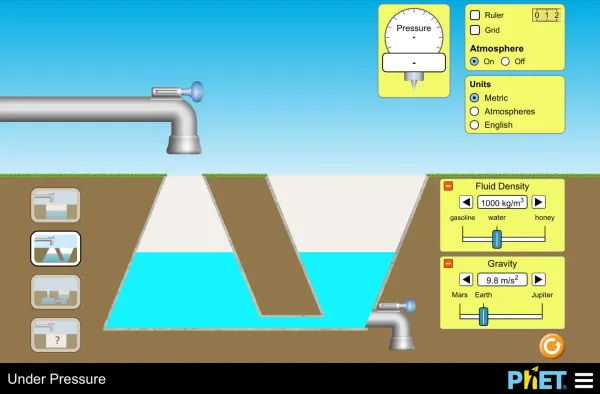
Full screen · PhET Interactive Simulations, University of Colorado Boulder, CC BY 4.0
Recap
- Pressure is force per unit area, P = F ÷ A, in pascals.
- Fluids push on every surface and in every direction, and the weight of the air gives about 101 kPa at sea level.
- Liquid pressure grows with depth: P = ρgh, about 100 kPa extra for every 10 m of seawater.
- Hydraulics pass the same pressure to a bigger piston, multiplying the force.
- Mechanical advantage = output force ÷ input force, paid for by moving the input further.
| Idea | Formula or fact |
|---|---|
| Pressure | P = F ÷ A (Pa = N/m²) |
| Atmospheric pressure | about 101 kPa at sea level |
| Liquid pressure | P = ρgh, g = 9.8 N/kg |
| Hydraulics | same pressure, F = P × A on each piston |
| Mechanical advantage | output force ÷ input force |
How is Year 10 maths going?
See the Year 10 maths guide