Forces and acceleration: F = ma, inertia and force pairs
What this lesson covers
- Acceleration measures how quickly velocity changes, including a change of direction.
- A bigger net force gives a bigger acceleration; a bigger mass gives a smaller one.
- Force, mass and acceleration are linked by F = ma.
- Inertia is an object's resistance to a change in its motion, and it grows with mass.
- Forces come in action and reaction pairs: equal in size, opposite in direction, acting on two different objects.
Acceleration is a change in velocity
- Velocity is speed in a particular direction, so it changes if you speed up, slow down or turn.
- Acceleration tells you how much the velocity changes each second.
- To calculate it, divide the change in velocity by the time taken: a = change in velocity ÷ time.
- Velocity is in metres per second (m/s) and time is in seconds, so acceleration is in metres per second per second (m/s²).
- A car going round a roundabout at a steady 30 km/h is still accelerating, because its direction keeps changing.
| What happens | Is velocity changing? | Accelerating? |
|---|---|---|
| Bus pulls away from a stop | Speed goes up | Yes |
| Cyclist brakes at a red light | Speed goes down | Yes (slowing down is acceleration too) |
| Car takes a corner at a steady speed | Direction changes | Yes |
| Ferry cruises in a straight line at a steady speed | No change | No |
Example: how quickly a car speeds up
- A car starts from rest and reaches 27 m/s (about 97 km/h) in 9 seconds.
- Find its average acceleration.
- change in velocity = 27 − 0 = 27 m/sit started at rest
- a = 27 ÷ 9change in velocity ÷ time
- a = 3 m/s²it gains 3 m/s every second
Net force and mass decide the acceleration
- Most objects have several forces on them at once, such as a push, friction and weight.
- The net force is what is left over when you combine them, taking direction into account.
- If the forces are balanced, the net force is zero and the velocity stays the same.
- If the mass stays the same, doubling the net force doubles the acceleration.
- If the net force stays the same, doubling the mass halves the acceleration, which is why an empty trolley is easier to get moving than a full one.
| Change | Kept the same | Effect on acceleration |
|---|---|---|
| Bigger net force | Mass | Bigger acceleration |
| Smaller net force | Mass | Smaller acceleration |
| Bigger mass | Net force | Smaller acceleration |
| Smaller mass | Net force | Bigger acceleration |
The equation F = ma
- Net force equals mass times acceleration: F = ma.
- Force is measured in newtons (N), mass in kilograms (kg) and acceleration in m/s².
- One newton is the net force that makes a 1 kg mass accelerate at 1 m/s².
- Rearrange it to find the other quantities: a = F ÷ m and m = F ÷ a.
- Always use the net force, not just one of the forces acting.
| To find | Use | Units |
|---|---|---|
| Net force | F = m × a | N |
| Acceleration | a = F ÷ m | m/s² |
| Mass | m = F ÷ a | kg |
Example: pushing a loaded trolley
- A student pushes a 40 kg trolley forward with a force of 100 N.
- Friction acts backwards on the trolley with a force of 20 N.
- Find the trolley's acceleration.
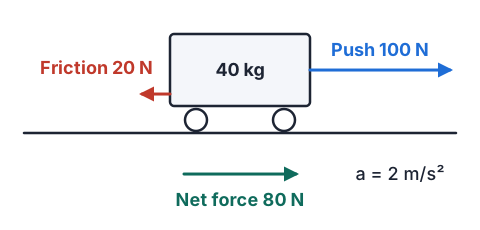
- net force = 100 − 20 = 80 N forwardthe forces act in opposite directions
- a = F ÷ m = 80 ÷ 40rearranged F = ma
- a = 2 m/s² forward
- check: 40 × 2 = 80 Nm × a gives back the net force
Inertia: objects resist changes in motion
- An object keeps doing what it is already doing (staying still, or moving at a steady velocity) unless a net force acts on it.
- This tendency to resist a change in motion is called inertia.
- The more mass an object has, the more inertia it has, so it takes a bigger force to start it, stop it or turn it.
- A 120 kg prop running at full speed is much harder to stop than a 70 kg halfback at the same speed.
- When a car stops suddenly, your body keeps moving forward; the seatbelt supplies the force that slows you down with the car.
Forces come in action and reaction pairs
- A force is always an interaction between two objects, so forces never appear on their own.
- If object A pushes or pulls on object B, then B pushes or pulls back on A at the same moment.
- The two forces are the same size and point in opposite directions.
- They act on different objects, so they never cancel each other out.
- That is why a swimmer can push off a wall: the swimmer pushes the wall, and the wall pushes the swimmer away.
| Action | Reaction | Acts on |
|---|---|---|
| Swimmer's feet push back on the pool wall | Wall pushes the swimmer forward | Wall, then swimmer |
| Rocket pushes hot gas downwards | Gas pushes the rocket upwards | Gas, then rocket |
| Your foot pushes back on the ground as you walk | Ground pushes you forward | Ground, then you |
| Earth pulls you down (your weight) | You pull Earth up by the same amount | You, then Earth |
Example: who gets thrown back more in a tackle?
- A 110 kg forward runs into a 75 kg winger.
- During the hit, the forward pushes the winger with 1500 N.
- Find the force on the forward, and each player's acceleration during the hit.
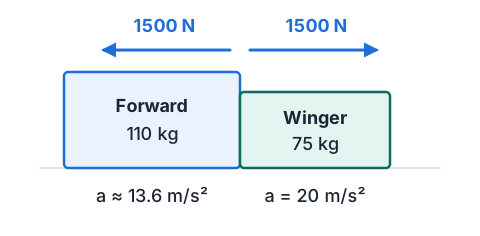
- force on forward = 1500 N, opposite directionaction and reaction pair
- winger: a = 1500 ÷ 75 = 20 m/s²a = F ÷ m
- forward: a = 1500 ÷ 110 ≈ 13.6 m/s²same force, bigger mass
- same force, but the winger accelerates moreless mass means less inertia
Air resistance and a falling skydiver
- Air resistance pushes against anything moving through air, and it gets bigger as the object goes faster.
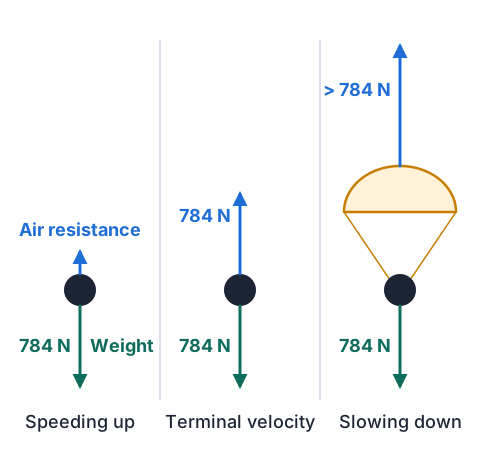
- An 80 kg skydiver has a weight of 80 × 9.8 = 784 N (using g = 9.8 N/kg), and this stays the same all the way down.
- Just after jumping, air resistance is small, so the net force is large and downward, and the skydiver accelerates.
- As speed rises, air resistance grows, the net force shrinks and the acceleration gets smaller.
- When air resistance reaches 784 N the forces balance, the acceleration is zero and the skydiver falls at a steady top speed called terminal velocity.
- Opening the parachute makes air resistance much bigger than the weight, so the net force points up and the skydiver slows down to a new, lower terminal velocity.
| Stage | Forces | Motion |
|---|---|---|
| Just after jumping | Weight much bigger than air resistance | Speeding up quickly |
| Falling faster | Air resistance growing, net force shrinking | Still speeding up, but less each second |
| Terminal velocity | Air resistance equals weight | Steady speed |
| Parachute opens | Air resistance bigger than weight | Slowing down |
| New terminal velocity | Balanced again at a lower speed | Steady, slow speed |
Investigating air resistance with paper parachutes
- Change one thing: the area of the parachute canopy.
- Measure the time to fall 2.0 m, repeated three times for each canopy, and take the mean.
- Keep the same: the load (mass) hanging under the canopy, the drop height, the canopy material, the string length and an indoor space with no draughts.
- If a bigger canopy gives a longer fall time, that shows a bigger area produces more air resistance at a given speed, so the terminal velocity is lower.
- Hand timing a short fall is the biggest source of error, so drop from as high as is safe and repeat.
Example: drawing a conclusion from the parachute data
- A class dropped the same 10 g load from 2.0 m under canopies of different area.
- Each time is the mean of three trials.
| Canopy area (cm²) | Mean fall time (s) |
|---|---|
| 0 (no canopy) | 0.7 |
| 100 | 1.1 |
| 200 | 1.5 |
| 400 | 2.1 |
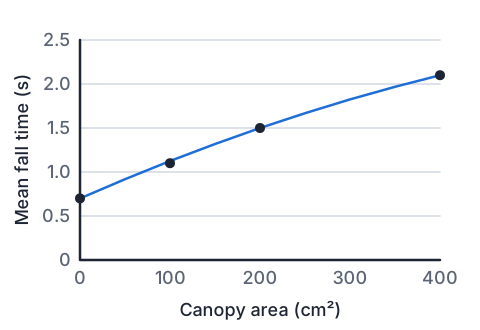
- as area goes up, fall time goes upthe trend in every row
- 400 cm² is 4 times 100 cm², but 2.1 s is not 4 times 1.1 sthe pattern is not proportional
- same weight every time, so the difference is air resistanceload was controlled
- bigger canopy: more air resistance, lower terminal velocity, longer fall
Common mistakes
- If something is moving, there must be a net force pushing it forward.An object moving at a steady velocity has zero net force on it; a net force changes the velocity, it is not needed to keep it.
- The trolley has a 100 N push, so a = 100 ÷ 40 = 2.5 m/s².F = ma uses the net force, so take away the friction first: (100 − 20) ÷ 40 = 2 m/s².
- Action and reaction forces cancel out, so nothing can accelerate.The two forces in a pair act on different objects, so they never cancel; only forces on the same object combine into a net force.
- In a tackle, the heavier player pushes harder on the lighter one.The forces on the two players are equal and opposite; the lighter player is thrown back more because the same force on less mass gives more acceleration.
Flick the card, keep the coin
You need: a plastic cup, a playing card or postcard, a $1 or $2 coin
- Lay the card flat across the top of the cup and put the coin in the middle of the card, over the opening.
- Push the card slowly sideways with one finger and see where the coin goes.
- Set it up again, then flick the edge of the card hard and fast sideways with your finger.
- Repeat the slow push and the fast flick a few times each.
- Look for: pushed slowly, the coin rides along with the card because friction has time to speed it up; flicked fast, the card shoots away and the coin drops straight into the cup, because its inertia keeps it where it was and the friction acts for too short a time to move it far.
Safety: A flicked card or coin can fly off the table, so flick sideways away from anyone's face, and use a plastic cup so nothing breaks if it tips.
Your turn
- 1. A 1200 kg car has a net forward force of 3600 N on it. What is its acceleration?
- 2. A cyclist and bike have a total mass of 80 kg and accelerate at 1.5 m/s². What net force is acting?
- 3. A 2 kg trolley is pulled with 10 N while friction acts against it with 4 N. Find the net force and the acceleration.
- 4. A swimmer pushes on the pool wall with 300 N. What force does the wall put on the swimmer, and why does the wall not move noticeably?
- 5. A ball bearing is dropped into a tall tube of cooking oil. Its speed rises at first, then stays steady. Explain this using forces.
Show answer
1. a = F ÷ m = 3600 ÷ 1200 = 3 m/s². 2. F = ma = 80 × 1.5 = 120 N. 3. Net force = 10 − 4 = 6 N, so a = 6 ÷ 2 = 3 m/s² in the direction of the pull. 4. 300 N pushing the swimmer away from the wall (the reaction force); the wall is fixed to the ground and the whole Earth, so its mass is huge and its acceleration is too small to notice. 5. Weight pulls the ball down; the oil pushes up with drag (and a small buoyant force). Drag grows with speed until the upward forces equal the weight, the net force is zero and the ball falls at a steady terminal velocity.
Forces and Motion: Basics
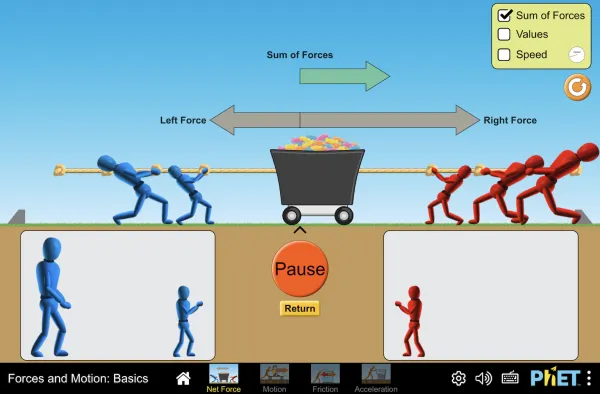
Full screen · PhET Interactive Simulations, University of Colorado Boulder, CC BY 4.0
Recap
- Acceleration is change in velocity ÷ time, in m/s², and turning counts as accelerating.
- F = ma links net force, mass and acceleration; always use the net force.
- More mass means more inertia, so the same force gives less acceleration.
- Every force has a partner that is equal, opposite and acting on the other object.
- Air resistance grows with speed until it balances weight, giving terminal velocity.
| Idea | Key fact |
|---|---|
| Acceleration | a = change in velocity ÷ time, in m/s² |
| Newton's second law | F = ma (N = kg × m/s²) |
| Inertia | Resistance to change in motion, set by mass |
| Force pairs | Equal size, opposite direction, different objects |
| Terminal velocity | Drag equals weight, so a = 0 |
How is Year 10 maths going?
See the Year 10 maths guide