The water cycle part 1: Earth's spheres, the Sun and weather
What this lesson covers
- Earth is one system of four spheres, and water moves between all of them.
- Evaporation, condensation, freezing, melting and precipitation move water around the cycle.
- Changes of state take in or give out energy, and this drives clouds, humidity, temperature and rain.
- The atmosphere is mostly nitrogen and oxygen, with argon, carbon dioxide and a changing amount of water vapour.
- Sunlight heats Earth's surface most at the equator and less and less towards the poles.
Earth is a system of four spheres
- Scientists split the Earth system into four connected parts, called spheres.
- Water is found in all four, and it is constantly moving from one to another.
- The same water molecule might be in the sea one month, in a cloud the next, and in a kūmara plant after that.
- Frozen water in glaciers and sea ice is sometimes given its own name, the cryosphere, but it is often counted as part of the hydrosphere.
| Sphere | What it is | Water there |
|---|---|---|
| Atmosphere | The layer of air around Earth | Water vapour, cloud droplets, ice crystals |
| Hydrosphere | All of Earth's water | Oceans, lakes, rivers, glaciers, groundwater |
| Geosphere | Rock, soil and Earth's interior | Water in soil and in cracks and pores in rock |
| Biosphere | All living things | Water inside plants, animals and people |
What the atmosphere is made of
- The atmosphere is a thin shell of gases held to Earth by gravity.
- Dry air is about four fifths nitrogen and one fifth oxygen.
- Argon and carbon dioxide make up most of the rest, and carbon dioxide is only about 0.04%, though it matters a lot for trapping heat.
- Water vapour is different: its amount changes from almost none over a desert or polar ice to around 4% in hot, humid tropical air.
- Water vapour is an invisible gas. Clouds and steam you can see are tiny liquid droplets, not vapour.
| Gas | Share of dry air | Note |
|---|---|---|
| Nitrogen | about 78% | Unreactive; most of what you breathe in |
| Oxygen | about 21% | Used in respiration and burning |
| Argon | about 0.9% | Unreactive noble gas |
| Carbon dioxide | about 0.04% | Used in photosynthesis; traps heat |
| Water vapour | 0% to about 4% (varies) | Source of clouds and rain |
The Sun heats the equator most
- Energy from the Sun warms land, water and air, and this energy powers the water cycle.
- Latitude is how far north or south of the equator a place is, from 0° at the equator to 90° at the poles.
- Near the equator the Sun is high in the sky, so its rays hit the ground almost straight on and the energy is concentrated on a small area.
- At higher latitudes the rays arrive at a low angle, so the same energy is spread over a bigger area and also passes through more atmosphere.
- So average temperatures fall as latitude increases, which is one reason Kaitaia (about 35° S) is warmer than Invercargill (about 46° S).
| Latitude | Example | Sun's rays | Heating |
|---|---|---|---|
| 0° | Equator, Indonesia | Nearly straight down | Strongest |
| about 35° to 47° S | New Zealand | At a moderate angle | Medium |
| about 78° S | Scott Base, Antarctica | Very low angle | Weakest |
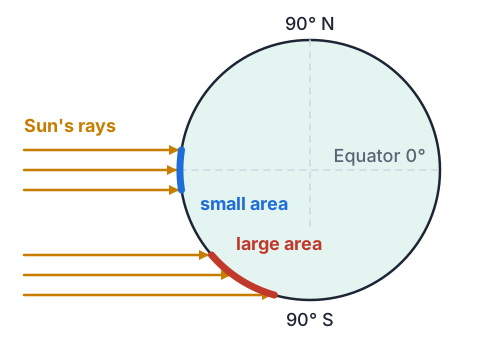
Example: why a low Sun heats less
- A torch shone straight down onto paper lights up a patch of 100 cm².
- Tilt the torch so the beam hits the paper at 30° to the surface, like the Sun low in the sky. The patch stretches to 200 cm².
- What happens to the energy reaching each square centimetre?
- same torch, so the same total energy each secondonly the angle changed
- area: 100 cm² becomes 200 cm²a slanted beam spreads out
- energy per cm² = total ÷ areaspread over twice the area
- each cm² gets half as much energy, so it warms less
- this is why high latitudes and winter are colderthe Sun is lower in the sky
Changes of state move water and energy
- Water changes state as it moves around the cycle: solid ice, liquid water and gaseous water vapour.
- Evaporation and melting take in energy, so they cool their surroundings. That is why you feel cold getting out of the sea on a windy day.
- Condensation and freezing give out energy, so they warm their surroundings.
- Precipitation is not a change of state. It is water, liquid or frozen, falling from clouds to the ground.
- Some ice turns straight into vapour without melting (sublimation), which slowly shrinks snow on dry, sunny mountain days.
| Process | Change | Energy | Where you see it |
|---|---|---|---|
| Evaporation | Liquid to gas | Taken in | Puddles drying, the ocean surface |
| Condensation | Gas to liquid | Given out | Clouds, fog, dew on grass |
| Freezing | Liquid to solid | Given out | Frost on puddles, sea ice |
| Melting | Solid to liquid | Taken in | Snowmelt feeding rivers in spring |
| Precipitation | No change, just falling | Not applicable | Rain, snow, sleet, hail |
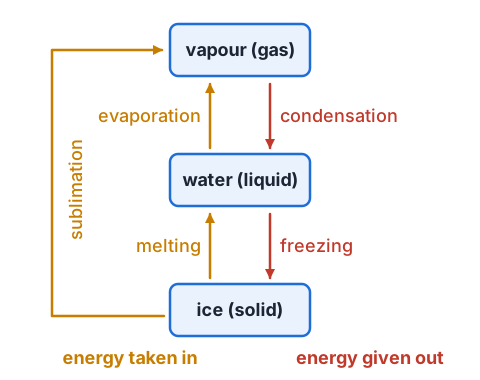
How changes of state make weather
- Humidity is the amount of water vapour in the air. Warm air can hold much more vapour than cold air.
- When moist air cools enough, some vapour condenses into droplets and a cloud or fog forms. The temperature where this starts is the dew point.
- Condensation releases energy, which warms the air and helps it keep rising. That extra energy is what powers thunderstorms and cyclones.
- When cloud droplets grow big enough, they fall as precipitation.
- Evaporation does the opposite job: it takes energy away, so lakes, the sea and damp ground cool the air above them.
| Weather feature | Change of state behind it |
|---|---|
| Cloud and fog | Condensation as moist air cools |
| High humidity | Lots of evaporation into warm air |
| Cool sea breeze | Evaporation taking energy from the sea surface |
| Storm energy | Condensation releasing energy in rising air |
| Frost | Vapour turning straight into ice on cold surfaces overnight |
Example: why the West Coast is wet and Canterbury is dry
- Hokitika gets about 2.9 m of rain a year. Christchurch, on the other side of the Southern Alps, gets about 0.6 m.
- Use changes of state to explain the difference.
| Place | Average rain a year (mm), 1991 to 2020 |
|---|---|
| Hokitika | 2921 |
| Christchurch | 618 |
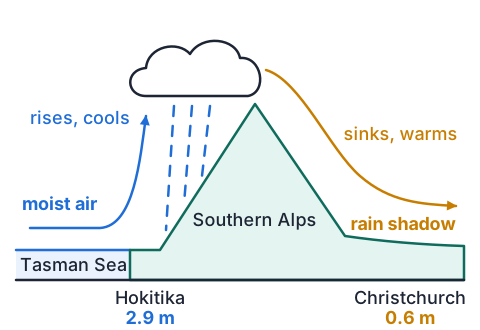
- westerly winds cross the Tasman Seaevaporation loads the air with water vapour
- the air reaches the Southern Alps and is forced upmountains block its path
- rising air coolspressure is lower higher up, so the air expands and cools
- vapour condenses into cloud, then falls as rain or snow on the west sidecooled below its dew point
- the air sinks down the east side and warms, with little water lefta dry, warm nor'wester
- the West Coast is wet and Canterbury is in a rain shadow
Where Earth's water is stored
- At any moment almost all of Earth's water is sitting in a store, not moving between them.
- The time water spends in a store is its residence time. A long residence time means a store slows down the cycle.
- The atmosphere holds very little water, but it is replaced every week or two, so it is the fastest part of the cycle.
- Ice sheets and deep groundwater can lock water away for thousands of years, taking it out of the cycle for a long time.
- The figures below are rounded values from hydrology references, so treat them as a guide, not exact numbers.
| Store | Share of Earth's water | Typical residence time |
|---|---|---|
| Oceans | about 96.5% | about 3000 years |
| Ice sheets and glaciers | about 1.7% | decades (glaciers) to many thousands of years (Antarctica) |
| Groundwater | about 1.7% | months to 10 000 years, depending on depth |
| Lakes | about 0.01% | years to about 100 years |
| Rivers | less than 0.001% | weeks to months |
| Atmosphere | about 0.001% | about 9 days |
Example: using storage data
- Use the storage table to answer: why does a store such as a glacier or an aquifer change how quickly water moves through the cycle?
- Christchurch's tap water is pumped from aquifers under the Canterbury Plains, filled by rain and by water soaking from rivers such as the Waimakariri.
- atmosphere: about 9 dayswater passes through quickly
- groundwater: months to thousands of yearswater moves slowly through rock and gravel
- rain soaking into the plains can take years or decades to reach a deep welllong residence time
- stores hold water back, delaying its return to rivers, the sea and the air
- a dry summer does not empty a deep aquifer straight awayit was filled over many years
Common mistakes
- The steam from a kettle and the clouds in the sky are water vapour.Water vapour is an invisible gas; steam and clouds are tiny liquid droplets that formed when vapour condensed.
- Condensation cools the air, because it happens when things are cold.Cooling starts condensation, but condensation itself gives out energy and warms the air; it is evaporation that takes energy in and cools.
- Precipitation is the change of state from gas to liquid.That change is condensation; precipitation is water or ice falling from clouds, with no change of state needed.
- The equator is hotter because it is closer to the Sun.The difference in distance is tiny; the equator is hotter because the Sun's rays arrive nearly straight on, so the same energy lands on a smaller area.
Model the Sun's rays with a torch
You need: a torch or a phone torch, an empty toilet roll tube, sticky tape, 2 sheets of plain paper, a ruler and a pencil, a stack of books
- Tape the toilet roll tube over the torch so the light comes out as a neat round beam.
- Rule a grid of 1 cm squares on one sheet of paper and lay it flat on the table.
- Rest the torch on a stack of books so it points straight down at the grid from about 15 cm above, trace round the lit patch, and count the squares inside it.
- Keep the end of the tube the same distance from the middle of the grid, but tilt the torch so the beam meets the paper at a low angle, then trace and count the patch again.
- Look for: the tilted patch is longer, covers far more squares and looks dimmer, because the same light is spread over a bigger area, just as low sunlight near the poles heats each square metre less than overhead sunlight at the equator.
Safety: A phone torch is bright enough to dazzle, so keep the beam pointed at the paper and never shine it into anyone's eyes.
Your turn
- 1. Water is inside the leaves of a kauri tree. Which sphere is it in?
- 2. A puddle dries up on a sunny afternoon. Name the change of state, and say whether energy is taken in or given out.
- 3. Explain why the equator is warmer than Antarctica, using the idea of sunlight being spread out.
- 4. Dry air is about 21% oxygen. About how many litres of oxygen are there in 100 L of dry air?
- 5. Use the storage table to explain why water in the atmosphere is replaced much faster than water in the oceans.
Show answer
1. The biosphere (living things). 2. Evaporation; energy is taken in from the Sun and the ground. 3. At the equator the Sun's rays arrive nearly straight on, so the energy is concentrated on a small area; near the poles the rays arrive at a low angle, so the same energy is spread over a much larger area (and passes through more air), heating each square metre less. 4. About 21 L. 5. The atmosphere holds a tiny amount of water that stays about 9 days before falling as precipitation, while the oceans hold a huge amount that stays about 3000 years on average.
States of Matter: Basics
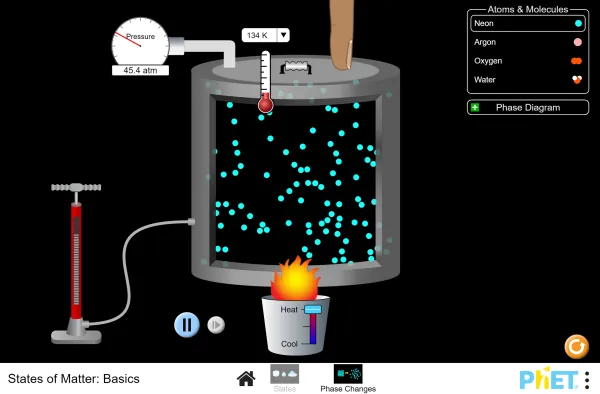
Full screen · PhET Interactive Simulations, University of Colorado Boulder, CC BY 4.0
Recap
- Water moves between the atmosphere, hydrosphere, geosphere and biosphere.
- Dry air is about 78% nitrogen, 21% oxygen, 0.9% argon and 0.04% carbon dioxide, plus a varying amount of water vapour.
- The Sun's heating is strongest at the equator and weakens as latitude increases.
- Evaporation and melting take in energy; condensation and freezing give it out, and this shapes clouds, humidity and storms.
- Stores such as ice and groundwater hold water for a long time and slow the cycle.
| Idea | Key fact |
|---|---|
| Spheres | atmosphere, hydrosphere, geosphere, biosphere |
| Atmosphere | mostly nitrogen and oxygen |
| Latitude | higher latitude, less heating |
| Energy in | evaporation, melting |
| Energy out | condensation, freezing |
| Stores | long residence time slows the cycle |
How is Year 10 maths going?
See the Year 10 maths guide