The water cycle part 2: evaporation, clouds and precipitation
What this lesson covers
- The Sun's energy evaporates water from oceans, lakes, rivers, soil and living things.
- Water vapour that cools condenses onto tiny particles, making the droplets we see as clouds.
- Rain, snow, sleet and hail fall once drops or ice grow too heavy for the air to hold up.
- Earth has a fixed amount of water that keeps recycling, some through quick loops and some through very slow ones.
From the big picture to each step
- Part 1 showed that water moves between four spheres, that the Sun supplies the energy, and that ice and groundwater store water for a long time.
- This part zooms in on the main steps: water rising into the air, forming clouds and falling back down.
- It finishes with ways to model and test the cycle yourself.
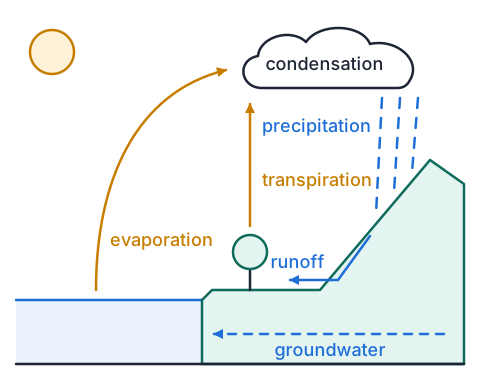
Evaporation: the Sun lifts water into the air
- Particles at the surface of liquid water are always moving. When the Sun warms them, some gain enough energy to break away and become water vapour.
- Water evaporates from oceans, lakes such as Taupō, rivers such as the Waikato, wet soil and living things.
- Plants pull water up from their roots and lose it as vapour through tiny pores in their leaves called stomata. This is transpiration, and a large tree can give off more than 100 L on a hot day.
- Animals add water vapour too, when they breathe out and sweat.
- Evaporation is faster when the water is warmer, the surface area is bigger, the air is dry and the wind carries the damp air away.
| Source | Process | NZ example |
|---|---|---|
| Ocean | Evaporation | The Tasman Sea, the main source of West Coast rain |
| Lakes and rivers | Evaporation | Lake Taupō on a hot summer day |
| Soil | Evaporation | Paddocks drying after rain |
| Plants | Transpiration | Pine forests and native bush |
| Animals | Breathing out, sweating | A rugby team after a game |
Condensation: how clouds form
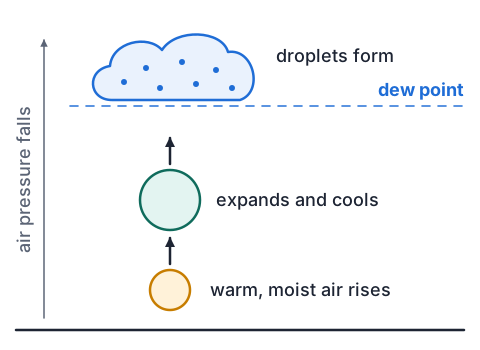
- Warm air carrying water vapour rises, because it is less dense than the cooler air around it.
- Higher up, the air pressure is lower, so the rising air expands and cools.
- When it cools to its dew point, vapour condenses into liquid droplets around tiny specks of dust, sea salt or smoke.
- Each droplet is only about a hundredth of a millimetre across, so they float in the air, but billions together scatter light and we see a cloud.
- Fog is simply a cloud at ground level, and dew forms when vapour condenses on grass that has cooled overnight.
Example: the wet outside of a cold bottle
- A bottle of water straight from the fridge is put on a table on a humid day. Within minutes the outside is covered in droplets.
- Explain where the water came from.
- the water did not leak through the plasticthe bottle is sealed
- the air touching the bottle is cooledenergy moves from the warm air to the cold bottle
- that air cools below its dew pointhumid air has a high dew point
- water vapour condenses into droplets on the bottlegas turning into liquid
- the water came from vapour in the air: the same process that makes clouds
Precipitation: when water falls back down
- Cloud droplets are held up by rising air. They bump into each other and join, and in cold clouds ice crystals grow by collecting vapour.
- Once a drop or crystal is too heavy for the rising air to support, it falls. About a million cloud droplets make one raindrop.
- Which type of precipitation reaches the ground depends on the temperatures it falls through.
- Precipitation returns water to the ground and sea, where it runs off, soaks in, or is stored as snow and ice.
| Type | How it forms | Where in NZ |
|---|---|---|
| Rain | Liquid drops, or snow that melts fully on the way down | Everywhere, most on the West Coast |
| Snow | Ice crystals that stay frozen all the way down | Southern Alps, Central Plateau |
| Sleet | A mix of rain and snow, or snow that partly melts as it falls | Southland and high country in winter |
| Hail | Ice lumps carried up and down by strong updraughts in thunderstorms, gaining a layer each trip | Canterbury and Waikato storms |
The same water, used again and again
- Earth has about 1.4 billion cubic kilometres of water, and that amount stays almost the same.
- Water is not used up; it only moves and changes state. The water in your drink may once have been in a glacier, a moa or the ocean.
- Some loops are quick: water can transpire from a forest and fall as rain on the same area within days.
- Other loops are very slow: snow buried in a glacier or water in a deep aquifer can be kept out of circulation for hundreds or thousands of years.
- Because the total is fixed, using fresh water faster than the cycle returns it, for example by over-pumping groundwater, causes shortages.
| Loop | Path | Time |
|---|---|---|
| Short | Leaf transpires, vapour condenses, rain falls on the same forest | Days |
| Short | Sea evaporates, cloud forms, rain falls back on the sea | About 1 to 2 weeks |
| Medium | Rain soaks into soil, flows to a river, reaches the sea | Weeks to years |
| Long | Snow becomes glacier ice, flows downhill, melts into a river | Years to centuries |
| Very long | Ice in Antarctica, or water in deep aquifers | Thousands of years or more |
Example: tracing a short loop and a long loop
- Follow two raindrops that fall in New Zealand on the same day.
- One lands on a Waikato dairy farm. The other falls as snow high on the Franz Josef Glacier.
- Waikato: grass roots take up the watersoaked into the soil
- the water transpires from the grass within a day or twosun warms the leaves
- it rises, condenses and falls as rain againshort loop, days
- Franz Josef: the snow is buried by more snow and pressed into icestored in the cryosphere
- the ice creeps downhill for years before melting at the glacier's endlong loop
- same type of water, very different timescales: days versus years or more
Modelling the water cycle
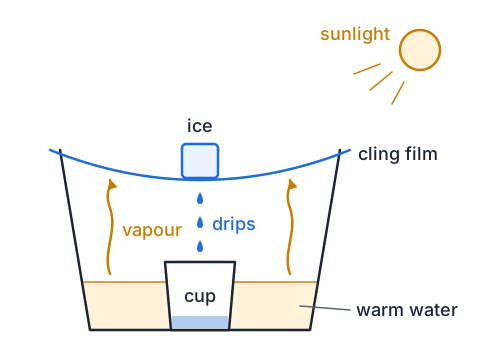
- Put warm water in the bottom of a large clear bowl, stand an empty cup in the middle, cover the bowl with cling film and put ice in the middle of the film.
- Leave it in sunlight. Vapour rises, condenses on the cold film, and drips into the cup.
- A model is useful because it shows processes you cannot easily see in real life, sped up and in a small space.
- Every model also has limits, and saying what they are is part of using it well.
| Part of the model | Represents | Limitation |
|---|---|---|
| Warm water | Ocean or lake | Real oceans are salty, and the salt stays behind |
| Sunlight or a lamp | The Sun's energy | Heating is even, not changing with latitude |
| Cold cling film with ice | Cool air high up where clouds form | Real air cools by rising, not by touching ice |
| Drips into the cup | Precipitation | No snow, hail, runoff or groundwater |
Example: testing what speeds up evaporation
- Change: the surface area of the water (dishes of 50, 100 and 200 cm²). Measure: mass of water lost in 24 hours. Keep the same: starting volume (100 mL), water temperature, place in the room and time.
- Each result is the mean of three dishes.
| Surface area (cm²) | Mean mass lost in 24 h (g) |
|---|---|
| 50 | 4 |
| 100 | 8 |
| 200 | 16 |
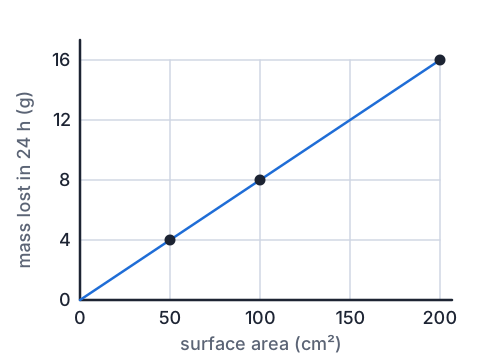
- 100 is double 50, and 8 g is double 4 gcompare rows
- 200 is double 100, and 16 g is double 8 gthe pattern holds
- mass lost is proportional to surface areadouble one, double the other
- more surface means more particles at the top able to escapethe reason
- a larger surface area gives faster evaporation
Common mistakes
- Water only evaporates when it is heated until it boils.Evaporation happens from the surface at any temperature, just faster when the water is warm, the air is dry and windy, and the surface is large.
- Rising air cools because it is moving further from the warm ground.It cools because the air pressure is lower higher up, so the rising air expands, and expanding air cools.
- Hail is just frozen rain, so it only falls in cold weather.Hail grows in layers as strong thunderstorm updraughts carry ice up and down through the cloud, so it often falls in summer storms.
- Two dishes holding 100 mL each will dry at the same rate, because they hold the same amount.The wider dish dries faster, because more of its particles are at the surface where they can escape.
Pull water out of the air
You need: 2 matching drinking glasses, a tray, cold tap water, a handful of ice cubes, food colouring, a paper towel
- Stand both glasses on the tray and fill each about three quarters full with cold tap water.
- Add a few drops of food colouring to both glasses and stir.
- Add the ice cubes to one glass only, then dry the outside of both glasses with the paper towel.
- Leave them side by side for 10 minutes, then run a fingertip down the outside of each glass and wipe it on the paper towel.
- Look for: the iced glass goes misty and then beaded with droplets while the other stays fairly dry, and the droplets are clear, not coloured, so they did not leak through the glass; they are water vapour from the air that cooled below its dew point and condensed, the same way clouds form.
Safety: A cold, wet glass is slippery, so keep both glasses on the tray and carry them with two hands so one does not slide off and break; food colouring stains, so wipe drips straight away.
Your turn
- 1. What is the name for water vapour leaving a plant through its leaves?
- 2. Moist air is blown up over the Kaimai Range. Explain why clouds often form over the hills.
- 3. What is the difference between hail and sleet?
- 4. In the bowl model, what does the ice on the cling film represent, and what is one limitation of this part?
- 5. It rains somewhere on Earth every day, yet the total amount of water on Earth does not go up. Why not?
Show answer
1. Transpiration. 2. The air is forced to rise; higher up the pressure is lower, so it expands and cools; once it cools to its dew point the water vapour condenses into droplets, forming cloud. 3. Hail is lumps of ice built up in layers as strong updraughts in a thunderstorm carry them up and down; sleet is a mix of rain and snow, or snow that has partly melted as it falls. 4. The cold air high in the atmosphere where vapour condenses; a limitation is that real air cools mainly by rising and expanding, not by touching something cold. 5. Water is not created by rain; rain is water that evaporated earlier. The total is fixed and just keeps cycling, so precipitation is balanced by evaporation and transpiration.
Recap
- The Sun's energy evaporates water from seas, lakes, rivers and soil, and plants release it by transpiration.
- Rising air expands and cools; at the dew point vapour condenses on tiny particles to make cloud.
- Drops and ice crystals fall as rain, snow, sleet or hail when they are too heavy to stay up.
- Earth's water is a fixed amount moving through short loops (days) and long loops (centuries or more).
- Models show the cycle in action, but always say what the model leaves out.
| Step | What happens | Energy |
|---|---|---|
| Evaporation and transpiration | Liquid becomes vapour | Taken in from the Sun |
| Condensation | Vapour becomes cloud droplets | Given out to the air |
| Precipitation | Water or ice falls to the ground | No change of state needed |
| Collection and storage | Runoff, rivers, groundwater, ice | Melting takes in, freezing gives out |
How is Year 10 maths going?
See the Year 10 maths guide