Thermoregulation: how your body controls its temperature
What this lesson covers
- Why mammals keep a steady core body temperature, and what that temperature is
- Temperature receptors in the skin and in the brain
- The brain as the control centre for temperature
- How sweating and vasodilation increase heat loss
- How shivering and vasoconstriction keep heat in and make more
- Thermoregulation as negative feedback and an example of homeostasis
Why temperature has to stay steady
- Mammals, including humans, keep their core body temperature almost constant whatever the weather; for people it is about 37 °C, normally between about 36.5 °C and 37.5 °C.
- Core temperature means the temperature deep inside the body, around the organs, not the temperature of the skin.
- The enzymes that run the chemical reactions in your cells work best at around 37 °C.
- If core temperature drops below about 35 °C (hypothermia) reactions slow down and thinking becomes confused, and if it climbs above about 40 °C enzymes and organs start to fail, which can be fatal.
- Controlling body temperature in this way is called thermoregulation.
| Core temperature | What it means |
|---|---|
| Below 35 °C | Hypothermia: clumsiness, confusion, danger |
| 36.5 to 37.5 °C | Normal range |
| 38 °C or more | Fever, often fighting an infection |
| Above 40 °C | Heat stroke risk: emergency |
Homeostasis and negative feedback
- Homeostasis is keeping conditions inside the body stable while conditions outside keep changing; temperature, blood sugar and water content are all controlled this way.
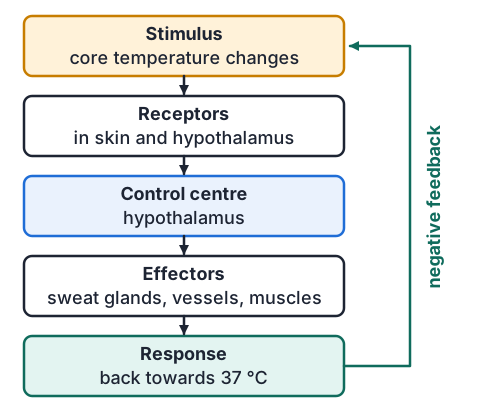
- Thermoregulation uses negative feedback: when temperature moves away from normal, the body responds in the opposite direction to bring it back.
- A heat pump with a thermostat works the same way: too cold and it heats, too warm and it switches to cooling.
- Because the loop keeps running, the temperature never sits perfectly still; it wobbles in a narrow band around 37 °C.
Sensing temperature
- Temperature receptors in the skin detect the temperature of your surroundings, giving early warning before your core changes.
- Temperature receptors in the hypothalamus, a small region at the base of the brain, detect the temperature of the blood flowing through it, which tells the brain your core temperature.
- The hypothalamus is the control centre: it compares the information with the normal value and sends nerve signals to effectors.
- The effectors are sweat glands, the muscles in the walls of small blood vessels in the skin, and the skeletal muscles that shiver.
| Part of the loop | In thermoregulation |
|---|---|
| Stimulus | Body temperature rises or falls |
| Receptors | Temperature receptors in the skin and hypothalamus |
| Control centre | Hypothalamus in the brain |
| Messages | Nerve signals along motor neurons |
| Effectors | Sweat glands, blood vessels in the skin, skeletal muscles |
| Response | Heat lost or kept, bringing temperature back to normal |
When you are too hot
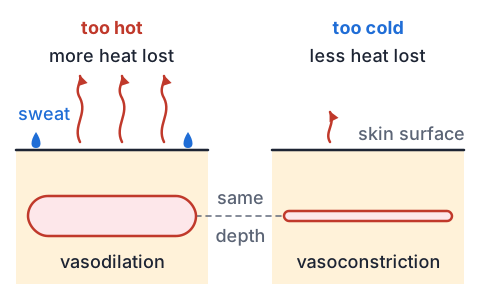
- Sweat glands release sweat onto the skin, and as the water evaporates it takes thermal energy from the skin with it, cooling you.
- Vasodilation means the small blood vessels supplying the skin widen, so more warm blood flows close to the surface and more heat is lost to the air.
- That extra blood near the surface is why your face goes red when you run.
- Sweating works poorly on a humid day, because the air is already full of water vapour and sweat evaporates slowly.
When you are too cold
- Vasoconstriction means the small blood vessels supplying the skin narrow, so less warm blood flows near the surface and less heat escapes; skin looks pale and fingers feel cold, but the core stays warm.
- Shivering is rapid, automatic contraction of skeletal muscles, and the extra respiration in those muscles releases thermal energy.
- Sweating stops, so no heat is lost by evaporation.
- Tiny muscles also raise body hairs, giving goosebumps; in furry mammals such as sheep this traps a thicker layer of insulating air, though in humans it helps very little.
| Response | Too hot | Too cold |
|---|---|---|
| Sweat glands | Release more sweat | Release little or no sweat |
| Skin blood vessels | Vasodilation (widen) | Vasoconstriction (narrow) |
| Skeletal muscles | Relaxed | Shivering |
| Body hairs | Lie flat | Stand up (goosebumps) |
| Overall effect | More heat lost | Less heat lost, more heat made |
A common mistake
- Blood vessels do not move closer to or further from the skin surface; they stay in the same place.
- What changes is their width, which changes how much blood flows through them.
- In an answer, write that vessels widen or narrow, not that they move.
Following the loop in a hot rugby game
- Twenty minutes into a summer game, a player's muscles are releasing a lot of heat and his core temperature begins to rise above normal.
- Follow the negative feedback loop step by step.
- Stimulus: core temperature rises above about 37 °Cworking muscles release heat
- Receptors in the hypothalamus detect warmer bloodreceptors
- Hypothalamus sends nerve signals to sweat glands and skin blood vesselscontrol centre
- Sweating increases and skin vessels dilateeffectors respond
- More heat lost by evaporation and from the skin surfaceresponse
- Temperature falls back towards 37 °C, so the responses ease offnegative feedback
A cold Southern Ocean swim
- Water draws heat away from the body more than 20 times faster than still air at the same temperature, so a swimmer in 10 °C water loses heat very quickly.
- Explain how the body responds, and why its defences are limited.
- Skin receptors detect cold water immediatelyearly warning before the core cools
- Hypothalamus triggers vasoconstriction in the skinkeeps warm blood in the core
- Shivering starts as the core begins to coolmuscle respiration releases heat
- Heat is still lost faster than it is madewater conducts heat well
- Limit time in the water and wear a wetsuit; seals rely on thick blubber for the same reason
Investigating skin temperature and exercise
- Question: does skin temperature on the forearm change after exercise?
- Change the amount of exercise, for example 0, 2 and 4 minutes of step-ups, and measure forearm skin temperature with an infrared or stick-on thermometer before and straight after.
- Keep the same: room temperature, clothing, the spot measured, the step height and stepping pace, and how long after stopping you take the reading.
- A rise would show vasodilation bringing warm blood to the skin; a fall could show sweat evaporating, so record whether the skin is sweaty too.
- For safety and ethics, volunteers agree to take part, anyone with a heart or breathing condition sits out, and anyone can stop at any time.
Common mistakes
- Sweat cools you down because sweat is cold.Sweat comes out at body temperature; it only cools you as it evaporates, taking thermal energy from the skin, so sweat that drips off does little.
- Shivering warms you up because your muscles rub together and make friction.Shivering muscles contract rapidly, and the extra respiration needed for that releases thermal energy.
- The skin decides when to sweat or shiver.Skin receptors only send information; the hypothalamus is the control centre, and it also has its own receptors that sense the temperature of the blood.
- Negative feedback means the body's response is bad for it.Negative means the response acts against the change, so a rise in temperature triggers cooling and a fall triggers warming, bringing it back to normal.
Feel how sweat cools you
You need: a bowl of lukewarm tap water, a face cloth, a piece of stiff card or a magazine to fan with
- Run the tap until the water feels neither warm nor cool on the inside of your wrist, and half fill the bowl.
- Dip the face cloth in the bowl, squeeze it out, and wipe a wet patch on the inside of one forearm; leave the other forearm dry.
- Hold both forearms side by side and fan them together with the card for one minute.
- Stop fanning for a minute, then fan again, noticing how each arm feels as the wet patch dries.
- Look for: the wet arm feels clearly cooler even though the water was at about skin temperature, and cooler still while you fan, because evaporating water takes thermal energy from the skin and moving air speeds evaporation up; this is exactly how sweating cools you.
Safety: Hot tap water can be hot enough to scald, so test it on the back of your hand before you use it, and wipe up spills so nobody slips.
Your turn
- 1. What is normal human core body temperature, and which part of the brain controls it?
- 2. Explain how sweating cools the body.
- 3. Why do your fingers go pale and cold on a frosty morning?
- 4. Explain why thermoregulation is called negative feedback.
- 5. A runner's face turns red in a race. Name the process and explain how it helps.
Show answer
1. About 37 °C, normally 36.5 to 37.5 °C; the hypothalamus. 2. Sweat glands release sweat, and as the water evaporates it takes thermal energy from the skin. 3. Vasoconstriction narrows skin blood vessels, so less warm blood reaches the fingers and less heat is lost from them, keeping the core warm. 4. A change in temperature triggers responses that act against that change, returning temperature to normal, after which the responses stop. 5. Vasodilation: skin blood vessels widen, so more warm blood flows near the surface and more heat is lost to the air.
What to take away
- Mammals keep core temperature in a narrow range, about 37 °C in humans, so enzymes work well.
- Receptors in the skin and hypothalamus detect temperature; the hypothalamus is the control centre.
- Too hot: sweating and vasodilation increase heat loss.
- Too cold: vasoconstriction reduces heat loss and shivering releases heat.
- Each response opposes the change, which is negative feedback, and this keeps the body in homeostasis.
How is Year 10 maths going?
See the Year 10 maths guide