Solving linear equations and inequations
What this lesson covers
- Solving is undoing, with the same operation on both sides, so the balance is kept.
- An inequation has a range of solutions, and multiplying or dividing by a negative reverses its sign.
What Level 1 adds
- You solved one-sided equations and one inequation in Year 10.
- Now the unknown sits on both sides, and questions start in words.
- And every step needs a reason, not just an answer.
| Year 10 | Level 1 |
|---|---|
| x on one side | x on both sides, with brackets |
| One fraction | two fractions with different denominators |
| An equation given to you | an equation you form from words |
| One inequation | inequations, double ones, whole-number answers |
| An answer | an answer with a reason for every step |
The unknown on both sides
- Solve 3(2x − 1) = 4x + 9.
- Expand first, then move every x term to one side.
- x = 6, and both sides come to 33.
| Step | Leaves | Why |
|---|---|---|
| Expand the bracket | 6x − 3 = 4x + 9 | distributive law |
| Subtract 4x | 2x − 3 = 9 | same on both sides |
| Add 3 | 2x = 12 | same on both sides |
| Divide by 2 | x = 6 | same on both sides |
| Check | 33 = 33 | both sides agree |
A minus in front of the bracket
- Solve 5 − 2(x − 4) = 3x − 7.
- The −2 multiplies both terms: minus times minus is plus 8.
- Move x to the side where it stays positive. x = 4.
| Step | Leaves | Why |
|---|---|---|
| Expand −2(x − 4) | 5 − 2x + 8 = 3x − 7 | −2 × −4 = +8 |
| Collect | 13 − 2x = 3x − 7 | like terms |
| Add 2x, add 7 | 20 = 5x | x term stays positive |
| Divide by 5 | x = 4 | same on both sides |
| Check | 5 = 5 | 5 − 0 and 12 − 7 |
Saying why, not just what
- Name the operation: "subtract 4x from both sides".
- Both sides get the same step, so the equation stays balanced.
- Finish by checking in the original, not your last line.
Two fractions: clear them both at once
- Solve (x + 1)/3 + (x − 1)/4 = 3.
- Times every term by 12, the common denominator.
- Keep each numerator in a bracket. x = 5.
| Step | Leaves | Note |
|---|---|---|
| Common denominator | 12 | LCM of 3 and 4 |
| Times every term | 4(x + 1) + 3(x − 1) = 36 | keep the brackets |
| Expand, collect | 7x + 1 = 36 | |
| Subtract 1, divide by 7 | x = 5 | |
| Check | 2 + 1 = 3 | correct |
Forming an equation from words
- Plan A: $30 a month plus $2 per GB.
- Plan B: $45 a month plus 50c per GB.
- For how much data do they cost the same?
| Stage | What you write |
|---|---|
| 1. Define | let g be the data used in a month, in GB |
| 2. Write each quantity | the cost of each plan, in dollars |
| 3. Link them | "costs the same" means an equals sign |
| 4. Solve and check | then answer the question in words |
Solving the phone plan
- Each plan is a fixed charge plus a rate times g.
- Same cost, so set the two expressions equal.
- g = 10. Both plans cost $50.
| Plan | Cost | Note |
|---|---|---|
| Plan A | 30 + 2g | dollars |
| Plan B | 45 + 0.5g | dollars |
| Same cost | 30 + 2g = 45 + 0.5g | |
| Subtract 30, 0.5g | 1.5g = 15 | g = 10 |
| Check | $50 and $50 | correct |
What the answer means
- At 10 GB a month, the two plans cost the same.
- Below 10 GB, Plan A is cheaper.
- Above 10 GB, Plan B is cheaper.
| Data | Plan A | Plan B |
|---|---|---|
| 4 GB | $38 | $47 |
| 10 GB | $50 | $50 |
| 20 GB | $70 | $55 |
An inequation with a reversal
- Solve 3(x + 2) > 5x − 4.
- Dividing by −2 reverses the sign: x < 5.
- Solve it the other way round and you get x < 5 again.
| Step | Leaves | Note |
|---|---|---|
| Expand | 3x + 6 > 5x − 4 | |
| Subtract 5x and 6 | −2x > −10 | |
| Divide by −2 | x < 5 | sign reverses |
| Or move x right | 10 > 2x, so x < 5 | same answer |
| Check x = 4 | 18 > 16 | true |
The answer is a set of numbers
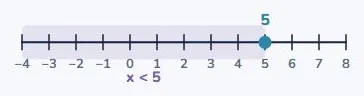
- Every number less than 5 works.
- 5 itself does not: 21 > 21 is false.
- On paper: an open circle at 5, shaded to the left.
A double inequation
- Solve −3 ≤ 2x + 1 < 9.
- Do the same step to all three parts.
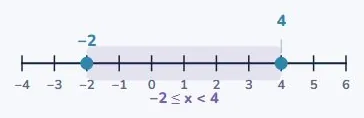
- −2 ≤ x < 4. Dividing by a positive: no reversal.
| Step | Leaves | Note |
|---|---|---|
| Subtract 1 from all three | −4 ≤ 2x < 8 | |
| Divide all three by 2 | −2 ≤ x < 4 | positive, no reversal |
| Left end | −2 included | ≤ |
| Right end | 4 excluded | < |
Between two ends
- On paper: closed circle at −2, as −2 is included.
- On paper: open circle at 4, as 4 is not.
- Whole numbers only: −2, −1, 0, 1, 2 and 3.
How many tickets at most?
- $250 for a class trip. Bus $85, tickets $12 each.
- t ≤ 13.75, but you cannot buy part of a ticket.
- Round down: at most 13. Fourteen goes over.
| Step | Leaves | Note |
|---|---|---|
| Budget | 85 + 12t ≤ 250 | t = tickets |
| Subtract 85 | 12t ≤ 165 | |
| Divide by 12 | t ≤ 13.75 | |
| Whole tickets | at most 13 | round down |
| Check | 13: $241, 14: $253 | 14 is over |
What to take away
- Seven lines, and the first one is the reason for every step.
| Solving is undoing | the same step on both sides |
| Brackets first | a minus outside hits both terms |
| Two fractions | clear with the common denominator |
| From words | define the letter, with its units |
| An inequation | has a range of solutions |
| × or ÷ by a negative | reverses the sign |
| In context | round the way the question needs |
Your turn: four questions
- Pause here and write each one out, with reasons.
- Question 1: watch the minus in front of the second fraction.
- Questions 2 and 4: define your letter first.
| Question | |
|---|---|
| 1 | Solve (x + 1)/3 − (x − 1)/4 = 1. |
| 2 | Hāngī costs $180, plates sell at $15. Plates for $420 profit? |
| 3 | Solve 7 − 3x ≥ 19 and show it on a number line. |
| 4 | Van $140, $35 per paddler, budget $500. Most paddlers? |
Show answer
1. x = 5. Times every term by 12: 4(x + 1) − 3(x − 1) = 12. The minus multiplies both terms, so 4x + 4 − 3x + 3 = 12, x + 7 = 12. Check: 2 − 1 = 1. 2. 40 plates. Let p be the number of plates: 15p − 180 = 420, 15p = 600, p = 40. 3. x ≤ −4. Subtract 7 for −3x ≥ 12, then divide by −3, which reverses the sign. Closed dot at −4, shaded to the left. 4. At most 10 paddlers. 140 + 35n ≤ 500, 35n ≤ 360, n ≤ 10.28… (360 ÷ 35), rounded down because 11 would cost $525.
The answers
- 1. x = 5.
- 2. 15p − 180 = 420, so 40 plates.
- 3. x ≤ −4, closed circle at −4, shaded left.
- 4. n ≤ 10.28… (360 ÷ 35), so at most 10 paddlers.
Is your child on track?
Take the free placement test