Solving quadratic equations by factorising
What this lesson covers
- If two quantities multiply to zero, at least one of them is zero.
- A quadratic equation can have two, one or no real solutions, and the solutions are where its graph crosses the x-axis.
Year 10 gave you the brackets
- Last year the quadratic arrived already factorised.
- Now you rearrange it and factorise it yourself.
- And every step comes with its reason.
| Question | What it asks of you |
|---|---|
| Year 10: (x − 2)(x + 4) = 0 | already factorised, read it off |
| Level 1: x² = 5x + 14 | rearrange, factorise, then solve |
| Level 1: a context | form the equation yourself |
| Every step | says why it is allowed |
Why it has to equal zero
- If two numbers multiply to zero, one of them is zero.
- No other number works that way.
- Six is two times three, or one times six, or many others.
| Equation | Tells you | Because |
|---|---|---|
| a × b = 0 | a = 0 or b = 0 | only 0 does this |
| (x − 3)(x + 5) = 0 | x = 3 or x = −5 | set each bracket to 0 |
| (x − 1)(x − 2) = 6 | no conclusion | many pairs make 6 |
| So first | get 0 on one side |
Rearrange to zero first
- Subtract five x and fourteen from both sides.
- Factorise: minus seven and two.
- Null factor law, then check both answers.
| Step | Working | Why |
|---|---|---|
| Start | x² = 5x + 14 | |
| Subtract 5x and 14 | x² − 5x − 14 = 0 | same to both sides |
| Factorise | (x − 7)(x + 2) = 0 | × −14, + −5 |
| Null factor law | x = 7 or x = −2 | one bracket is 0 |
| Check | 49 = 35 + 14 | 4 = −10 + 14 |
Do not divide by x
- Dividing both sides by x gives x equals three.
- But x might be zero, and you cannot divide by zero.
- Rearrange and factorise instead: two solutions.
| Method | Working | Result |
|---|---|---|
| Divide by x | x² ÷ x = 3x ÷ x | x = 3 only |
| But x could be 0 | you cannot divide by 0 | x = 0 is lost |
| Rearrange instead | x² − 3x = 0 | |
| Common factor | x(x − 3) = 0 | x = 0 or x = 3 |
When the number in front is not 1
- Multiply a by c: two times minus three is minus six.
- Find two numbers: times to minus six, add to five.
- Split the middle, group in pairs, take out the bracket.
| Step | Working | Note |
|---|---|---|
| 2x² + 5x − 3 = 0 | a is 2, so use ac | ac = −6 |
| Need × −6, + 5 | 6 and −1 | |
| Split the middle | 2x² + 6x − x − 3 | |
| Group in pairs | 2x(x + 3) − 1(x + 3) | |
| Common bracket | (2x − 1)(x + 3) = 0 |
Solving each bracket
- Two x minus one is zero, so x is a half.
- x plus three is zero, so x is minus three.
- Both check back to zero.
| Bracket | Set to 0 | Solution |
|---|---|---|
| 2x − 1 = 0 | 2x = 1 | x = 1/2 |
| x + 3 = 0 | x = −3 | |
| Check x = 1/2 | 0.5 + 2.5 − 3 | = 0 |
| Check x = −3 | 18 − 15 − 3 | = 0 |
A repeated root
- Minus three and minus three: times to nine, add to minus six.
- So it is x minus three, squared.
- Both brackets give the same answer. One solution.
| Step | Working | Note |
|---|---|---|
| x² − 6x + 9 = 0 | need × 9, + −6 | |
| −3 and −3 | multiply to 9, add to −6 | |
| Factorise | (x − 3)(x − 3) = 0 | a perfect square |
| Both brackets | give x = 3 | one solution |
The solutions are on the graph
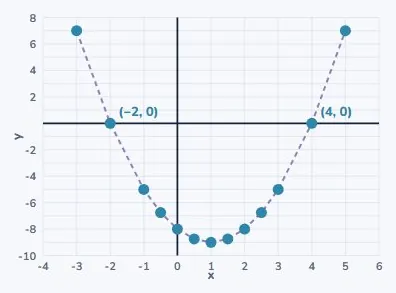
- On the x-axis, y is zero.
- So solving equals zero asks where the graph meets the axis.
- It crosses at minus two and four.
Two, one or no real solutions
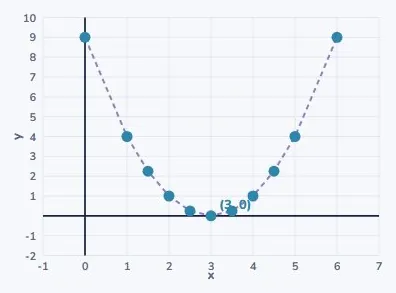
- A repeated root: the graph just touches the axis.
- Here it touches once, at three.
- A graph that never reaches the axis has no real solutions.
Forming the equation from words
- Name the unknown: the width is w metres.
- The length is three more, so w plus three.
- Length times width is forty. Rearrange to zero.
| Words | Algebra | Note |
|---|---|---|
| Width | w metres | the unknown |
| Length is 3 more | w + 3 | |
| Area is 40 m² | w(w + 3) = 40 | length × width |
| Expand, subtract 40 | w² + 3w − 40 = 0 | now it is = 0 |
Solve it, then reject what cannot be
- Eight and minus five: times to minus forty, add to three.
- w is five, or w is minus eight.
- A width cannot be negative, so minus eight is rejected.
| Step | Working | Reason |
|---|---|---|
| Factorise | (w + 8)(w − 5) = 0 | × −40, + 3 |
| Null factor law | w = −8 or w = 5 | |
| Reject w = −8 | a width cannot be negative | |
| Answer | 5 m wide, 8 m long | check: 5 × 8 = 40 |
Writing it up as reasoning
- Say what the letter stands for, with units.
- Give the reason beside each step.
- Finish with an answer to the question that was asked.
| Line | What you write |
|---|---|
| Define the unknown | let w be the width in metres |
| Form the equation | w(w + 3) = 40, because area is length × width |
| Give each reason | rearranged to 0, then the null factor law |
| Reject with a reason | w = −8 is impossible: a width is positive |
| Answer the question | the rectangle is 5 m wide and 8 m long |
What to take away
- Get it to zero, factorise, and say why at every step.
| Null factor law | only works when one side is 0 |
| Rearrange first | everything on one side, 0 on the other |
| Never divide by x | you lose the solution x = 0 |
| When a is not 1 | split the middle using ac |
| A repeated root | one solution, the graph touches the axis |
| The solutions | are the x-intercepts of the graph |
| In a context | reject what cannot happen, and say why |
Your turn: four questions
- Pause here and write all four out, with reasons.
- Question 1 is not equal to zero yet.
- Question 3 has a solution to reject. Say why.
| Question | |
|---|---|
| 1 | Solve x² = 4x + 21. |
| 2 | Solve 2x² + x − 6 = 0. |
| 3 | A garden is 2 m longer than wide. Area 48 m². Find its width. |
| 4 | How many times does y = x² + 10x + 25 meet the x-axis? Why? |
Show answer
1. x = 7 or x = −3. Rearrange to x² − 4x − 21 = 0, which factorises to (x − 7)(x + 3) = 0, then use the null factor law. 2. x = 3/2 or x = −2. ac = −12, so split the middle with 4 and −3: 2x(x + 2) − 3(x + 2) = (2x − 3)(x + 2) = 0. 3. The width is 6 m. w(w + 2) = 48 gives w² + 2w − 48 = 0, so (w + 8)(w − 6) = 0 and w = 6 or −8. Reject −8 because a width cannot be negative. 4. Once, at x = −5. It factorises to (x + 5)², a repeated root, so the graph touches the x-axis at one point instead of crossing it twice.
The answers
- x = 7 or x = −3.
- x = 3/2 or x = −2.
- Width 6 m. Reject −8: a width cannot be negative.
- Once, at x = −5. It is (x + 5)², a repeated root.
Is your child on track?
Take the free placement test