Volume of cones, pyramids, spheres and composite solids
What this lesson covers
- A pyramid or cone holds one third of the prism or cylinder with the same base and height.
- The volume of a composite solid is the sum or difference of the volumes of its parts.
Year 10 gave you the prism
- Last year: prisms, and a third for a pyramid.
- Now: cones, spheres and solids built from parts.
- And working back from a volume to a length.
| Where | What you do |
|---|---|
| Year 10: prisms | volume = base area × length |
| Year 10: pyramids | a third, stated but not explained |
| Level 1: cones and spheres | exact in π, then rounded |
| Level 1: composites | add or subtract the parts |
| Level 1: unknowns | work back from a volume |
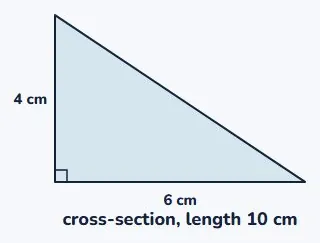
A prism is base area × height
- The base is a right triangle: ½ × 6 × 4 = 12 cm².
- The same triangle runs 10 cm through the prism.
- V = 12 × 10 = 120 cm³
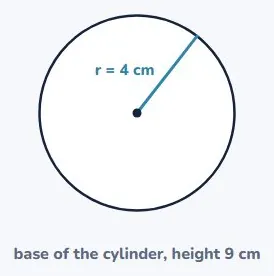
A cylinder is the same idea
- The base is a circle: π × 4² = 16π cm².
- Height 9 cm: V = 16π × 9 = 144π cm³
- Rounded to 1 d.p.: 452.4 cm³
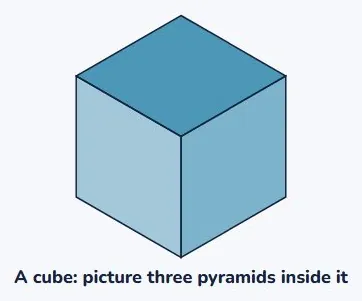
Why a pyramid is a third
- Three identical pyramids fill a cube exactly.
- Each has the cube’s base and the cube’s height.
- So each is ⅓ × base area × height.
A square-based pyramid
- Base 6 cm by 6 cm, vertical height 7 cm.
- Work out the prism it sits inside.
- Take a third: 84 cm³.
| Step | Working | Result |
|---|---|---|
| Base area | 6 × 6 | 36 cm² |
| Prism, same base | 36 × 7 | 252 cm³ |
| Pyramid is a third | 252 ÷ 3 | 84 cm³ |
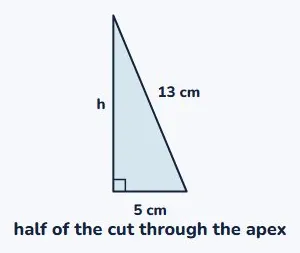
Slant height is not the height
- The slant is the hypotenuse of this triangle.
- h² = 13² − 5² = 144
- h = 12 cm, the vertical height.
The cone is a third of its cylinder
- Use h = 12, never the slant of 13.
- A third of 300π is 100π cm³.
- Rounded to 1 d.p.: 314.2 cm³
| Step | Working | Result |
|---|---|---|
| Base area | π × 5² | 25π cm² |
| Cylinder, same base | 25π × 12 | 300π cm³ |
| Cone is a third | 300π ÷ 3 | 100π cm³ |
| Rounded | to 1 d.p. | 314.2 cm³ |
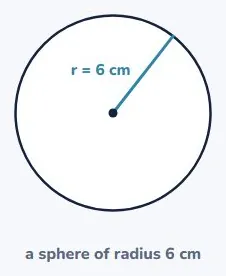
A sphere: 4/3 πr³
- Only the radius is needed.
- 6³ = 216, and 4/3 × 216 = 288
- V = 288π, about 904.8 cm³
A hemisphere is half a sphere
- Given a diameter? Halve it before anything else.
- Work out the whole sphere, then halve it.
- Exact answer first, then round.
| Step | Working | Result |
|---|---|---|
| Diameter 10 cm | halve it first | r = 5 cm |
| Whole sphere | 4/3 × π × 125 | 500π/3 cm³ |
| Half of it | 500π/3 ÷ 2 | 250π/3 cm³ |
| Rounded | to 1 d.p. | 261.8 cm³ |
Composite: add the parts
- A silo: a cylinder with a hemisphere on top.
- Both have radius 3 m, and they do not overlap.
- So the volumes add: 90π m³.
| Part | Working | Volume |
|---|---|---|
| Cylinder | π × 3² × 8 | 72π m³ |
| Hemisphere | 2/3 × π × 3³ | 18π m³ |
| Add the parts | 72π + 18π | 90π m³ |
| Rounded | to 1 d.p. | 282.7 m³ |
Composite: subtract the hole
- A cone drilled out of a cylinder, same base and height.
- What is left is the cylinder minus the cone.
- 200π: two thirds of the cylinder remain.
| Part | Working | Volume |
|---|---|---|
| Cylinder | π × 5² × 12 | 300π cm³ |
| Cone taken out | a third of that | 100π cm³ |
| Subtract | 300π − 100π | 200π cm³ |
| Rounded | to 1 d.p. | 628.3 cm³ |
Working back to a height
- A cone of radius 6 cm must hold 500 mL.
- Substitute what you know, then solve for h.
- Round up, or it holds less than 500 mL.
| Step | Working | Note |
|---|---|---|
| 500 mL | is 500 cm³ | 1 mL = 1 cm³ |
| Substitute r = 6 | 1/3 × π × 36 × h | = 12πh |
| Set equal | 12πh = 500 | |
| Divide by 12π | h = 13.26... | |
| Round up | h = 13.3 cm | 13.2 holds too little |
How many full cups?
- An urn: radius 10 cm, height 30 cm.
- Change to millilitres, then divide by one cup.
- Round down: only full cups count.
| Step | Working | Result |
|---|---|---|
| Urn | π × 10² × 30 | 3000π cm³ |
| In millilitres | 1 cm³ = 1 mL | 9424.8 mL |
| Cups of 300 mL | 9424.8 ÷ 300 | 31.4 |
| Round down | 31 full cups | the 32nd is not full |
What to take away
- Base area × height, a third for a point, and say why.
| Prism or cylinder | base area × height |
| Pyramid or cone | a third of the prism or cylinder |
| Slant height given | Pythagoras for the vertical height |
| Sphere | 4/3 πr³, and a hemisphere is half |
| Composite solid | add the parts, subtract the holes |
| Unknown dimension | set the formula equal, then solve |
| Rounding | exact in π first, then fit the context |
Your turn: four questions
- Pause here and write all four out, with reasons.
- Watch for diameters and slant heights.
- Give an exact answer, then a rounded one with units.
| Question | |
|---|---|
| 1 | A cylinder has diameter 12 cm and height 5 cm. Find its volume. |
| 2 | A cone has radius 6 cm and slant height 10 cm. Find its volume. |
| 3 | A hemisphere bowl has diameter 18 cm. How many mL does it hold? |
| 4 | Cone r 3, h 10 cm; a hemisphere, r 3 cm, on its base. Volume? |
Show answer
1. 180π, about 565.5 cm³. The diameter is 12, so the radius is 6. Base area 36π, times the height 5. 2. 96π, about 301.6 cm³. The slant is the hypotenuse, so h² = 10² − 6² = 64 and h = 8. Then a third of 36π × 8. 3. 486π cm³, about 1526.8 mL. The radius is 9, so half of 4/3 × π × 729, and 1 cm³ is 1 mL. 4. 48π, about 150.8 cm³. The cone is a third of 9π × 10, which is 30π, the hemisphere is 2/3 × π × 27, which is 18π, and the parts are added.
The answers
- 180π, about 565.5 cm³
- h = 8, so 96π, about 301.6 cm³
- 486π cm³, about 1526.8 mL
- 30π + 18π = 48π, about 150.8 cm³
Is your child on track?
Take the free placement test