Surface area of pyramids, cones and spheres
What this lesson covers
- Surface area is the total area of every face, so a net shows exactly what to add up.
- Cones and spheres have curved surfaces with their own area formulas; the skill is knowing which pieces a solid has, and which faces are hidden.
Year 10 counted the faces of a box
- Six rectangles, in three matching pairs.
- Level 1 adds pyramids, cones and spheres.
- And solids joined together.
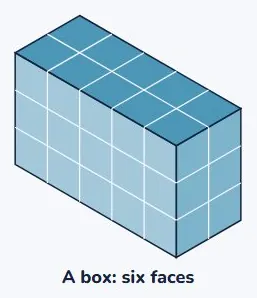
Surface area is every face added up
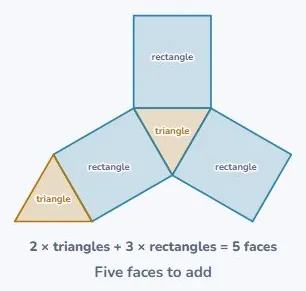
- Unfold the solid into its net.
- Every face of the net is one area to find.
- A triangular prism: two triangles, three rectangles.
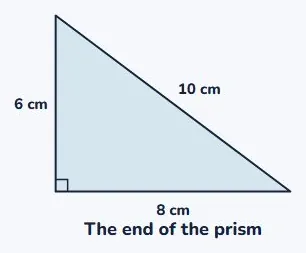
A triangular prism, 12 cm long
- The end is a right triangle: 6, 8 and 10 cm.
- Each side of the triangle is one rectangle.
- So the three rectangles are all different.
All five faces
- Two triangles, each half of six times eight.
- Each rectangle is a side of the triangle times 12.
- Total: 336 cm².
| Face | Working | Area |
|---|---|---|
| 2 triangles | 2 × ½ × 6 × 8 | 48 cm² |
| Rectangle | 6 × 12 | 72 cm² |
| Rectangle | 8 × 12 | 96 cm² |
| Rectangle | 10 × 12 | 120 cm² |
| Total | all five faces | 336 cm² |
A cylinder unrolled
- Two circles and one rectangle.
- The rectangle wraps once round the circle.
- So its width is the circumference, 2πr.
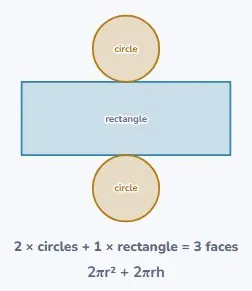
Radius 5 cm, height 8 cm
- Two circles: 50π.
- The rectangle, 2π × 5 by 8: 80π.
- Exact 130π cm², rounded 408.4 cm².
| Piece | Working | Area |
|---|---|---|
| 2 circles | 2 × π × 5² | 50π |
| Rectangle | 2π × 5, by 8 | 80π |
| Total, exact | add the π terms | 130π cm² |
| Rounded | to 1 d.p. | 408.4 cm² |
Slant height, not vertical height
- Square base 10 cm, vertical height 12 cm.
- Each triangle is measured up its sloping face.
- Pythagoras: half the base, the height, and l.
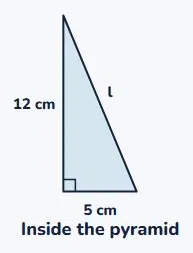
The square-based pyramid
- Slant height: the square root of 169 is 13.
- One square, and four triangles of 65.
- Total: 360 cm².
| Step | Working | Result |
|---|---|---|
| Slant height | √(12² + 5²) | l = 13 cm |
| Square base | 10 × 10 | 100 cm² |
| Each triangle | ½ × 10 × 13 | 65 cm² |
| Four triangles | 4 × 65 | 260 cm² |
| Total | 100 + 260 | 360 cm² |
A cone needs its slant height too
- Radius 6 cm, vertical height 8 cm.
- The curved surface is πrl, with l up the slope.
- Pythagoras gives l = 10 cm.
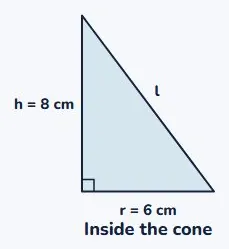
The cone: πr² + πrl
- The circle base: 36π.
- The curved surface: 60π.
- Exact 96π cm², rounded 301.6 cm².
| Piece | Working | Area |
|---|---|---|
| Slant height | √(6² + 8²) | l = 10 cm |
| Circle base | π × 6² | 36π |
| Curved surface | π × 6 × 10 | 60π |
| Total, exact | 36π + 60π | 96π cm² |
| Rounded | to 1 d.p. | 301.6 cm² |
A sphere: 4πr²
- One curved surface and no flat faces.
- Radius 7 cm: 4 × π × 49 = 196π.
- About 615.8 cm².
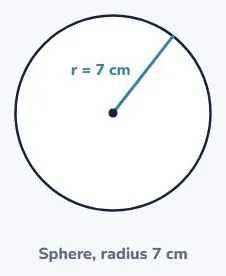
A hemisphere has a flat face
- Half the sphere gives only the curved part: 2πr².
- The cut leaves a flat circle: πr².
- So a solid hemisphere is 3πr².
| Solid | Piece | Area |
|---|---|---|
| Sphere | one curved surface | 196π ≈ 615.8 cm² |
| Hemisphere | half the curve | 98π |
| plus the flat circle | 49π | |
| Hemisphere | total, 3πr² | 147π ≈ 461.8 cm² |
A silo: a cylinder with a dome
- Radius 4 cm, cylinder 9 cm tall, hemisphere on top.
- Where two solids join, both faces are inside.
- Count only what paint could reach.
| Face | Counted? | Why |
|---|---|---|
| Cylinder base | counted | on the outside |
| Cylinder side | counted | on the outside |
| Cylinder top | not counted | under the dome |
| Dome flat circle | not counted | glued to the top |
| Dome curve | counted | on the outside |
Adding the outside pieces
- One circle base, one curved side, one dome.
- Add the π terms: 120π.
- Rounded once, at the end: 377.0 cm².
| Piece | Working | Area |
|---|---|---|
| Base circle | π × 4² | 16π |
| Curved side | 2π × 4 × 9 | 72π |
| Dome | ½ × 4π × 4² | 32π |
| Total, exact | 16π + 72π + 32π | 120π cm² |
| Rounded | to 1 d.p. | 377.0 cm² |
What to take away
- List every face, find each area, add, then round.
| Surface area | every face, and the net lists them |
| Cylinder | 2πr² + 2πrh |
| Pyramid, cone | slant height l, from Pythagoras |
| Cone | πr² + πrl |
| Sphere | 4πr², and a hemisphere is 3πr² |
| Composite | leave out the faces that are joined |
| Answers | exact in π, then rounded, units² |
Your turn: find the surface area
- Pause here and list the faces before you calculate.
- Questions 2 and 4 give a vertical height.
- Give curved answers exact, then to 1 d.p.
| Find the surface area | |
|---|---|
| 1 | Triangular prism: right-angled end 9, 12, 15 cm, length 20 cm |
| 2 | Cone: radius 5 cm, vertical height 12 cm |
| 3 | Solid hemisphere: radius 10 cm |
| 4 | Cylinder r 3, h 10 cm; cone on top, r 3, vertical h 4 cm |
Show answer
1. 828 cm². Ends 2 × ½ × 9 × 12 = 108, rectangles 9 × 20 + 12 × 20 + 15 × 20 = 720, total 828. 2. 90π ≈ 282.7 cm². Slant height √(5² + 12²) = 13, so 25π + 65π = 90π. 3. 300π ≈ 942.5 cm². Curved half 2π × 10² = 200π, plus the flat circle 100π. 4. 84π ≈ 263.9 cm². Cone slant √(3² + 4²) = 5. Base 9π, side 2π × 3 × 10 = 60π, cone π × 3 × 5 = 15π. The cylinder top and cone base are hidden.
The answers
- 828 cm².
- l = 13 cm, so 90π ≈ 282.7 cm².
- 300π ≈ 942.5 cm², including the flat circle.
- l = 5 cm, so 84π ≈ 263.9 cm². Two faces hidden.
Is your child on track?
Take the free placement test