Physical properties and the uses of materials
What this lesson covers
- Link each physical property to the job a material has to do.
- Explain melting and boiling points, conductivity, solubility, malleability, hardness and density from particles and forces.
- Explain why alloys are harder and less malleable than pure metals, and why ionic solids are brittle.
- Use data from a table to compare materials for a use.
- Write an evaluation that joins the use, the property, the particles and the forces, and compares the options.
From a job to a property to the particles
- Every question on this standard follows one chain: the use needs a property, and the property comes from the particles and the forces between them.
- Start from the job: a wire must carry current, a fertiliser must dissolve in soil water, a paddle must be light but stiff.
- Name the property that job needs, then explain that property from the particles and how strongly they attract each other.
- The 2025 assessment report said answers that leaned on vague words such as 'strong', 'light' or 'hard', without saying which particles and forces, were held to lower grades.
| Property | What it depends on |
|---|---|
| Melting and boiling point | How strong the forces are that must be overcome |
| Electrical conductivity | Charged particles (electrons or ions) free to move |
| Thermal conductivity | Delocalised electrons and closely packed particles passing energy on |
| Solubility in water | Whether water's attraction to the particles beats their attraction to each other |
| Malleability and hardness | Whether layers of particles can slide without the bonds breaking |
| Density | Mass of each particle and how closely the particles pack |
Melting point and density: real data
- Melting a solid means giving its particles enough energy to overcome the forces holding them in place.
- Iodine is molecular, so melting it only overcomes weak forces between I₂ molecules, and it melts at a low temperature for a solid.
- Metals melt only when the strong metallic bonding is overcome, so most have high melting points; sodium is an exception, with weaker bonding from just one delocalised electron per atom.
- Lead is soft and melts at a low temperature for a metal, so it was easy to cast and bend into pipes and roof flashing, though it is no longer used for drinking water pipes because it is toxic.
- Density depends on how heavy each particle is and how tightly they pack: lead atoms are heavy and closely packed, while magnesium atoms are light.
| Substance | Type | Melting point (°C) | Density (g/cm³) |
|---|---|---|---|
| Iron | Metallic | 1538 | 7.87 |
| Copper | Metallic | 1085 | 8.93 |
| Aluminium | Metallic | 660 | 2.70 |
| Magnesium | Metallic | 650 | 1.74 |
| Lead | Metallic | 327 | 11.34 |
| Iodine | Molecular | 114 | 4.93 |
| Sodium | Metallic | 98 | 0.97 |
Electrical and thermal conductivity
- A material conducts electricity only if it has charged particles that are free to move.
- Metals and graphite conduct as solids because they have delocalised electrons; ionic materials conduct only when melted or dissolved, when their ions are free to move.
- Molecular substances, diamond and most polymers have no free charged particles, so they are insulators, which is why cables are coated in plastic.
- Metals also conduct heat well: delocalised electrons carry energy quickly through the lattice, and closely packed cations pass vibrations on to their neighbours.
- Polymers conduct heat poorly, so pot handles and oven mitts are made from them.
| Type | Conducts as a solid? | Conducts when melted or dissolved? |
|---|---|---|
| Metallic | Yes (delocalised electrons) | Yes, when melted |
| Ionic | No (ions fixed) | Yes (ions free to move) |
| Molecular | No | No (pure substance) |
| Covalent network | Graphite yes, diamond no | Does not melt or dissolve easily |
| Polymer | No (most) | No |
Solubility: why salt dissolves
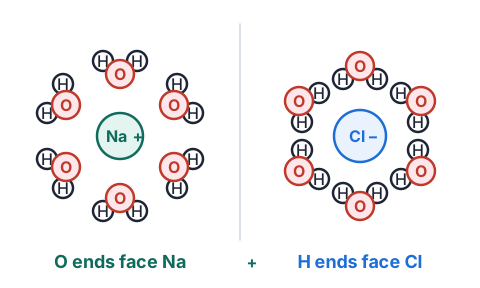
- A water molecule has a slightly negative oxygen end and slightly positive hydrogen ends.
- When salt meets water, the oxygen ends are attracted to Na⁺ ions and the hydrogen ends to Cl⁻ ions at the edge of the crystal.
- Salt dissolves because the attraction between water molecules and the ions is enough to pull ions out of the lattice, and each ion then moves through the water surrounded by water molecules.
- Covalent networks, metals and most polymers do not dissolve: water cannot attract their particles more strongly than they attract each other.
- Polymers also have very long chains held by many forces, which is why a polythene kayak or a muka net stays whole in water.
| Sodium chloride | Value |
|---|---|
| Melting point | 801 °C |
| Boiling point | 1465 °C |
| Solubility in water at 25 °C | 36.0 g per 100 g of water |
| Density | 2.17 g/cm³ |
Malleability, hardness and alloys
- A malleable material can be hammered, pressed or rolled into a new shape without breaking.
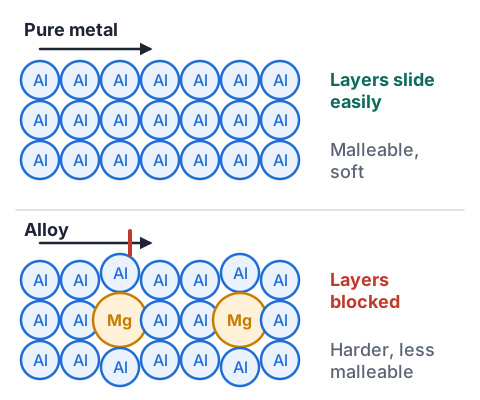
- In a pure metal all the cations are the same size, so a push makes whole layers slide over each other, and the delocalised electrons keep holding them together in the new position.
- An alloy is a mixture of a metal with at least one other element, such as aluminium with magnesium, or iron with carbon in steel.
- The different-sized atoms disrupt the regular layers, so it takes more force to make them slide: an alloy is harder and less malleable than its pure metal.
- That is why wheels, paddles and bike frames use alloys: pure aluminium or magnesium would dent and bend too easily.
Why ionic solids are hard but brittle
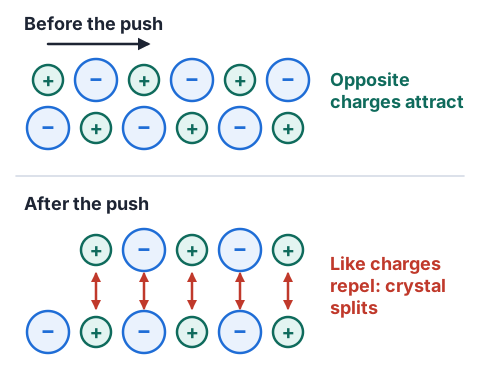
- Ionic bonds are strong, so salt crystals are hard and have high melting points.
- But if a force pushes one layer of ions along by one place, positive ions end up next to positive ions and negative next to negative.
- Like charges repel, so the layers push apart and the crystal shatters or crumbles instead of bending.
- This is the difference to a metal, where the sea of electrons holds the cations together whichever way they slide.
Diamond, graphite and non-stick coatings
- Diamond is the hardest natural material because every carbon is held by four strong covalent bonds in 3D, so it tips drill bits and saw blades for cutting stone.
- Graphite has the same strong bonds within its layers, but the weak forces between layers let them slide, so it is used in pencils and as a dry lubricant.
- Graphite's delocalised electrons and very high melting point make it suitable for electrodes and the brushes in electric motors.
- PTFE, the non-stick coating on pans, is a polymer whose carbon chain is completely covered by fluorine atoms.
- Other substances, including food and water, are attracted only very weakly to that fluorine surface, so they do not stick, and the strong carbon to fluorine bonds let the coating stand up to normal cooking temperatures.
Example: why house wiring is copper
- Question: explain why copper is used for the wires inside the walls of a house.
- Each grade below adds to the one before; the Excellence answer joins the use, the properties, the particles and the forces, and uses data.
- Achieved: copper conducts electricity and is ductile, so it can be drawn into wire; it is a metallic solid with delocalised electrons.properties and use, type, particles
- Merit: copper is a lattice of cations in a sea of delocalised electrons that move when a voltage is applied, carrying current; the non-directional metallic bond lets layers slide, so it can be drawn into thin wire without breaking.explains both properties from structure and bonding
- Excellence: as Merit, plus the strong metallic bonding gives copper a high melting point (1085 °C), so it stays solid even when the wire warms up under load, and copper does not dissolve when walls get damp, so it can be safely sealed inside a plastic coating, which insulates because its polymer chains have no free charged particles.evaluates the whole job, with data
Example: a soluble fertiliser
- Ammonium nitrate, NH₄NO₃, is an ionic nitrate fertiliser: plants take up nitrogen mainly as ions dissolved in soil water.
- Use the data to explain why it suits being spread on a paddock before rain.
- Being so soluble is also the drawback: after heavy rain, nitrate that plants do not take up can wash into streams and groundwater.
| Ammonium nitrate | Value |
|---|---|
| Solubility in water at 25 °C | 213 g per 100 g of water |
| Melting point | 169.6 °C |
| Density | 1.72 g/cm³ |
- ionic lattice of NH₄⁺ and NO₃⁻ ions held by ionic bondstype, particles, force
- water molecules attract the ions strongly enough to pull them out of the latticewhy it dissolves
- 213 g dissolves in 100 g of water, about six times as much as salt (36.0 g)data from both tables
- rain dissolves it quickly and carries the nitrate ions to the roots
Example: evaluating magnesium alloy wheels
- Question: a racing car team must choose between steel wheels and magnesium alloy wheels. Using the melting point and density table, discuss which is better.
- A wheel must be light, so the car accelerates and corners well, and hard enough not to dent or bend.
- density: magnesium 1.74 g/cm³, iron (most of steel) 7.87 g/cm³from the table
- 7.87 ÷ 1.74 ≈ 4.5, so the same volume of magnesium has under a quarter of the massmagnesium atoms are much lighter than iron atoms
- pure magnesium is too soft: its identical cations slide easilymalleability
- alloying adds atoms of different sizes that block the layers sliding, making it harderfixes the weakness
- magnesium alloy: far lighter, and hard enough for racing; steel is harder and stronger but about 4.5 times heavier for the same size, so it suits everyday cars where cost matters more
What an Excellence answer does
- 1. Say what the use demands (light, conducts, dissolves, does not dent).
- 2. Name the material type and describe its particles and forces precisely.
- 3. Explain each property needed from those particles and forces.
- 4. Bring in the data given, with numbers and units.
- 5. Compare with the other option or say what the material cannot do, then make a clear judgement.
Common mistakes
- Solid salt conducts electricity because it is made of ions.Ions in solid salt are fixed in the lattice; it conducts only when melted or dissolved, when the ions are free to move.
- Alloys are harder because the bonds in them are stronger.Alloys are harder because different-sized atoms disrupt the layers, so the layers cannot slide as easily.
- Salt dissolves because water breaks the covalent bonds in the NaCl molecules.Salt has no molecules or covalent bonds; water molecules attract the Na⁺ and Cl⁻ ions and pull them out of the lattice.
- Magnesium wheels are better because magnesium is lighter.Say why: magnesium has a lower density (1.74 g/cm³) because its atoms are lighter, so a wheel of the same size has less mass.
Which plastics float?
You need: a clear glass or jar of water, salt, a teaspoon, scissors, a scrap of plastic shopping bag, a strip cut from a milk bottle, a strip cut from a clear soft-drink bottle, a bottle cap
- Cut small pieces, about 2 cm across, from the plastic bag, the milk bottle and the soft-drink bottle, and check the recycling number on each.
- Push each piece and the bottle cap under the water, rubbing off any air bubbles, and let go.
- Note which float and which sink.
- Stir in salt, a teaspoon at a time, until it stops dissolving, and test the sinkers again.
- Look for: the bag (LDPE, 4), milk bottle (HDPE, 2) and cap (usually PP, 5) float because their chains pack loosely enough to be less dense than water, while the soft-drink bottle (PET, 1) sinks even in very salty water.
Safety: Cutting thick bottle plastic with scissors can slip and nick a hand, so cut with the blades pointing away from you, or ask an adult to cut the strips.
Exam-style question: a frying pan
- A frying pan has an aluminium body, a PTFE non-stick coating on the inside, and a plastic handle.
- (a) Name the type of material for the aluminium body and for the PTFE coating.
- (b) Explain why aluminium is suitable for the body of the pan.
- (c) Discuss why the handle is made from a polymer rather than from aluminium.
Show answer
1. (a) Aluminium is a metallic solid; PTFE is a polymer. (b) Aluminium is a lattice of cations surrounded by delocalised electrons, held by strong metallic bonding. The delocalised electrons carry heat energy quickly from the element to the food, so the pan heats evenly. The strong metallic bonding means a lot of energy is needed to melt it, so it stays solid on the stove. The non-directional bonding lets layers slide, so aluminium can be pressed into a pan shape. Its low density for a metal (2.70 g/cm³) keeps the pan light to lift. Describing one property with its use is Achieved; explaining it from the particles and forces is Merit. (c) The handle must stay cool enough to hold. A polymer is long chain molecules held by covalent bonds along the chain and weak forces between chains; it has no delocalised electrons, so it conducts heat poorly. Aluminium would carry heat straight to the hand. The trade-off is that most polymers soften at far lower temperatures than aluminium, so the handle is kept away from the heat. Comparing both materials, linking each one's particles and forces to how well it conducts heat, and making a judgement is Excellence.
Your turn
Using the melting point and density table, which metal there has the lowest melting point, and what is its melting point?
Why does solid salt not conduct electricity, while salt water does?
A crystal of salt is hit with a hammer and shatters. Why?
Why is graphite used in pencils but diamond in drill tips?
Why is a magnesium alloy used for a wheel instead of pure magnesium?
Show answer
1. Sodium, 98 °C. 2. In the solid the ions are held in fixed positions in the lattice; in salt water they are free to move and carry charge. 3. The blow shifts a layer of ions so like charges line up; they repel and the lattice splits. 4. Graphite's layers have only weak forces between them, so they slide off onto paper; in diamond every atom is held by four strong covalent bonds in 3D, making it extremely hard. 5. The different-sized atoms in the alloy disrupt the layers so they cannot slide as easily, making it harder and less likely to dent or bend.
Recap
- Use needs property; property comes from particles and the forces between them.
- Melting point follows the strength of the forces overcome; conducting needs free charged particles.
- Salt dissolves because water molecules pull its ions out of the lattice; networks, metals and polymers do not dissolve.
- Alloys are harder than pure metals because mixed-size atoms stop layers sliding; ionic solids are brittle because like charges meet and repel.
- An Excellence answer joins use, property, particles and forces, uses the data and makes a judgement.
| Use | Property needed | Because |
|---|---|---|
| Copper wire | Conducts, ductile | Delocalised electrons; layers slide |
| Magnesium alloy wheel | Low density, hard | Light atoms; mixed sizes block sliding |
| Nitrate fertiliser | Very soluble | Water pulls ions from the lattice |
| Diamond drill tip | Very hard | Four strong covalent bonds per atom in 3D |
| Pencil graphite | Soft, slippery | Weak forces between layers |
| Non-stick PTFE | Nothing sticks | Fluorine-covered chains attract little |
How is NCEA Level 1 maths going?
See the NCEA Level 1 maths guide