Pythagoras: 7 exam questions solved step by step
What this lesson covers
- In a right-angled triangle, the square on the hypotenuse equals the sum of the squares on the other two sides.
- A 3D length is found by using Pythagoras' theorem twice, in two right-angled triangles that share a side.
7 questions, one theorem
- 1. Find the right angle.
- 2. Hypotenuse c: opposite it, the longest.
- 3. Finding c: add the squares.
- 4. A shorter side: subtract.
- 5. Keep it exact; round at the end.
Question 1 · Achieved
- A right-angled triangle has shorter
- sides 5 cm and 9 cm.
- Find the hypotenuse c, to 1 dp.
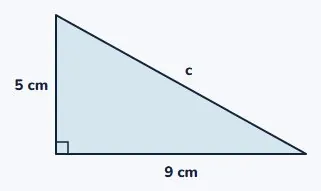
Q1: find the hypotenuse
- c is opposite the 90°.
- Add the squares.
- c² = 5² + 9²Pythagoras
- c² = 25 + 81 = 106
- c = √106square root
- √106 = 10.2956…calculator
- c ≈ 10.3 cm1 dp
- 10.3 > 9 and 10.3 > 5
Question 2 · Achieved
- A right-angled triangle has
- hypotenuse 12 cm and a side of 8 cm.
- Find the other side a, to 1 dp.
- Careful: 12 cm is the longest side.
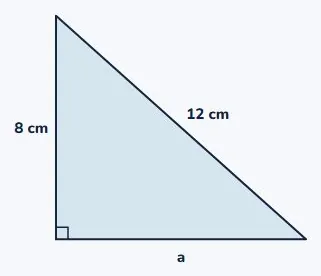
Q2: find a shorter side
- a is a shorter side.
- So subtract.
- a² + 8² = 12²Pythagoras
- a² = 12² − 8²−8² both sides
- a² = 144 − 64 = 80
- a = √80
- √80 = 8.9442…calculator
- a ≈ 8.9 cm1 dp
- 144 + 64 = 208, √208 ≈ 14.4
- 14.4 > 12: impossiblelonger than c
- 8.9 < 12
Question 3 · Merit, in context
- A 4.5 m ladder leans on a wall.
- Its foot is 1.2 m from the wall.
- How high up the wall does it reach?
- Give your answer to 2 dp.
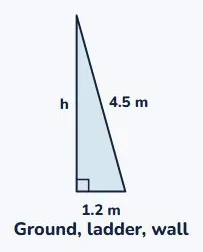
Q3: the ladder
- Ladder is the hypotenuse.
- Subtract, then root.
- h² + 1.2² = 4.5²Pythagoras
- h² = 4.5² − 1.2²−1.2² both sides
- h² = 20.25 − 1.44 = 18.81
- h = √18.81
- √18.81 = 4.3370…calculator
- h ≈ 4.34 m2 dp
- 4.34 < 4.5shorter than ladder
- It reaches about 4.34 m up
Question 4 · Merit, in context
- A builder marks out a deck corner.
- Sides 2.4 m and 3.2 m, diagonal 4.1 m.
- Is the corner a right angle? Explain.
Q4: is it a right angle?
- Use the converse.
- Compare, then explain.
- 2.4² + 3.2² = 5.76 + 10.24
- = 16
- 4.1² = 16.81longest side
- 16 ≠ 16.81
- Not a right anglesquares do not match
- For 90°: diagonal = √16 = 4 m
Question 5 · Merit, in context
- A kayak paddles 1.2 km due east,
- then 500 m due north.
- How far is it from its start, in m?
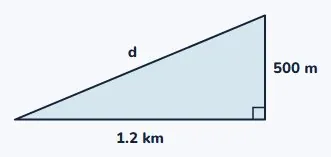
Q5: the kayak
- East, then north: 90°.
- Same units first.
- √(1.2² + 500²) ≈ 500mixed units
- 1.2 km = 1200 m× 1000
- d² = 1200² + 500²Pythagoras
- d² = 1 440 000 + 250 000
- = 1 690 000
- d = √1 690 000 = 1300
- 1300 m from the start
- 1.2² + 0.5² = 1.69 = 1.3²in km
Question 6 · Excellence
- A box is 80 cm by 50 cm by 30 cm.
- Will a 1 m fishing rod fit inside,
- lying straight? Explain.
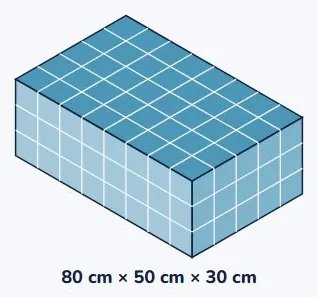
Q6: two triangles
- Longest: space diagonal.
- Floor first, keep exact.
- f² = 80² + 50²floor triangle
- f² = 6400 + 2500 = 8900
- f = √8900keep exact
- Triangle 2: sides f, 30, d
- d² = f² + 30²height at 90° to floor
- d² = 8900 + 900 = 9800
Q6: does the rod fit?
- Round only at the end.
- Compare in one unit.
- d² = 9800
- d = √9800
- √9800 = 98.9949…calculator
- d ≈ 98.99 cm2 dp
- 1 m = 100 cm
- 98.99 cm < 100 cm
- No, the 1 m rod will not fit
Question 7 · Excellence, in context
- A tent is a square-based pyramid.
- Its base is 6 m by 6 m.
- Each sloping edge is 5 m long.
- How tall is the centre pole? (2 dp)
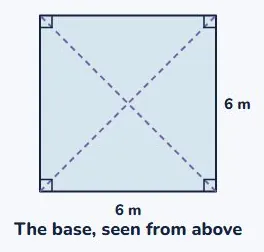
Q7: centre to corner first
- Pole meets base at 90°.
- Base triangle first.
- k = centre to a corner
- k² = 3² + 3²half of 6 each way
- k² = 9 + 9 = 18
- k = √18keep exact
- Triangle 2: pole h, k, edge 5
- h² + k² = 5²edge is hypotenuse
- h² + 18 = 25k² = 18
Q7: the height of the pole
- Subtract, then root.
- Round at the end.
- h² + 18 = 25
- h² = 25 − 18 = 7−18 both sides
- h = √7
- √7 = 2.6457…calculator
- h ≈ 2.65 m2 dp
- 2.65 < 5shorter than edge
- The pole is about 2.65 m tall
The method that solved all seven
- Right angle, hypotenuse, square, root, then round.
| Step | How |
|---|---|
| Right angle | find it before anything else |
| Hypotenuse | opposite 90°, the longest |
| Short side | subtract, never add |
| Same units | convert before you square |
| Converse | squares match: a right angle |
| 3D lengths | two triangles, keep it exact |
| Rounding | only at the end, with units |
Is your child on track?
Take the free placement test