Optimal solutions: 7 exam questions solved step by step
What this lesson covers
- The best option depends on the quantity being compared, so the comparison has to be set up before the choice is made.
- Where two cost rules cross is the point at which the better option changes.
7 questions, one way of working
- 1. Name the measure: cheapest, largest.
- 2. Write a rule for each option.
- 3. Equal: solve. Better: an inequation.
- 4. Maximum: halfway between the zeros.
- 5. Answer in words, with numbers.
Question 1 · Achieved, in context
- Bike hire in Rotorua, for 3 hours.
- Company A: $15, plus $5 an hour.
- Company B: $25, plus $3 an hour.
- Which is cheaper? Justify it.
Q1: bike hire for 3 hours
- Measure: total cost.
- Fee + rate × hours.
- Let h = number of hours
- A = 15 + 5hfee + rate × hours
- B = 25 + 3h
- A = 15 + 5 × 3 = 30h = 3
- B = 25 + 3 × 3 = 34h = 3
- 30 < 34, a saving of $4
- Company A is cheaper, by $4
Question 2 · Achieved, in context
- A gym has two ways to pay.
- Plan P: $40 to join, then $8 a visit.
- Plan Q: $12 a visit, nothing to join.
- When do both cost the same?
Q2: the break-even point
- Same cost: set equal.
- Check in both rules.
- P = 40 + 8nn = number of visits
- Q = 12nno joining fee
- 40 + 8n = 12nP = Q
- 40 = 4n−8n both sides
- n = 10÷ 4
- P = 40 + 80 = 120
- Q = 12 × 10 = 120
- 10 visits, both cost $120
Question 3 · Merit, in context
- Bike hire: A = 15 + 5h, B = 25 + 3h
- Hire is charged in whole hours.
- For which hires is B cheaper?
- Answer in hours, not just in h.
Q3: when is B cheaper?
- Cheaper: less than.
- Whole hours only.
- 25 + 3h < 15 + 5hB < A
- 25 < 15 + 2h−3h both sides
- 10 < 2h−15 both sides
- 5 < h, so h > 5÷ 2, sign stays
- h = 5: A = 40, B = 40break-even
- h = 6: A = 45, B = 43B wins
- 6 hours or more: B is cheaper
Question 4 · Merit, in context
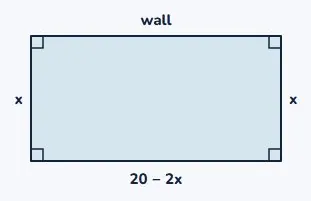
- A vege garden against a wall.
- 20 m of fence for the other 3 sides.
- Width x m, so A = x(20 − 2x).
- Find the largest possible area.
Q4: the largest garden
- Opens downward: a max.
- Max is halfway.
- length = 20 − 2xtwo widths use 2x
- A = x(20 − 2x) = −2x² + 20xx² negative: a max
- A = 0: x = 0 or 20 − 2x = 0
- zeros: x = 0 and x = 10
- x = (0 + 10) ÷ 2 = 5halfway
- length = 20 − 2 × 5 = 10
- A = 5 × 10 = 50
- x = 4 or 6: A = 48 < 50
- 50 m², 5 m wide by 10 m long
Question 5 · Merit, in context
- A school quiz night sells tickets.
- At $p each, it sells 200 − 10p.
- Income: R = p(200 − 10p) dollars.
- Which price gives the most income?
Q5: the best ticket price
- Measure: income.
- Halfway between zeros.
- R = −10p² + 200popens downward
- R = 0: p = 0 or 200 − 10p = 0
- zeros: p = 0 and p = 20
- p = (0 + 20) ÷ 2 = 10halfway
- tickets = 200 − 10 × 10 = 100
- R = 10 × 100 = 1000
- p = 9: 9 × 110 = 990
- p = 11: 11 × 90 = 990
- $10 a ticket, income $1000
Question 6 · Excellence
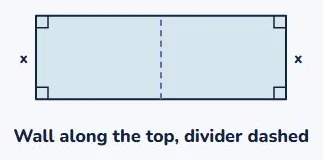
- Two sheep pens, side by side,
- against a woolshed wall.
- 24 m of fence, one across the middle.
- Find the pens with the most area.
Q6: two pens, one fence
- The divider is a width.
- Then halfway again.
- Let x = width of the pens (m)
- length = 24 − 3x3 widths use 3x
- A = x(24 − 3x) = −3x² + 24xopens downward
- zeros: x = 0 and x = 824 − 3x = 0
- x = (0 + 8) ÷ 2 = 4halfway
- length = 24 − 3 × 4 = 12
- A = 4 × 12 = 48
- x = 3 or 5: A = 45 < 48
- 4 m by 12 m, 48 m² in total
Question 7 · Excellence
- C: $f fixed, plus $4 an hour.
- D: $7 an hour, no fixed fee.
- Show they break even at h = f/3.
- Find f for 4 hours; when is C cheaper?
Q7: break-even with a letter
- Same method, a letter.
- Solve for h.
- C = f + 4h
- D = 7h
- f + 4h = 7hC = D
- f = 3h−4h both sides
- h = f/3÷ 3
- h = 4: f = 3 × 4 = 12
- C = 12 + 16 = 28, D = 28
Q7: when is C cheaper?
- Cheaper: less than.
- Whole hours only.
- C = 12 + 4h, D = 7h
- 12 + 4h < 7hC < D
- 12 < 3h−4h both sides
- 4 < h, so h > 4÷ 3
- h = 5: C = 32, D = 35
- f = $12; C cheaper from 5 hours
The method that solved all seven
- Name the measure, compare, and justify in words.
| Step | How |
|---|---|
| The measure | name what best means first |
| Two rules | fixed fee + rate × amount |
| Break-even | set the rules equal, solve |
| Better when | an inequation, then check |
| Whole units | h > 5 means 6 hours or more |
| Most area | halfway between the zeros |
| Justify it | choice, numbers and reason |
Is your child on track?
Take the free placement test