Quadratic equations: 7 exam questions solved step by step
What this lesson covers
- If two quantities multiply to zero, at least one of them is zero.
- A quadratic equation can have two, one or no real solutions, and the solutions are where its graph crosses the x-axis.
7 questions, one method
- 1. Rearrange so one side is 0.
- 2. Factorise.
- 3. Each bracket = 0 (null factor law).
- 4. Check every answer.
Question 1 · Achieved
- Solve x² + 2x − 15 = 0
Q1: x² + 2x − 15 = 0
- Multiply to −15, add to 2.
- Check both roots.
- 5 × −3 = −15, 5 + −3 = 2
- (x + 5)(x − 3) = 0factorise
- x + 5 = 0 or x − 3 = 0null factor law
- x = −5
- x = 3
- x = 3: 9 + 6 − 15 = 0
- x = −5: 25 − 10 − 15 = 0
- x = −5 or x = 3
Try it: the roots on the graph
Question 2 · Achieved
- Solve x² = 7x − 10
Q2: x² = 7x − 10
- Not 0 yet: rearrange.
- Check in the original.
- x² = 7x − 10
- x² − 7x + 10 = 0−7x, +10 both sides
- −2 × −5 = 10, −2 + −5 = −7
- (x − 2)(x − 5) = 0factorise
- x = 2 or x = 5null factor law
- x = 2: 4 = 14 − 10
- x = 5: 25 = 35 − 10
Question 3 · Merit
- Solve 3x² − 10x − 8 = 0
Q3: 3x² − 10x − 8 = 0
- A = 3: use ac.
- Split the middle term.
- ac = 3 × −8 = −24
- −12 × 2 = −24, −12 + 2 = −10
- 3x² − 12x + 2x − 8 = 0split the middle
- 3x(x − 4) + 2(x − 4) = 0factorise in pairs
- (3x + 2)(x − 4) = 0common bracket
- 3x = −2, x = −2/3
- x = 4
- x = 4: 48 − 40 − 8 = 0
- x = −2/3 or x = 4
Question 4 · Merit
- Solve (x + 2)(x − 3) = 14
- Careful: the right side is 14, not 0.
Q4: (x + 2)(x − 3) = 14
- Brackets = 14 tells you nothing.
- Expand, then get to 0.
- x² − 3x + 2x − 6 = 14expand
- x² − x − 6 = 14collect x terms
- x² − x − 20 = 0−14 both sides
- −5 × 4 = −20, −5 + 4 = −1
- (x − 5)(x + 4) = 0factorise
- x = 5 or x = −4null factor law
- x = 5: 7 × 2 = 14
- x = −4: (−2)(−7) = 14
Try it: expand, then rearrange
Question 5 · Merit, in context
- A ball is thrown up.
- Height after t seconds: h = 20t − 5t²
- When is the ball 15 m high?
Q5: when is h = 15?
- Keep t² positive.
- Two answers can both fit.
- 20t − 5t² = 15h = 15
- 0 = 5t² − 20t + 15all to the right
- 0 = t² − 4t + 3÷ 5
- 0 = (t − 1)(t − 3)−1 × −3, −1 + −3
- t = 1 or t = 3
- t = 1: 20 − 5 = 15
- t = 3: 60 − 45 = 15
- 1 s going up, 3 s coming down
Question 6 · Excellence
- Two consecutive odd numbers
- Multiply to 143.
- Find the two numbers.
Q6: odd numbers, product 143
- Define the unknown.
- Reject only with a reason.
- Let n = the smaller odd number
- next odd number = n + 2
- n(n + 2) = 143
- n² + 2n − 143 = 0expand, −143
- (n + 13)(n − 11) = 013 × −11, 13 + −11
- n = −13 or n = 11
- 11 × 13 = 143
- (−13)(−11) = 143
- 11 and 13, or −13 and −11
Question 7 · Excellence
- A right-angled triangle has sides
- X, x + 7 and hypotenuse x + 8 (cm).
- Find the three side lengths.
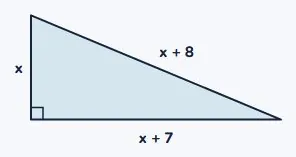
Q7: form the equation
- Pythagoras: a² + b² = c²
- Expand each square fully.
- x² + (x + 7)² = (x + 8)²Pythagoras
- (x + 7)² = x² + 14x + 49
- (x + 8)² = x² + 16x + 64
- x² + x² + 14x + 49
- = x² + 16x + 64
- 2x² + 14x + 49 = x² + 16x + 64
- x² − 2x − 15 = 0−x², −16x, −64
Q7: solve, reject, check
- A length cannot be negative.
- Answer in words, with units.
- x² − 2x − 15 = 0
- (x − 5)(x + 3) = 0−5 × 3, −5 + 3
- x = 5 or x = −3
- x = −3side would be −3 cm
- sides 5, 12, 13x, x + 7, x + 8
- 25 + 144 = 169 = 13²
- 5 cm, 12 cm and 13 cm
Common mistakes
- (x + 2)(x − 3) = 14, so x + 2 = 14 or x − 3 = 14The null factor law needs 0 on one side: expand to x² − x − 20 = 0, so (x − 5)(x + 4) = 0, x = 5 or x = −4.
- x² + 2x − 15 = (x + 5)(x − 3) = 0, so x = 5 or x = −3Set each bracket to 0: x + 5 = 0 gives x = −5 and x − 3 = 0 gives x = 3; the signs flip.
- x = 5 or x = −3, so the sides are 5, 12, 13 or −3, 4, 5.Reject x = −3 with a reason: a side of −3 cm is impossible, so the sides are 5 cm, 12 cm and 13 cm.
The method that solved all seven
- Zero, factorise, solve, check, and reason in context.
| Step | How |
|---|---|
| Get to zero | everything on one side first |
| Factorise | multiply to c, add to b |
| a is not 1 | split the middle using ac |
| Solve | each bracket equals 0 |
| Check | substitute both roots back |
| In context | reject only with a reason |
Practise this
Worksheet with answersWithout answersDownload PDF
2026 practice paper with worked answersOpen the paper
Report a mistake
More in AS 91947
 Expanding, index laws and algebraic fractions8 min
 Factorising quadratics, HCF and difference of squares8 min
 Algebraic proof: even, odd and consecutive numbers8 min
 Solving linear equations and inequations8 min
 Solving quadratic equations by factorising8 min
 Simultaneous equations: elimination and substitution8 min
 Straight-line graphs, gradient and rate of change8 min
 Optimal solutions: break-even and maximum area7 min
 Pythagoras' theorem in 2D and 3D explained7 min
 Trigonometry: SOH CAH TOA, elevation and 3D7 min
 Similar shapes: scale factors, area and volume7 min
 Surface area of pyramids, cones and spheres7 min
 Volume of cones, pyramids, spheres and composite solids7 min
 Expressions: 7 exam questions solved step by step11 min
 Factorising: 7 exam questions solved step by step10 min
 Generalising: 7 exam questions solved step by step10 min
 Equations and inequations: 7 exam questions solved11 minQuadratic equations: 7 exam questions solved step by step11 min
 Simultaneous equations: 7 exam questions solved step by step12 min
 Straight-line graphs: 7 exam questions solved step by step11 min
 Optimal solutions: 7 exam questions solved step by step11 min
 Pythagoras: 7 exam questions solved step by step11 min
 Trigonometry: 7 exam questions solved step by step10 min
 Similar shapes: 7 exam questions solved step by step10 min
 Surface area: 7 exam questions solved step by step11 min
 Volume: 7 exam questions solved step by step10 min
Is your child on track?
Take the free placement test