Simultaneous equations: 7 exam questions solved step by step
What this lesson covers
- Two equations in two unknowns are solved by the pair of values that makes both true at once.
- Graphically, that pair is the point where the two lines cross.
7 questions, one method
- 1. Label the equations (1) and (2).
- 2. Eliminate or substitute one letter.
- 3. Solve, then find the other letter.
- 4. Check in both original equations.
Question 1 · Achieved
- Solve 2x + y = 11 (1)
- and 3x − y = 9 (2)
Q1: 2x + y = 11, 3x − y = 9
- Opposite signs: add.
- Check in both equations.
- +y and −y: opposite signs
- 5x = 20(1) + (2)
- x = 4÷ 5
- 2 × 4 + y = 11x = 4 into (1)
- 8 + y = 11, y = 3
- (1): 8 + 3 = 11
- (2): 12 − 3 = 9
- x = 4, y = 3
Question 2 · Achieved
- Solve y = 3x − 2 (1)
- and 2x + y = 13 (2)
Q2: y = 3x − 2, 2x + y = 13
- y is given: substitute.
- Use brackets.
- 2x + (3x − 2) = 13replace y in (2)
- 5x − 2 = 13collect x terms
- 5x = 15+2 both sides
- x = 3÷ 5
- y = 3 × 3 − 2 = 7x = 3 into (1)
- (1): 7 = 9 − 2
- (2): 6 + 7 = 13
- x = 3, y = 7
Question 3 · Merit
- Solve 3x + 4y = 18 (1)
- and 2x − 3y = −5 (2)
- Careful with the negative.
Q3: make the x terms match
- Multiply both equations.
- Minus a negative is plus.
- 6x + 8y = 36(1) × 2
- 6x − 9y = −15(2) × 3
- 6x − 6x = 0(1) − (2): x goes
- 8y − (−9y) = 17yminus a negative
- 36 − (−15) = 51
- 17y = 51
- y = 3÷ 17
Q3: find x, check both
- Back into equation (1).
- Check both equations.
- y = 3
- 3x + 4 × 3 = 18y = 3 into (1)
- 3x + 12 = 18
- 3x = 6−12 both sides
- x = 2÷ 3
- (1): 6 + 12 = 18
- (2): 4 − 9 = −5
- x = 2, y = 3
Question 4 · Merit
- The lines y = 2x + 1 and x + y = 7
- Find where they cross, using algebra.
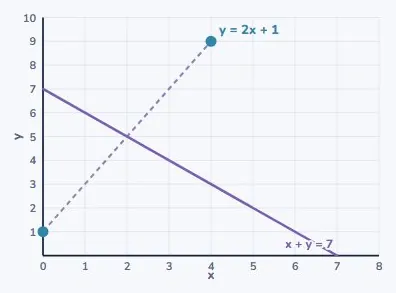
Q4: where the lines cross
- Crossing = fits both.
- y is given: substitute.
- x + (2x + 1) = 7replace y
- 3x + 1 = 7collect x terms
- 3x = 6−1 both sides
- x = 2÷ 3
- y = 2 × 2 + 1 = 5x = 2 into y = 2x + 1
- 2 + 5 = 7
- they cross at (2, 5)
Question 5 · Merit, in context
- Hāngī tickets: adults $15, children $8.
- 120 tickets sold, $1450 taken.
- How many of each were sold?
Q5: hāngī tickets
- Define the letters.
- Answer in words.
- a = adult, c = child tickets
- a + c = 120counts tickets
- 15a + 8c = 1450counts dollars
- 8a + 8c = 960first × 8
- 7a = 490, a = 70money − that, ÷ 7
- 70 + c = 120, c = 50
- 70 + 50 = 120
- 1050 + 400 = 1450
- 70 adult, 50 child tickets
Question 6 · Excellence, in context
- Kayak hire: a fixed fee + an hourly rate.
- 2 hours costs $50. 5 hours costs $95.
- How many hours can you hire for $140?
Q6: find the fee and the rate
- Stage 1: fee and rate.
- Same sign: subtract.
- f = fee ($), r = rate ($ per h)
- f + 2r = 502 hours (1)
- f + 5r = 955 hours (2)
- 3r = 45(2) − (1)
- r = 15÷ 3
- f + 30 = 50, f = 20
- (2): 20 + 75 = 95
- $20 fee, $15 per hour
Q6: hours for $140
- Stage 2: use the rule.
- Do not forget the fee.
- $20 fee, $15 per hour
- 140 ÷ 15 ≈ 9.3forgets the $20 fee
- C = 15h + 20cost of h hours
- 15h + 20 = 140C = 140
- 15h = 120−20 both sides
- h = 8÷ 15
- 15 × 8 + 20 = 140
- 8 hours of kayak hire
Question 7 · Excellence
- 3x + y = 5k (1), k a constant
- x − y = 3k (2)
- Solve for x and y in terms of k.
- If x = 6, find k and the point.
Q7: solve in terms of k
- k is just a number.
- Add: the y terms cancel.
- 4x = 8k(1) + (2)
- x = 2k÷ 4
- 2k − y = 3kx = 2k into (2)
- −y = k, y = −k−2k both sides
- (1): 6k − k = 5k
- (2): 2k − (−k) = 3k
- x = 2k, y = −k
Q7: the lines meet at x = 6
- Use x = 2k.
- Check with k = 3.
- x = 2k, y = −k
- 2k = 6x = 6
- k = 3÷ 2
- y = −3y = −k
- (1): 18 − 3 = 15 = 5 × 3
- (2): 6 − (−3) = 9 = 3 × 3
- k = 3, point (6, −3)
The method that solved all seven
- Label, match, eliminate, check both, and answer in words.
| Step | How |
|---|---|
| Label | number them (1) and (2) |
| Match | multiply every term |
| Eliminate | add if opposite, else subtract |
| Substitute | when one gives y already |
| Back-sub | find the other letter |
| Check | in both original equations |
| Context | answer in words, with units |
Is your child on track?
Take the free placement test