Similar shapes: 7 exam questions solved step by step
What this lesson covers
- Similar shapes have equal corresponding angles and corresponding sides in the same ratio.
- If lengths scale by k, areas scale by k squared and volumes by k cubed.
7 questions, one method
- 1. Show they are similar, and why.
- 2. Match corresponding sides.
- 3. Find k from a known pair.
- 4. Lengths × k, areas × k², volumes × k³.
Question 1 · Achieved
- Rectangle A: 4 cm by 10 cm
- Rectangle B: 6 cm by 15 cm
- Rectangle C: 7 cm by 13 cm
- Which is similar to A? Why?
Q1: which rectangle is similar?
- Angles match already.
- Short ÷ short, long ÷ long.
- all angles 90°rectangles
- B: 6 ÷ 4 = 1.5, 15 ÷ 10 = 1.5
- B is similar, k = 1.5
- C: 7 ÷ 4 = 1.75, 13 ÷ 10 = 1.3
- C is not similarratios differ
- B is similar to A; C is not.
Question 2 · Achieved
- Two triangles are similar.
- Small: 6 cm, 8 cm, y
- Large, same order: 9 cm, x, 15 cm
- Find x and y.
Q2: find x and y
- k from the known pair.
- Up × k, down ÷ k.
- 6 with 9, 8 with x, y with 15
- k = 9 ÷ 6 = 1.5small to large
- x = 8 × 1.5 = 12 cmsmall to large: × k
- y = 15 ÷ 1.5 = 10 cmlarge to small: ÷ k
- 12 > 8, 10 < 15
- x = 12 cm, y = 10 cm
Question 3 · Merit
- Triangle PQR: angles 48° and 62°
- Triangle XYZ: angles 62° and 70°
- Similar? Give your reasoning.
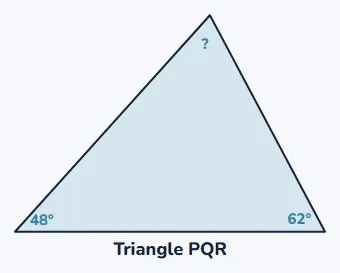
Q3: are they similar?
- Angles add to 180°.
- Equal angles: similar.
- PQR: 180 − 48 − 62 = 70°angle sum 180°
- PQR: 48°, 62°, 70°
- XYZ: 180 − 62 − 70 = 48°angle sum 180°
- XYZ: 48°, 62°, 70°
- all three angles equal
- Similar: all angles equal
Question 4 · Merit
- DE is parallel to BC.
- AD = 6 cm, DB = 4 cm, DE = 9 cm
- Find BC.
- Careful: which side of the big one?
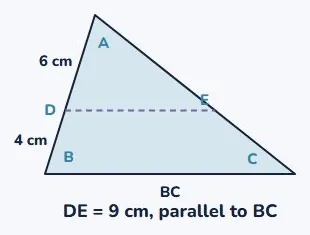
Q4: DE parallel to BC
- Prove similar first.
- Use the whole side.
- angle A sharedcommon angle
- angle D = angle Bcorresponding, DE ∥ BC
- triangles similar
- AB = 6 + 4 = 10 cmthe whole side
- k = 10 ÷ 6 = 5/3AB ÷ AD
- BC = 9 × 5/3 = 15 cm
- 9 × 4 ÷ 6 = 6 cmused the piece DB
Question 5 · Merit, in context
- A student 160 cm tall
- casts a shadow 2 m long.
- The flagpole's shadow is 12.5 m.
- How tall is the flagpole?
Q5: the flagpole
- Reason, then units.
- Shadows give k.
- same sun angle, both 90°two equal angles
- triangles similar
- 160 cm = 1.6 msame units
- k = 12.5 ÷ 2 = 6.25shadow ÷ shadow
- h = 1.6 × 6.25 = 10 mheight × k
- The flagpole is 10 m tall.
Question 6 · Excellence
- Two similar triangular sails.
- Small: area 16 m², height 4.8 m
- Large: area 25 m²
- How tall is the large sail?
Q6: from areas to a height
- Area ratio is k².
- Square root for k.
- 4.8 × 25 ÷ 16 = 7.5 mareas scale by k²
- k² = 25 ÷ 16area ratio
- k = √25 ÷ √16 = 5/4 = 1.25square root
- h = 4.8 × 1.25 = 6 mlengths scale by k
- 16 × 1.25² = 16 × 1.5625 = 25
- The large sail is 6 m tall.
Question 7 · Excellence
- Two similar paint tins.
- Surface areas: 225 cm² and 576 cm²
- The small tin holds 250 mL.
- How much does the large tin hold?
Q7: from areas to a volume
- Areas back to k.
- Then k³ for volume.
- k² = 576 ÷ 225 = 2.56areas scale by k²
- k = √2.56 = 1.6square root
- k³ = 1.6³ = 4.096volumes scale by k³
- V = 250 × 4.096small volume × k³
- = 1024 mL
- 250 × 2.56 = 640 mLk² is for areas
- The large tin holds 1024 mL.
The method that solved all seven
- Prove similar, find k, then use k, k² or k³.
| Step | How |
|---|---|
| Similar? | equal angles, sides in 1 ratio |
| Triangles | two equal angles are enough |
| Match sides | in order, by their angles |
| Scale factor | from a pair known on both |
| Lengths | × k, or ÷ k to go back |
| Whole side | never just the piece |
| Area factor | k², so k = √(area ratio) |
| Volumes | scale by k³, never k² |
Is your child on track?
Take the free placement test