Surface area: 7 exam questions solved step by step
What this lesson covers
- Surface area is the total area of every face, so a net shows exactly what to add up.
- Cones and spheres have curved surfaces with their own area formulas; the skill is knowing which pieces a solid has, and which faces are hidden.
7 questions, one method
- 1. Picture the net: list every face.
- 2. Slant heights from Pythagoras.
- 3. Leave out hidden faces.
- 4. Add, keep π, round at the end.
Question 1 · Achieved
- A triangular prism is 20 cm long.
- Its ends are right-angled triangles,
- sides 5 cm, 12 cm and 13 cm.
- Find its total surface area.
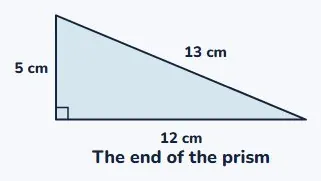
Q1: triangular prism, 20 cm
- List the five faces.
- Triangle: the right angle.
- 2 triangles, 3 rectangles
- Ends: 2 × ½ × 5 × 12 = 60sides at right angle
- 5 × 20 = 100rectangle
- 12 × 20 = 240rectangle
- 13 × 20 = 260rectangle
- SA = 60 + 100 + 240 + 260
- SA = 660 cm²
- 30 × 20 + 60 = 660perimeter × length
Question 2 · Achieved
- A closed cylinder has radius 3 cm
- and height 10 cm.
- Find its total surface area, to 1 d.p.
Q2: cylinder, r = 3, h = 10
- Closed: two circles.
- Keep π until the end.
- SA = 2πr² + 2πrhcircles + curved side
- 2 × π × 3² = 18πtwo circles
- 2 × π × 3 × 10 = 60πcurved side
- SA = 18π + 60π = 78π cm²
- 78π = 245.044...
- SA ≈ 245.0 cm² (1 d.p.)
Question 3 · Merit
- A square-based pyramid has a base
- 16 cm by 16 cm, vertical height 6 cm.
- Find its total surface area.
- Careful: 6 cm is not up the triangles.
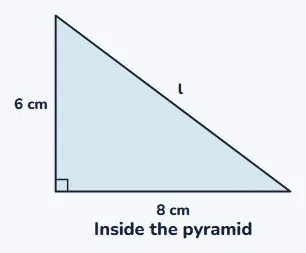
Q3: square-based pyramid
- Slant height first.
- Then base + 4 triangles.
- l² = 6² + 8²Pythagoras, half of 16
- l² = 36 + 64 = 100
- l = 10 cm
- Base: 16 × 16 = 256
- Triangle: ½ × 16 × 10 = 80
- 4 × 80 = 320four triangles
- SA = 256 + 320
- SA = 576 cm²
- Triangles with 6: SA = 448used 6, not l
Question 4 · Merit
- A solid cone has base radius 8 cm
- and vertical height 6 cm.
- Find its total surface area, to 1 d.p.
Q4: cone, r = 8, h = 6
- πrl needs the slant l.
- Base + curved surface.
- l² = 8² + 6² = 64 + 36Pythagoras
- l = √100 = 10 cm
- SA = πr² + πrlbase + curved surface
- π × 8² = 64πbase
- π × 8 × 10 = 80πcurved surface
- SA = 64π + 80π = 144π cm²
- 144π = 452.389...
- SA ≈ 452.4 cm² (1 d.p.)
Question 5 · Merit, in context
- A climbing dome: a hemisphere, 6 m across.
- Only the curved outside is painted.
- 1 L of paint covers 8 m².
- Paint comes in 1 L tins. How many tins?
Q5: painting the dome
- 6 m is the diameter.
- Round the tins up.
- r = 6 ÷ 2 = 3 m6 m is the diameter
- Curved SA = ½ × 4πr² = 2πr²no floor
- 2 × π × 3² = 18π m²
- 18π = 56.548... m²
- 18π ÷ 8 = 7.068... L8 m² per litre
- 7 tinscover only 56 m²
- 8 tins of paintround up
Question 6 · Excellence, in context
- A water tank: a cylinder, radius 3 m,
- height 5 m, with a cone roof on top,
- vertical height 4 m.
- Find its total surface area, to 1 d.p.
Q6: which faces count?
- Count what paint reaches.
- Joined faces are hidden.
- Base circle: outside
- Cylinder side: outside
- Roof curve: outside
- Cylinder top, roof basejoined, inside
- l² = 3² + 4² = 9 + 16 = 25Pythagoras
- l = 5 m
Q6: add the three pieces
- Keep π in.
- Round once, in m².
- l = 5 m
- Base: π × 3² = 9ππr²
- Side: 2 × π × 3 × 5 = 30π2πrh
- Roof: π × 3 × 5 = 15ππrl
- SA = 9π + 30π + 15π
- = 54π m²
- 54π = 169.646...
- SA ≈ 169.6 m² (1 d.p.)
Question 7 · Excellence
- A closed cylinder has height = diameter.
- Its total surface area is 150π cm².
- Find its radius and its height.
Q7: form the equation
- Name the unknown: r.
- Height = diameter = 2r.
- Let radius = r, so h = 2r
- SA = 2πr² + 2πrh
- = 2πr² + 2πr(2r)h = 2r
- = 2πr² + 4πr²
- = 6πr²collect
- 6πr² = 150πthe given area
Q7: solve, reject, check
- A length cannot be negative.
- Answer in words, with units.
- 6πr² = 150π
- r² = 25÷ 6π both sides
- r = 5 or r = −5
- r = −5a radius is positive
- h = 2 × 5 = 10 cm
- 2π × 5² = 50π2πr²
- 2π × 5 × 10 = 100π2πrh
- 50π + 100π = 150π
- Radius 5 cm, height 10 cm
The method that solved all seven
- List every face, add, then round last.
| Step | How |
|---|---|
| Every face | picture the net, list them |
| Slant height | Pythagoras, not the height |
| Hidden face | joined faces do not count |
| Keep π in | add the π terms together |
| Round last | once, in cm² or m² |
Is your child on track?
Take the free placement test