Volume: 7 exam questions solved step by step
What this lesson covers
- A pyramid or cone holds one third of the prism or cylinder with the same base and height.
- The volume of a composite solid is the sum or difference of the volumes of its parts.
7 questions, one idea
- Prism, cylinder: base area × height.
- Pyramid, cone: ⅓ × base area × height.
- Sphere: 4/3 πr³. Hemisphere: half.
- Composite: add or take away the parts.
Question 1 · Achieved
- A triangular prism is 15 cm long.
- Its end is a right-angled triangle,
- sides 6 cm, 8 cm and 10 cm.
- Find its volume.
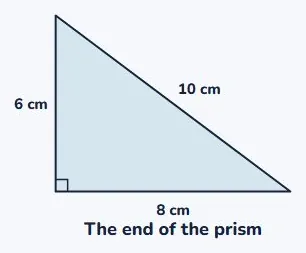
Q1: triangular prism, 15 cm
- Cross-section × length.
- Use 6 and 8, not 10.
- V = A × lcross-section × length
- A = ½ × b × h
- A = ½ × 6 × 8 = 24 cm²sides at right angle
- V = 24 × 15
- V = 360 cm³
Question 2 · Achieved
- A square-based pyramid has a base
- 9 cm by 9 cm, vertical height 10 cm.
- Find its volume.
Q2: square-based pyramid
- A third of the prism.
- Base area first.
- V = ⅓ × A × ha third of the prism
- A = 9 × 9 = 81 cm²
- V = ⅓ × 81 × 10
- 81 × 10 = 810the matching prism
- 810 ÷ 3 = 270
- V = 270 cm³
- 3 × 270 = 810
Question 3 · Merit
- A cone has base radius 6 cm
- and slant height 10 cm.
- Find its volume, to 1 d.p.
- Careful: 10 is not the height you need.
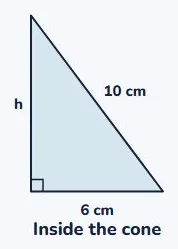
Q3: cone, r = 6, slant 10
- Height first, by Pythagoras.
- Then ⅓πr²h.
- h² + 6² = 10²Pythagoras, slant = 10
- h² = 100 − 36 = 64
- h = 8 cm
- V = ⅓πr²ha third of a cylinder
- V = ⅓ × π × 6² × 8
- = ⅓ × 288π = 96π cm³
- 96π = 301.592...
- V ≈ 301.6 cm³ (1 d.p.)
Question 4 · Merit, in context
- A marae kitchen bowl is a hemisphere,
- inside diameter 18 cm.
- How many litres does it hold, full?
- Give your answer to 2 d.p.
Q4: the bowl, in litres
- Radius, not diameter.
- 1 L = 1000 cm³.
- r = 18 ÷ 2 = 9 cmhalf the diameter
- V = ½ × 4/3 πr³ = ⅔πr³half a sphere
- V = ⅔ × π × 9³
- 9³ = 729, ⅔ × 729 = 486
- V = 486π cm³
- 486π = 1526.81... cm³
- 486π ÷ 1000 = 1.5268... L1 L = 1000 cm³
- The bowl holds about 1.53 L
Question 5 · Merit, in context
- A grain silo is a cylinder, radius 3 m,
- height 7 m, with a hemisphere on top.
- Find its volume, to 1 d.p.
Q5: the silo
- Find each part, then add.
- Keep π in.
- V = cylinder + hemisphere
- Cylinder: π × 3² × 7πr²h
- = 63π m³
- Dome: ⅔ × π × 3³⅔πr³
- = 18π m³
- V = 63π + 18π = 81π m³
- 81π = 254.469...
- V ≈ 254.5 m³ (1 d.p.)
Question 6 · Excellence
- A cylindrical can is 10 cm tall
- and must hold exactly 1 litre.
- Find the radius it needs, to 1 d.p.
Q6: working back to r
- Units first: cm³.
- Round only at the end.
- 1 L = 1000 cm³match the cm
- V = πr²h
- πr² × 10 = 1000
- r² = 1000/(10π) = 100/π÷ 10π both sides
- r² = 31.831...
- r = ±5.6419...√ both sides
- r = −5.6419...a radius is positive
- π × 5.6419² × 10 ≈ 1000
- r ≈ 5.6 cm (1 d.p.)
Question 7 · Excellence
- A ball fits exactly inside a can,
- touching the sides, top and bottom.
- What fraction of the can is empty?
- Show it is the same for any size ball.
Q7: the can and the ball
- No numbers: use r.
- Height = diameter = 2r.
- Ball radius = r
- Can: radius r, height 2rtouches all round
- Can: V = πr² × 2rπr²h
- = 2πr³
- Ball: V = 4/3 πr³sphere
Q7: what fraction is empty?
- Empty = can − ball.
- r cancels: any size.
- Can 2πr³, ball 4/3 πr³
- Empty = 2πr³ − 4/3 πr³
- = 6/3 πr³ − 4/3 πr³ = ⅔πr³
- Fraction = ⅔πr³ ÷ 2πr³empty ÷ whole can
- = ⅔ ÷ 2 = ⅓πr³ cancels
- r = 3: 18π ÷ 54π = ⅓
- ⅓ of the can is empty, any r
What solved all seven
- Formula, substitute, keep π, round last.
| Step | How |
|---|---|
| Prisms | base area × height, πr²h |
| Pyramids | ⅓ × base area × height |
| Spheres | 4/3 πr³, hemisphere ⅔πr³ |
| Composite | add or take away the parts |
| Check first | radius, true height, units |
| Round last | keep π in, then cm³, m³ or L |
Is your child on track?
Take the free placement test