Gradient graphs: 7 exam questions solved step by step
What this lesson covers
- The gradient graph is zero where the function turns, positive where it rises and negative where it falls.
- A cubic has a quadratic gradient graph and a quadratic has a straight-line gradient graph.
7 questions, one method
- 1. Turning point: f′ = 0, an x-intercept.
- 2. Rising: f′ above the axis.
- 3. Falling: f′ below the axis.
- 4. Degree drops by one: one smooth curve.
Question 1 · Achieved
- The graph of f(x) = x² + 2x − 3 is shown.
- Sketch the gradient graph, y = f′(x).
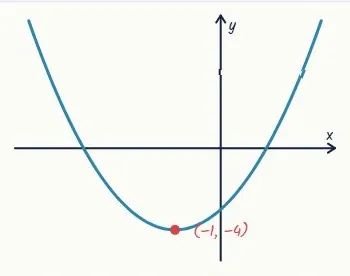
Q1: f(x) = x² + 2x − 3
- Turning point first.
- Then the signs.
- f turns at x = −1its minimum
- so f′(−1) = 0the x-intercept
- x < −1: falling, f′ < 0
- x > −1: rising, f′ > 0
- quadratic, so f′ is a linedegree drops by one
- f′(x) = 2x + 2differentiate
- 2x + 2 = 0 at x = −1
- f′(0) = 2the y-intercept
- line through (−1, 0) and (0, 2)
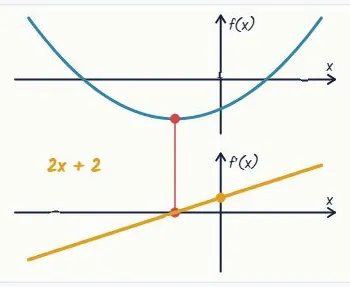
Q1: the sketch
- Cross at x = −1.
- Below, then above.
- One straight line.
Question 2 · Achieved, in context
- A drone takes off, rises, then comes down.
- Its gradient graph: dh/dt = 6 − 2t (m/s)
- When is the drone highest?
- Rising or falling at t = 4 s?
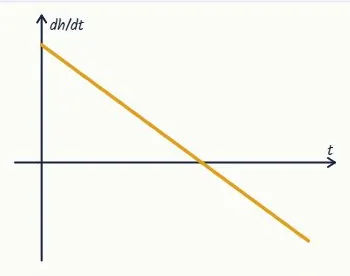
Q2: the drone
- Highest: gradient zero.
- Sign before and after.
- dh/dt = 0: 6 − 2t = 0stops rising
- t = 3
- t < 3: dh/dt > 0, rising
- t > 3: dh/dt < 0, falling
- + then −: a maximumsign change
- highest at t = 3 s
- t = 4: 6 − 2 × 4 = −2
- falling at 2 m/s when t = 4 s
Question 3 · Merit
- The cubic shown has a minimum at x = −1
- and a maximum at x = 3.
- Sketch y = f′(x). Where is it greatest?
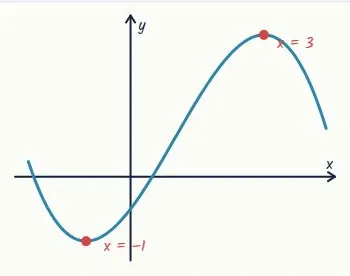
Q3: a cubic that ends falling
- Intercepts, then signs.
- Do not copy the curve.
- f′ = 0 at x = −1 and x = 3turning points
- x < −1: falling, f′ < 0
- −1 < x < 3: rising, f′ > 0
- x > 3: falling, f′ < 0
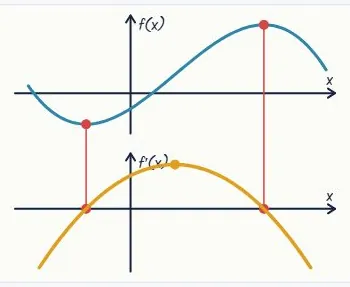
- cubic, so f′ is a paraboladegree drops by one
- − + −: it opens downwardupside down
- top at x = (−1 + 3) ÷ 2 = 1symmetric
- f′ greatest at x = 1
Q3: the sketch
- Under each turning point.
- Opens downward.
- Top at x = 1.
Question 4 · Merit
- f(x) = x³ − 6x² + 9x + 1
- Where does y = f′(x) cross the x-axis?
- Find its lowest point, then sketch it.
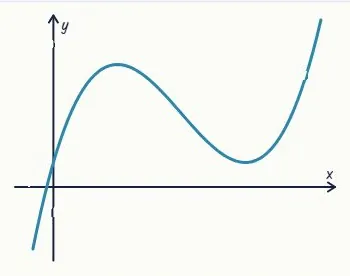
Q4: f(x) = x³ − 6x² + 9x + 1
- Term by term.
- Factorise for the zeros.
- x³ → 3x², −6x² → −12xpower down, minus 1
- 9x → 9, 1 → 0a constant → 0
- f′(x) = 3x² − 12x + 9
- = 3(x² − 4x + 3)take out 3
- = 3(x − 1)(x − 3)factorise
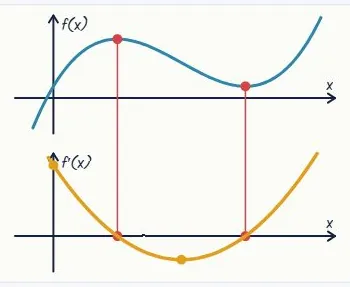
- crosses at x = 1 and x = 3
- lowest at x = (1 + 3) ÷ 2 = 2
- f′(2) = 12 − 24 + 9 = −3
- lowest point (2, −3)
Q4: the sketch
- Through x = 1 and x = 3.
- Lowest at (2, −3).
- Meets the y-axis at 9.
Question 5 · Merit
- The gradient graph y = f′(x) is shown.
- Find the turning points of f, and say
- which is a max and which is a min.
- Sketch a possible graph of f.
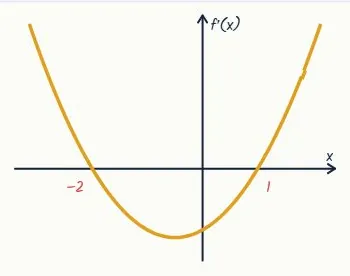
Q5: from f′ back to f
- Zeros are turning points.
- Sign change: max or min.
- f′ = 0 at x = −2 and x = 1turning points
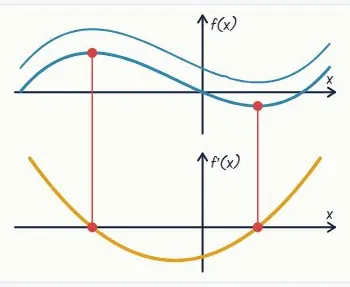
- x < −2: f′ > 0, f rising
- −2 < x < 1: f′ < 0, f falling
- x > 1: f′ > 0, f rising
- x = −2: + then −, a maximum
- x = 1: − then +, a minimum
- f′ is a parabola, so f is cubic
- max at x = −2, min at x = 1
Q5: a possible f
- Rise, fall, rise.
- Max at −2, min at 1.
- Any height will do.
Question 6 · Excellence
- f(x) = x³ − 3x² + 3x + 2
- Sam says f′(1) = 0, so f turns at x = 1.
- Is Sam right? Sketch y = f′(x).
- Careful: zero gradient is not always a turn.
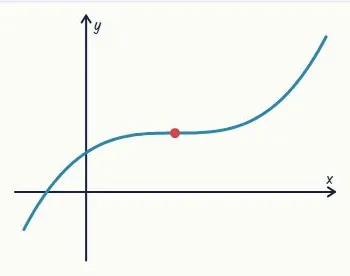
Q6: is it a turning point?
- Check the sign either side.
- No sign change, no turn.
- f′(x) = 3x² − 6x + 3differentiate
- = 3(x² − 2x + 1)take out 3
- = 3(x − 1)²a perfect square
- f′(1) = 3(0)² = 0stationary
- f′(0) = 3(−1)² = 3 > 0rising before
- f′(2) = 3(1)² = 3 > 0rising after
- turning point at x = 1no sign change
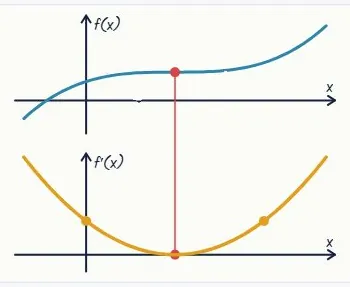
- f′ touches the axis at x = 1
- f flattens at x = 1, keeps rising
Q6: the sketch
- Touches at x = 1, no crossing.
- Above the axis everywhere else.
Question 7 · Excellence
- A cubic f has a positive x³ term and
- turning points at x = a and x = b.
- Show f′ is lowest at x = (a + b) ÷ 2.
- Then use it for a = −3 and b = 5.
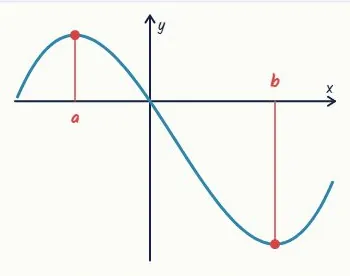
Q7: any cubic
- f′ is zero at a and b.
- Its turn is midway.
- f′(x) = k(x − a)(x − b), k > 0
- = k(x² − (a + b)x + ab)expand
- k(2x − (a + b)) = 0differentiate f′
- 2x = a + b
- x = (a + b) ÷ 2midway
- k > 0: f′ opens up, a minimum
- a = −3, b = 5: x = (−3 + 5) ÷ 2
- = 1
- f falls most steeply at x = 1
The method that solved all seven
- Turns, signs, degree, then one smooth curve.
| Step | How |
|---|---|
| Turns | f′ = 0: crosses the x-axis |
| Rising | f′ above the axis |
| Falling | f′ below the axis |
| Degree | drops by one |
| Steepest | furthest from the axis |
| Reverse | sign change: max or min |
| No change | flat, but not a turn |
Is your child on track?
Take the free placement test