Expected value: 7 exam questions solved step by step
What this lesson covers
- An expected number is the probability multiplied by the number of trials.
- Expected value is a long-run average, so it need not be a possible single outcome.
7 questions, two formulas
- 1. Expected number = n × p.
- 2. E(X) = Σ x × P(X = x).
- 3. Subtract any cost to play.
- 4. Round and explain in context.
Question 1 · Achieved, in context
- A packhouse grades 2500 kiwifruit.
- P(undersized) = 0.08
- How many are expected to be undersized?
Q1: expected number
- Trials × probability.
- Answer with units.
- expected number = n × p
- = 2500 × 0.08
- = 200
- about 200 undersized kiwifruit
- not undersized: 2500 − 200 = 2300
Question 2 · Achieved
- A fair spinner pays these prizes.
- Find the expected prize, E(X).
| Prize, x | P(X = x) |
|---|---|
| $0 | 0.5 |
| $2 | 0.3 |
| $5 | 0.15 |
| $20 | 0.05 |
Q2: E(X) for the spinner
- Check the total is 1.
- Each prize × its probability.
- 0.5 + 0.3 + 0.15 + 0.05 = 1
- E(X) = Σ x × P(X = x)
- = 0 × 0.5 + 2 × 0.3
- + 5 × 0.15 + 20 × 0.05
- = 0 + 0.6 + 0.75 + 1
- = 2.35
- expected prize: $2.35 a spin
Question 3 · Merit, in context
- The school charges $3 a spin.
- Find the player's expected net gain.
- Expected profit from 200 spins?
| Prize, x | P(X = x) |
|---|---|
| $0 | 0.5 |
| $2 | 0.3 |
| $5 | 0.15 |
| $20 | 0.05 |
Q3: subtract the cost
- E(X) is not the profit.
- Net = prize − cost.
- E(net) = E(X) − cost
- = 2.35 − 3
- = −0.65
- player: −$0.65 a spin on average
- school: +$0.65 a spin
- 200 × 0.65 = 130
- expected profit: $130
Question 4 · Merit
- X = people in a car on the bridge.
- Find k, then E(X).
- Explain what E(X) means.
| People, x | P(X = x) |
|---|---|
| 1 | 0.1 |
| 2 | 0.35 |
| 3 | k |
| 4 | 0.2 |
Q4: find k, then E(X)
- Find k first.
- E(X) need not be whole.
- 0.1 + 0.35 + k + 0.2 = 1total is 1
- 0.65 + k = 1add
- k = 0.35subtract 0.65
- E(X) = 1 × 0.1 + 2 × 0.35
- + 3 × 0.35 + 4 × 0.2
- = 0.1 + 0.7 + 1.05 + 0.8
- = 2.65 people
- a long-run average per car
Question 5 · Merit, in context
- A rugby club has 80 players.
- 60% are forwards, 40% backs.
- Injured: 15% of forwards, 10% of backs.
- How many injured players are expected?
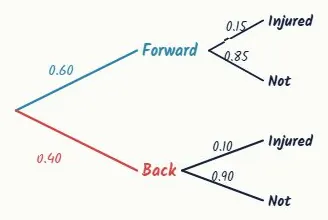
Q5: tree, then n × p
- Find P(injured) first.
- Round to whole people.
- P(F and I) = 0.6 × 0.15 = 0.09
- P(B and I) = 0.4 × 0.1 = 0.04
- P(I) = 0.09 + 0.04 = 0.13add across
- expected = 80 × 0.13
- = 10.4
- about 10 injured playerswhole people
- 48 × 0.15 + 32 × 0.1 = 10.4
Question 6 · Excellence
- A fair stall game costs $4 to play.
- Find x so the game is fair.
- Then find x for $1 profit a game.
| Result | Probability | Win |
|---|---|---|
| Top prize | 0.1 | $x |
| Money back | 0.25 | $4 |
| Nothing | the rest | $0 |
Q6: a fair game
- Fair: E(winnings) = cost.
- Form an equation in x.
- P(nothing) = 1 − 0.1 − 0.25 = 0.65
- E(W) = 0.1x + 0.25 × 4 + 0.65 × 0
- = 0.1x + 1
- 0.1x + 1 = 4fair: E(W) = cost
- 0.1x = 3subtract 1
- x = 30divide by 0.1
- fair top prize: $30
Q6: $1 profit a game
- Profit = cost − E(W).
- Check the new prize.
- E(W) = 0.1x + 1
- E(W) = 4 − 1 = 3school keeps $1
- 0.1x + 1 = 3
- 0.1x = 2, x = 20
- check: 0.1 × 20 + 1 = 3
- profit: 4 − 3 = $1 a game
- top prize: $20
Question 7 · Excellence, in context
- P(damaging frost this season) = 0.15
- No fans: a frost costs $40 000.
- Fans: $5000, and a frost costs $8000.
- Should the grower hire the fans?
Q7: expected cost each way
- Fans cost $5000 for sure.
- The frost loss is a chance.
- no fans: 0.15 × 40 000 = $6000
- fans: 5000 + 0.15 × 8000
- = 5000 + 1200 = $6200
- 6200 − 6000 = $200fans cost more
- 40 000p = 5000 + 8000pbreak-even frost risk
- 32 000p = 5000− 8000p
- p = 5000 ÷ 32 000 = 0.15625
Q7: decide, with reasons
- E(cost) is a long-run average.
- One season: look at the worst case.
- 0.15 is just under 0.156
- no fans: $200 cheaper on average
- no fans: lose $0 or $40 000
- fans: lose $5000 or $13 000
- fans cost $200 more, cap the loss
The method that solved all seven
- Multiply, add, subtract the cost, then explain.
| Step | How |
|---|---|
| Number | n × p, rounded in context |
| Check | probabilities add to 1 |
| Value | Σ x × P(X = x) |
| Net | subtract the cost to play |
| Fair | E(winnings) = cost |
| Meaning | a long-run average |
Is your child on track?
Take the free placement test