Probability trees: 7 exam questions solved step by step
What this lesson covers
- Each branch of a tree carries a probability conditional on the branches before it.
- Working backwards through a tree finds the probability of an earlier event given a later one.
7 questions, one tree method
- 1. Draw the tree from the words.
- 2. Along a path: multiply.
- 3. Across paths: add.
- 4. Backwards: path ÷ total.
Question 1 · Achieved, in context
- Ferry: wind warning on 30% of days.
- Warning: late 60%. No warning: late 10%.
- Draw the tree. Find P(warning and late).
Q1: build the tree
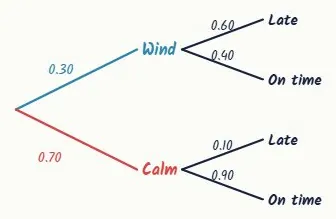
- First: wind 0.3, calm 0.7.
- After wind: late 0.6, on time 0.4.
- After calm: late 0.1, on time 0.9.
Q1: P(warning and late)
- Follow one path.
- Multiply along it.
- W: warning, L: late
- P(W and L) = P(W) × P(L | W)
- = 0.3 × 0.6multiply along
- = 0.18
Question 2 · Achieved
- Same ferry tree.
- Find P(the ferry is late).
Q2: P(late)
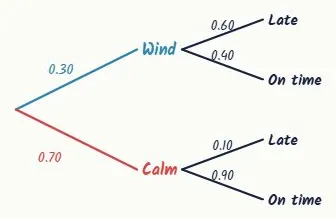
- Two paths end in late.
- Add across them.
- P(W and L) = 0.3 × 0.6 = 0.18
- P(not W and L) = 0.7 × 0.1 = 0.07
- P(L) = 0.18 + 0.07add across
- = 0.25
- 0.12 + 0.63 = 0.75 = 1 − 0.25
Question 3 · Merit
- Same ferry tree.
- The ferry is late today.
- Find P(there was a warning).
Q3: P(W | L)
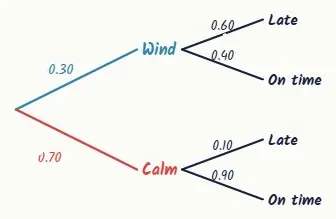
- Given late: late paths only.
- Path ÷ reduced total.
- P(W | L) = P(W and L) ÷ P(L)
- = 0.18 ÷ 0.25reduced total: P(L)
- = 0.72
- P(L | W) = 0.6forwards, not backwards
- 72% of late days had a warning
Question 4 · Merit, in context
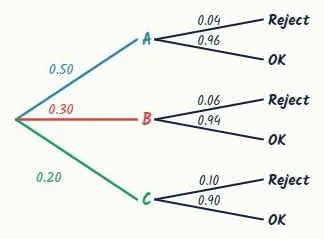
- Kiwifruit from orchards A 50%,
- B 30% and C 20%.
- Rejected: A 4%, B 6%, C 10%.
- Find P(a kiwifruit is rejected).
Q4: three first branches
- First: A 0.5, B 0.3, C 0.2.
- Then reject or OK: each pair adds to 1.
Q4: P(rejected)
- Three paths end in reject.
- Multiply along, add across.
- A, R: 0.5 × 0.04 = 0.02
- B, R: 0.3 × 0.06 = 0.018
- C, R: 0.2 × 0.1 = 0.02
- P(R) = 0.02 + 0.018 + 0.02add across
- = 0.058
- about 5.8% of fruit is rejected
Question 5 · Merit, in context
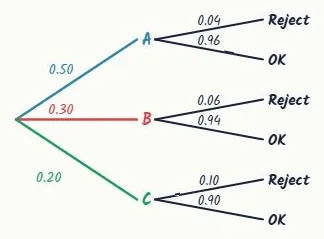
- Same kiwifruit tree.
- A kiwifruit is rejected.
- Find P(it came from orchard C).
- Compare with C's 20% share.
Q5: P(C | R)
- Reduced total: P(R).
- Answer in words.
- P(C | R) = P(C and R) ÷ P(R)
- = 0.02 ÷ 0.058P(R) from question 4
- = 0.344827…calculator
- = 0.34484 d.p.
- C: 20% of fruit, 34% of rejects
Question 6 · Excellence
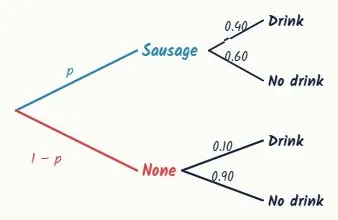
- Sausage sizzle: P(buys a sausage) = p.
- Drink: 40% of sausage buyers, 10% of others.
- 28% buy a drink. Find p,
- then P(sausage | drink).
Q6: a tree with an unknown
- First: sausage p, none 1 − p.
- Then drink or no drink.
Q6: form the equation
- Two paths end in a drink.
- Together they are 0.28.
- P(S) = p, P(not S) = 1 − pbranches add to 1
- P(S and D) = 0.4pmultiply along
- P(not S and D) = 0.1(1 − p)multiply along
- 0.4p + 0.1(1 − p) = 0.28add across: P(D)
- 0.4p + 0.1 − 0.1p = 0.28expand
- 0.3p + 0.1 = 0.28collect p terms
Q6: solve, then go backwards
- Check p in the equation.
- Then path ÷ total.
- 0.3p + 0.1 = 0.28
- 0.3p = 0.18subtract 0.1
- p = 0.18 ÷ 0.3 = 0.6divide by 0.3
- check: 0.4 × 0.6 + 0.1 × 0.4
- = 0.24 + 0.04 = 0.28
- P(S | D) = 0.24 ÷ 0.28path ÷ total
- = 0.857142…calculator
- = 0.85714 d.p.
Question 7 · Excellence, in context
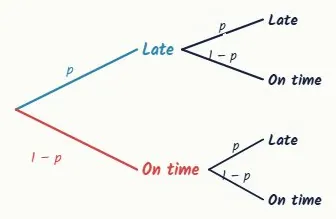
- Two Auckland buses to school.
- Each is late with probability p,
- independently.
- P(at least one late) = 0.36. Find p.
Q7: p on every branch
- Late p, on time 1 − p.
- The same at both stages.
Q7: use the complement
- At least one = 1 − none.
- A probability is 0 to 1.
- P(neither late) = (1 − p)²on time × on time
- (1 − p)² = 1 − 0.36 = 0.64complement
- 1 − p = 0.8 or 1 − p = −0.8
- p = 0.2
- p = 1.8a probability is ≤ 1
- check: 1 − 0.8² = 1 − 0.64 = 0.36
- each bus is late 20% of the time
The method that solved all seven
- Along, multiply. Across, add. Backwards, divide.
| Step | How |
|---|---|
| Draw | first event, then conditional |
| Each set | of branches adds to 1 |
| Along | multiply |
| Across | add the paths |
| Backwards | path ÷ the reduced total |
| Unknown | form an equation, then check |
Is your child on track?
Take the free placement test