Normal distribution: 7 exam questions solved step by step
What this lesson covers
- A normal distribution is symmetric about its mean, and its spread is measured by the standard deviation.
- A z-value counts how many standard deviations a value is from the mean.
7 questions, one method
- 1. Sketch the curve, shade the area.
- 2. z = (x − μ) ÷ σ, with its sign.
- 3. Normal probability, then round.
- 4. Check it against the sketch.
Question 1 · Achieved
- Kiwifruit weights at a packhouse are
- normal: mean 110 g, sd 9 g.
- Find P(a kiwifruit is under 122 g).
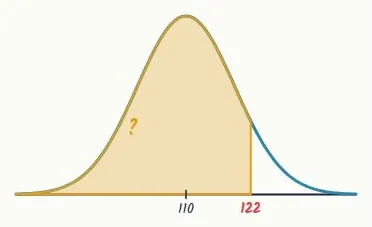
Q1: P(X < 122)
- Shaded left of 122.
- z first, then the area.
- μ = 110, σ = 9given
- P(X < 122)
- z = (122 − 110) ÷ 9
- = 12 ÷ 9 = 1.3333above: positive
- P(X < 122) = 0.908789
- = 0.90884 d.p.
- 0.9088 > 0.5over half is shaded
Question 2 · Achieved
- Same kiwifruit: mean 110 g, sd 9 g.
- Find P(a kiwifruit is over 100 g).
- Careful: 100 g is below the mean.
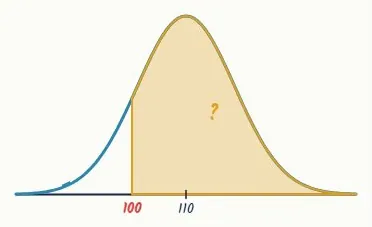
Q2: P(X > 100)
- Below the mean: z < 0.
- Shaded right: most of it.
- μ = 110, σ = 9given
- P(X > 100)
- z = (100 − 110) ÷ 9
- = −10 ÷ 9 = −1.1111below: negative
- P(X < 100) = 0.1333wrong side
- P(X > 100) = 0.866740
- = 0.86674 d.p.
- 0.8667 > 0.5most of the curve
Question 3 · Merit
- An Auckland bus route: trip times are
- normal, mean 42 min, sd 5 min.
- Find P(a trip takes 35 to 50 min).
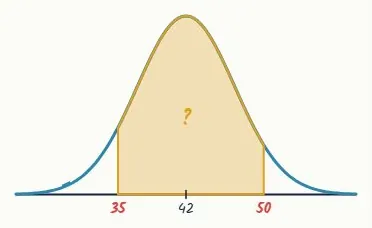
Q3: P(35 < X < 50)
- Two values: two z-values.
- One below, one above.
- μ = 42, σ = 5given
- P(35 < X < 50)
- z = (35 − 42) ÷ 5 = −1.4
- z = (50 − 42) ÷ 5 = 1.6
- P(−1.4 < Z < 1.6)same area
- P(35 < X < 50) = 0.864444
- = 0.86444 d.p.
- about 86% of trips35 to 50 min
Question 4 · Merit, in context
- Wellington ferry crossings are normal,
- mean 55 min, sd 4 min.
- Of 400 crossings, how many are
- expected to take over 61 min?
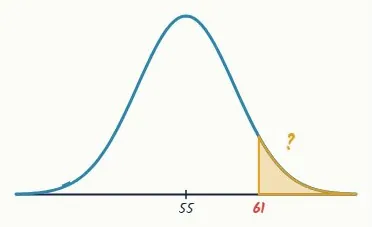
Q4: how many over 61 min?
- Probability first.
- Then n × probability.
- μ = 55, σ = 4given
- P(X > 61)
- z = (61 − 55) ÷ 4 = 1.5
- P(X > 61) = 0.066807
- expected = 400 × 0.066807
- = 26.72
- about 27 of 400 crossingscrossings are whole
Question 5 · Merit, in context
- Honey jars for a school fundraiser:
- normal, mean 508 g, sd 5 g.
- Rejected if under 500 g or over 520 g.
- What proportion are rejected?
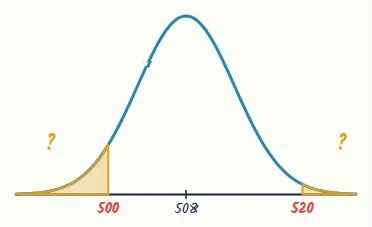
Q5: two tails
- Not symmetric: no doubling.
- Each tail, then add.
- μ = 508, σ = 5given
- P(X < 500) + P(X > 520)
- z = (500 − 508) ÷ 5 = −1.6
- z = (520 − 508) ÷ 5 = 2.4
- P(X < 500) = 0.054799
- P(X > 520) = 0.008198
- 0.054799 + 0.008198
- = 0.062997 ≈ 0.06304 d.p.
- about 6.3% of jars rejected
Question 6 · Excellence
- The bus route again: mean 42, sd 5 min.
- A trip has already taken over 45 min.
- Find P(it takes over 50 min).
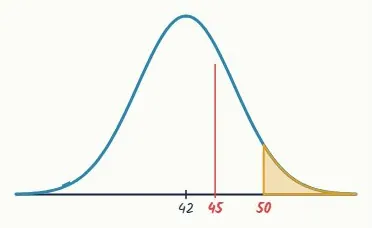
Q6: set it up
- "Given" shrinks the total.
- Over 50 is over 45.
- μ = 42, σ = 5given
- P(X > 50 | X > 45)given over 45
- P(A | B) = P(A and B) ÷ P(B)
- A: X > 50, B: X > 45
- A and B: X > 50over 50 is over 45
- = P(X > 50) ÷ P(X > 45)
Q6: the two areas
- P(X > 45) is the new total.
- Round only at the end.
- P(X > 50) ÷ P(X > 45)
- z = (50 − 42) ÷ 5 = 1.6
- P(X > 50) = 0.054799
- z = (45 − 42) ÷ 5 = 0.6
- P(X > 45) = 0.274253the reduced total
- 0.054799 ÷ 0.274253
- = 0.199812
- = 0.19984 d.p.
- about 1 in 5 of those tripsover 45 min
Question 7 · Excellence
- Girls' 100 m: mean 13.8 s, sd 0.5 s.
- Boys' 100 m: mean 12.5 s, sd 0.4 s.
- Aroha runs 13.1 s. Tama runs 11.9 s.
- Whose time is more impressive?
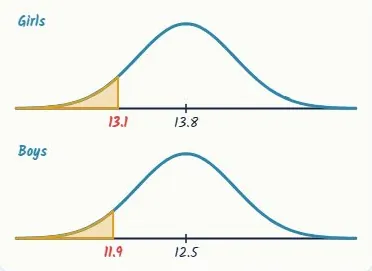
Q7: compare with z
- Different spreads.
- Faster is below: z < 0.
- Aroha 0.7 s, Tama 0.6 sspreads differ
- Aroha: z = (13.1 − 13.8) ÷ 0.5
- = −0.7 ÷ 0.5 = −1.4
- Tama: z = (11.9 − 12.5) ÷ 0.4
- = −0.6 ÷ 0.4 = −1.5
- −1.5 < −1.4further below
- Tama is 1.5 sd under his mean
Q7: back it with areas
- Who is faster than them?
- Smaller area: rarer time.
- girls: μ = 13.8, σ = 0.5
- P(X < 13.1) = 0.080757
- = 0.08084 d.p.
- boys: μ = 12.5, σ = 0.4
- P(X < 11.9) = 0.066807
- = 0.06684 d.p.
- 0.0668 < 0.0808fewer are faster
- Tama's time is more impressive
The method that solved all seven
- Sketch, find z, find the area, check, say it in context.
| Step | How |
|---|---|
| Sketch | shade the area you want |
| z-value | (x − μ) ÷ σ, sign and all |
| Probability | calculator, round at the end |
| Two tails | find each one, then add |
| Given that | divide by the reduced total |
| Compare | use z, not raw units |
Is your child on track?
Take the free placement test