Inverse normal: 7 exam questions solved step by step
What this lesson covers
- An inverse normal problem starts from a probability and works back to a value.
- The z-value for a known probability links the unknown mean or standard deviation to the data.
Working back from a probability
- Sketch the curve and shade the known area.
- Make it an area to the left, then find z.
- Solve z = (x − μ) ÷ σ for the unknown.
- Check which side of the mean, then round.
Question 1 · Achieved
- Hauraki Gulf snapper lengths are
- Normal: mean 34 cm, sd 5 cm.
- Find the length that 80% are shorter than.
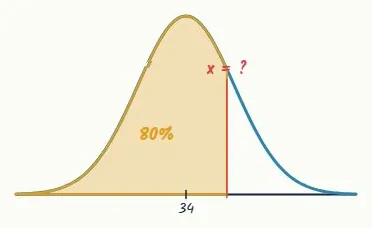
Q1: 80% shorter than x
- Area to the left: 0.8.
- Then x = μ + zσ.
- μ = 34, σ = 5given
- P(X < x) = 0.880% shorter
- z = 0.8416area 0.8 to the left
- x = μ + zσfrom z = (x − μ) ÷ σ
- x = 34 + 0.8416 × 5substitute
- = 34 + 4.208
- = 38.208
- x = 38.2 cm1 d.p.
- 38.2 > 34above the mean
Try it: 80% are shorter
Question 2 · Achieved
- The same snapper: mean 34 cm, sd 5 cm.
- Find the length that marks off
- The shortest 25%.
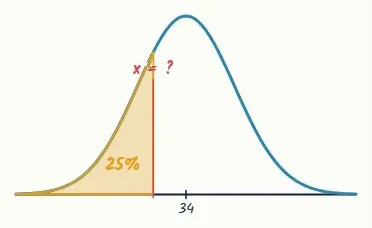
Q2: the shortest 25%
- Below the mean: z < 0.
- Check the side.
- μ = 34, σ = 5given
- P(X < x) = 0.25shortest 25%
- z = −0.6745below the mean
- x = 34 + (−0.6745) × 5
- = 34 − 3.3725
- = 30.6275 ≈ 30.6 cm1 d.p.
- 30.6 < 34below the mean
- z = +0.6745 gives 37.4 cmwrong side
Question 3 · Merit
- The same snapper: mean 34 cm, sd 5 cm.
- Find the limits of the middle 90%
- Of lengths.
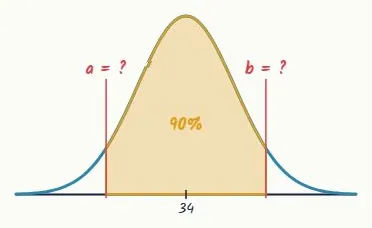
Q3: the middle 90%
- Split the 10%: 5% each end.
- Symmetric about 34.
- μ = 34, σ = 5given
- outside: 5% in each tail10% ÷ 2
- P(X < a) = 0.05: z = −1.6449
- a = 34 − 1.6449 × 5
- = 34 − 8.2245 = 25.7755
- P(X < b) = 0.95: z = 1.6449
- b = 34 + 8.2245 = 42.2245
- 25.78 cm to 42.22 cm2 d.p.
- 42.22 − 34 = 34 − 25.78symmetric
Question 4 · Merit
- The Days Bay ferry: crossing times are
- Normal with mean 25 min.
- 15% of crossings take over 28 min.
- Find the standard deviation.
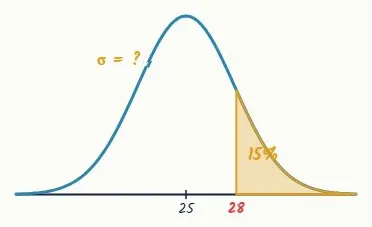
Q4: an unknown σ
- Over 28: left area 0.85.
- Substitute, solve for σ.
- μ = 25, P(X > 28) = 0.15given
- P(X < 28) = 0.85area to the left
- z = 1.036428 is above 25
- z = (x − μ) ÷ σ
- 1.0364 = (28 − 25) ÷ σsubstitute
- 1.0364σ = 3× σ
- σ = 3 ÷ 1.0364÷ 1.0364
- = 2.8946 ≈ 2.89 min2 d.p.
- σ > 0as it must be
Try it: change σ
Question 5 · Merit, in context
- Kiwifruit trays: weights normal, sd 150 g.
- At most 2% may be under 3500 g.
- The mean is set in whole grams.
- Find the smallest mean to set.
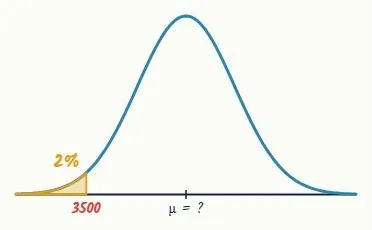
Q5: an unknown μ
- Solve for μ.
- Then round the safe way.
- σ = 150, P(X < 3500) = 0.02given
- z = −2.05373500 is below μ
- −2.0537 = (3500 − μ) ÷ 150substitute
- −308.055 = 3500 − μ× 150
- μ = 3500 + 308.055rearrange
- = 3808.055 g
- 3808 g: P = 0.020020over 2%
- 3809 g: P = 0.019699under 2%
- set the mean to 3809 g
Question 6 · Excellence
- Rangitoto summit walk times are normal.
- 10% take under 40 min.
- 20% take over 65 min.
- Find the mean and standard deviation.
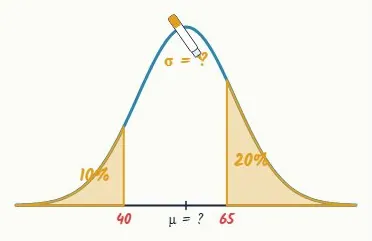
Q6: two equations
- One equation per fact.
- Two unknowns: μ and σ.
- P(X < 40) = 0.1: z = −1.2816
- −1.2816 = (40 − μ) ÷ σsubstitute
- μ − 1.2816σ = 40× σ, rearrange
- P(X > 65) = 0.2given
- P(X < 65) = 0.8: z = 0.8416
- 0.8416 = (65 − μ) ÷ σsubstitute
- μ + 0.8416σ = 65× σ, rearrange
Q6: solve them together
- Subtract to lose μ.
- Check in the second.
- μ − 1.2816σ = 40
- μ + 0.8416σ = 65
- 2.1232σ = 25second − first
- σ = 25 ÷ 2.1232 = 11.7747
- μ = 40 + 1.2816 × 11.7747
- = 40 + 15.0904
- = 55.0904
- μ ≈ 55.09 min, σ ≈ 11.77 min
- 55.09 + 0.8416 × 11.77 ≈ 65
Question 7 · Excellence
- Flour bags: normal, mean 1012 g, sd 8 g.
- At most 3% may be under 1000 g.
- Does the machine meet the rule?
- If not, keep the mean: largest sd?
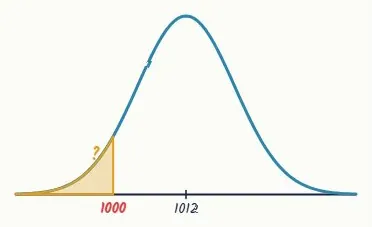
Q7: does it pass now?
- A forward question first.
- Compare with 3%.
- μ = 1012, σ = 8now
- z = (1000 − 1012) ÷ 8 = −1.5
- P(X < 1000) = 0.066807
- 0.0668 > 0.03over 3%
- No: about 6.7% are under
Q7: the largest σ
- Exactly 3% under 1000 g.
- Round down: the safe side.
- P(X < 1000) = 0.03the limit
- z = −1.8808below the mean
- −1.8808 = (1000 − 1012) ÷ σsubstitute
- −1.8808σ = −12× σ
- σ = −12 ÷ −1.8808÷ −1.8808
- = 6.3803
- σ = 6.38 g at mostround down
- 6.38: P = 0.029994under 3%
Common mistakes
- Shortest 25%: z = 0.6745, so 34 + 0.6745 × 5 = 37.4 cmThe shortest 25% are below the mean, so z = −0.6745 and the length is 34 − 0.6745 × 5 = 30.6 cm.
- 15% take over 28 min, so z = −1.036 and σ = −2.89The area to the left of 28 is 0.85, so z = +1.036 and σ = 3 ÷ 1.036 = 2.89 min.
- Middle 90%: the area to the left is 0.90.The middle 90% leaves 5% in each tail, so use 0.05 and 0.95: z = ±1.645, giving 25.78 cm to 42.22 cm.
- μ = 3808.055 g, so set the mean to 3808 g.3808 g gives slightly more than 2% under 3500 g, so round up to 3809 g.
The method that solved all seven
- Area to the left, z with its sign, solve, round safely.
| Step | How |
|---|---|
| Left area | turn "above" into "below" |
| Find z | negative below the mean |
| A value | x = μ + zσ |
| μ or σ | substitute into z, then solve |
| Both | two equations, subtract |
| Round | to the side the rule needs |
Practise this
Worksheet with answersWithout answersDownload PDF
2026 practice paper with worked answersOpen the paper
Report a mistake
More in AS 91267
 Probability: when to add and when to multiply7 min
 Two-way tables and conditional probability6 min
 Probability trees from written information, forwards and backwards8 min
 Expected value and expected numbers7 min
 Relative risk: above 1, below 1, and evaluating a claim7 min
 The normal distribution: probabilities and z-values8 min
 Inverse normal: finding a value, the mean or the standard deviation8 min
 Comparing distributions: shape, centre and spread7 min
 Probability rules: 7 exam questions solved step by step10 min
 Two-way tables: 7 exam questions solved step by step10 min
 Probability trees: 7 exam questions solved step by step10 min
 Expected value: 7 exam questions solved step by step10 min
 Relative risk: 7 exam questions solved step by step9 min
 Normal distribution: 7 exam questions solved step by step10 minInverse normal: 7 exam questions solved step by step10 min
 Comparing distributions: 7 exam questions solved step by step10 min
Is your child on track?
Take the free placement test