Exponential growth and decay: interest, depreciation, half-life
What this lesson covers
- Growth or decay by a fixed percentage each period is multiplication by the same factor each period.
- Finding how long something takes means solving for an index, which needs logarithms.
Same percentage, every period
- Interest on interest. Value lost on value.
- Each period multiplies by the same factor.
- That is exponential: start × factorⁿ.
Turning a percentage into a factor
- Growing 4.5%: multiply by 1.045.
- Losing 15%: multiply by 0.85.
- Doubling every 3 hours: 2^(t/3).
| Situation | Each period | |
|---|---|---|
| Grows 4.5% a year | × 1.045 | |
| Loses 15% a year | × 0.85 | 1 − 0.15 |
| Doubles every 3 hours | × 2 every 3 hours | 2^(t/3) |
Compound interest
- $5000 at 4.5% a year.
- Compounded yearly.
- factor = 1 + 0.045 = 1.045grows 4.5%
- A = 5000 × 1.045ⁿstart × factorⁿ
- A = 5000 × 1.045⁶n = 6
- = $6511.30
Depreciation
- A $28 000 car.
- Loses 15% a year.
- factor = 1 − 0.15 = 0.85loses 15%
- V = 28 000 × 0.85ⁿstart × factorⁿ
- V = 28 000 × 0.85⁴n = 4
- = 14 616.175
- = $14 616.18nearest cent
Not 15% × 4
- Not 60% off.
- 15% of what is left.
- Keeps 52.2%, not 40%.
- 4 × 15% = 60% off: keeps 40%not of the original
- 0.85 × 0.85 × 0.85 × 0.85each year × 0.85
- = 0.85⁴ = 0.5220
- keeps 52.2%, not 40%
How long to double at 6%?
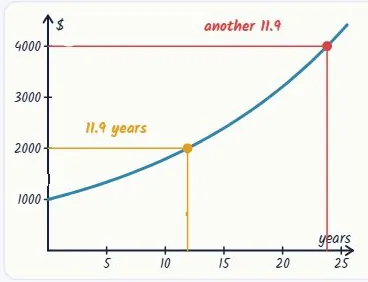
- Solve 1.06ⁿ = 2 with logs: 11.9 years.
- Doubling again takes the same time.
- That constant doubling time is the signature.
The working for doubling
- Logs bring n down.
- Round up, and say why.
- 1.06ⁿ = 2value doubles
- log 1.06ⁿ = log 2log both sides
- n log 1.06 = log 2power law
- n = log 2 ÷ log 1.06÷ log 1.06
- = 11.896
- 1.06¹¹ = 1.8983 < 2not yet doubled
- 1.06¹² = 2.0122 > 2doubled
- 12 years
Growth with a doubling time
- Divide by 200 first.
- Logs bring t/3 down.
- N = 200 × 2^(t/3)doubles every 3 h
- 200 × 2^(t/3) = 10 000N = 10 000
- 2^(t/3) = 50÷ 200
- (t/3) log 2 = log 50logs, power law
- t/3 = log 50 ÷ log 2÷ log 2
- = 5.6439
- t = 3 × 5.6439 ≈ 16.9 hours
Decay: when is it below 10 mg?
- Starts at 80 mg.
- Measured on the hour.
- 80 × 0.8ᵗ = 10loses 20% an hour
- 0.8ᵗ = 0.125÷ 80
- t log 0.8 = log 0.125logs, power law
- t = log 0.125 ÷ log 0.8
- = 9.32 hours
- 9 h: 80 × 0.8⁹ = 10.74 mgabove 10
- 10 h: 80 × 0.8¹⁰ = 8.59 mgbelow 10
- first below 10 mg: 10 hours
Where the marks are
- Achieved: evaluate a given model.
- Merit: form the model and solve for time.
- Excellence: interpret, including the rounding.
What to take away
- A percentage becomes a factor; time comes from logs.
| Grow r% | multiply by 1 + r/100 |
| Lose r% | multiply by 1 − r/100 |
| Model | start × factorⁿ |
| How long | solve for the index with logs |
| Whole periods | round up, and say why |
Your turn: four questions
- Pause here and answer each one.
- Questions 3 and 4 need logs.
- Think about rounding in context.
| Question | |
|---|---|
| 1 | $3000 at 5% compound interest a year. Value after 8 years? |
| 2 | A $1200 phone loses 25% a year. Value after 3 years? |
| 3 | At 7% a year, whole years to triple? |
| 4 | A town of 5000 grows 3% a year. When does it pass 8000? |
Show answer
1. 3000 × 1.05⁸ = $4432.37. 2. 1200 × 0.75³ = $506.25. 3. 1.07ⁿ = 3, n = log 3 ÷ log 1.07 = 16.24, so 17 years. 4. 1.03ⁿ = 1.6, n = 15.90, so in the 16th year (after 16 years).
The answers: questions 1 and 2
- 1. A = 3000 × 1.05ⁿgrows 5%: × 1.05
- A = 3000 × 1.05⁸n = 8
- = $4432.37
- 2. V = 1200 × 0.75ⁿloses 25%: × 0.75
- V = 1200 × 0.75³n = 3
- = 1200 × 0.421875
- = $506.25
The answers: question 3
- 3. P × 1.07ⁿ = 3Ptripled
- 1.07ⁿ = 3÷ P
- n log 1.07 = log 3logs, power law
- n = log 3 ÷ log 1.07
- = 16.24
- 1.07¹⁶ = 2.9522 < 3not yet tripled
- 17 years
The answers: question 4
- 4. 5000 × 1.03ⁿ = 8000grows 3%: × 1.03
- 1.03ⁿ = 8000 ÷ 5000 = 1.6÷ 5000
- n log 1.03 = log 1.6logs, power law
- n = log 1.6 ÷ log 1.03
- = 15.90
- 15 years: 5000 × 1.03¹⁵ ≈ 7790below 8000
- 16 years: 5000 × 1.03¹⁶ ≈ 8024above 8000
- passes 8000 after 16 years
Is your child on track?
Take the free placement test