Logarithms: what they mean and the log laws
What this lesson covers
- A logarithm is the index: log base a of x is the power a is raised to to give x.
- The log laws are the index laws written in log form.
A log answers one question
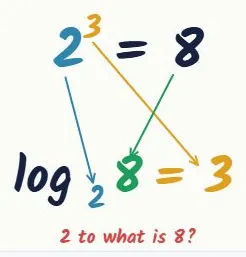
- log₂ 8 asks: 2 to what power is 8?
- The answer is 3, because 2³ = 8.
- A logarithm is an index.
Two ways to write one fact
- Index form: 2³ = 8.
- Log form: log₂ 8 = 3.
- Same base, and the power becomes the answer.
Reading logs as questions
- Ask the question the log is asking.
- log₅ 1 = 0, because 5⁰ = 1.
- log₃(1/9) = −2, because 3⁻² = 1/9.
| Log | Asks | Answer |
|---|---|---|
| log₂ 8 | 2 to what is 8? | 3 |
| log₁₀ 1000 | 10 to what is 1000? | 3 |
| log₅ 1 | 5 to what is 1? | 0 |
| log₃(1/9) | 3 to what is 1/9? | −2 |
The log laws are the index laws
- Multiplying adds indices, so logs add.
- Dividing subtracts them.
- A power inside comes out the front.
| Log of | Equals | Because |
|---|---|---|
| log(ab) | log a + log b | multiply: add indices |
| log(a/b) | log a − log b | divide: subtract |
| log(aⁿ) | n log a | power: multiply |
Combining logs
- Powers first.
- Then add or subtract.
- 2 log 3 + log 5
- = log 3² + log 5power law
- = log 9 + log 5
- = log(9 × 5)add: multiply inside
- = log 45
Solving 3ˣ = 20
- The unknown is an index.
- Take logs of both sides.
- 3ˣ = 20
- log 3ˣ = log 20log both sides
- x log 3 = log 20power law
- x = log 20 ÷ log 3÷ log 3
- = 2.727
- 3^2.727 ≈ 20.00check
A harder index: 5^(2x − 1) = 80
- Brackets round the index.
- Keep 4 decimal places.
- 5^(2x − 1) = 80
- (2x − 1) log 5 = log 80logs, power law
- 2x − 1 = log 80 ÷ log 5÷ log 5
- = 2.7227
- 2x = 3.7227add 1
- x = 3.7227 ÷ 2 = 1.861÷ 2
An equation with logs in it
- Combine into one log.
- Switch to index form.
- log₂ x + log₂(x + 2) = 3
- log₂(x(x + 2)) = 3add: multiply inside
- x(x + 2) = 2³index form
- x² + 2x = 8expand
- x² + 2x − 8 = 0subtract 8
- (x + 4)(x − 2) = 0factorise
- x = 2 or x = −4
Check in the original equation
- Substitute back.
- No logs of negatives.
- x = 2 or x = −4
- x = 2: log₂ 2 + log₂ 4
- = 1 + 2 = 3
- x = −4: log₂(−4)no log of a negative
- x = 2
Where the marks are
- Achieved: solve simple log and index equations.
- Merit: manipulate with the log laws.
- Excellence: logs inside a real model.
What to take away
- A log is an index. The log laws are the index laws.
| logₐ x = y | means aʸ = x |
| Multiply inside | add the logs |
| Divide inside | subtract the logs |
| Power inside | bring it to the front |
| aˣ = b | x = log b ÷ log a |
| Log equations | combine, then index form |
Your turn: four questions
- Pause here and answer each one.
- Question 1: ask the question the log asks.
- Question 4: switch to index form.
| Question | |
|---|---|
| 1 | Evaluate log₄ 64. |
| 2 | Write 2 log 3 + log 5 as a single log. |
| 3 | Solve 2ˣ = 50, to 3 decimal places. |
| 4 | Solve log₃(x + 1) = 2. |
Show answer
1. 4³ = 64, so 3. 2. log 9 + log 5 = log 45. 3. x = log 50 ÷ log 2 = 5.644. 4. x + 1 = 3² = 9, so x = 8.
The answers: questions 1 and 2
- 1. 4 to what power is 64?
- 4³ = 64, so log₄ 64 = 3
- 2. 2 log 3 = log 3² = log 9power law
- log 9 + log 5 = log(9 × 5)add: multiply inside
- = log 45
The answers: questions 3 and 4
- 3. 2ˣ = 50
- x log 2 = log 50logs, power law
- x = log 50 ÷ log 2÷ log 2
- = 5.644
- 4. log₃(x + 1) = 2
- x + 1 = 3²index form
- x + 1 = 9, so x = 8
- log₃ 9 = 2check
Is your child on track?
Take the free placement test