Index laws, fractional indices and surds

What this lesson covers
- Index laws apply to every factor inside a bracket, so a power of a product raises each part.
- A surd can be written as a fractional index, which lets the index laws do the work.
Indices are shorthand
- y³ means y × y × y.
- Every index law follows from that.
- When unsure, write it out.
The index laws
- Multiply: add the powers.
- Divide: subtract them.
- Power of a power: multiply them.
| Law | Form | Result |
|---|---|---|
| Multiply | aᵐ × aⁿ | aᵐ⁺ⁿ |
| Divide | aᵐ ÷ aⁿ | aᵐ⁻ⁿ |
| Power of a power | (aᵐ)ⁿ | aᵐⁿ |
| Zero | a⁰ | 1 |
| Negative | a⁻ⁿ | 1/aⁿ |
(2y)³ is not 2y³
- Write it out: 2y × 2y × 2y.
- The numbers: 2 × 2 × 2 = 8.
- The letters: y × y × y = y³. So 8y³.
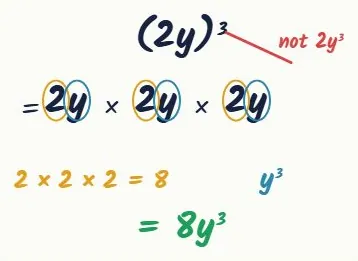
Every factor inside gets the power
- Each factor is raised.
- Including a minus sign.
- (3a²b)² = 3² × (a²)² × b²every factor
- = 9 × a⁴ × b²multiply the powers
- = 9a⁴b²
- (−2x)² = (−2)² × x²the minus too
- = 4x²(−2)² = 4
Negative indices mean one over
- A negative index: one over.
- Check what is raised.
- x⁻³ = 1/x³one over
- 2x⁻³ = 2 × 1/x³ = 2/x³only x is raised
- (2x)⁻¹ = 1/(2x)the whole bracket
- x⁻² ÷ x⁻⁵ = x^(−2 − (−5))subtract
- = x³
Fractional indices are roots
- Denominator: the root.
- Numerator: the power.
- 8^(2/3) = (∛8)²root, then power
- = 2² = 4∛8 = 2
- 27^(−1/3) = 1/27^(1/3)negative: one over
- = 1/∛27 = 1/3∛27 = 3
Why √x is x^(1/2)
- Add the indices.
- It squares to give x.
- x^(1/2) × x^(1/2)
- = x^(1/2 + 1/2)add the indices
- = x¹ = x
- so x^(1/2) = √x
Surd form to index form
- A root is a power.
- Then use the index laws.
- √(x⁵) = (x⁵)^(1/2)a root is power 1/2
- = x^(5 × 1/2) = x^(5/2)multiply indices
- 1/√x = 1/x^(1/2)
- = x^(−1/2)one over: negative
Simplifying surds
- Take out square factors.
- Like surds add.
- No surd underneath.
- √50 = √25 × √2 = 5√2square factor 25
- √12 = √4 × √3 = 2√3
- √27 = √9 × √3 = 3√3
- √12 + √27 = 2√3 + 3√3like surds
- = 5√3
- 6/√3 × √3/√3rationalise
- = 6√3/3
- = 2√3
Where the marks are
- Achieved: simplify and convert accurately.
- Merit: combine several laws in one expression.
- Simplest form, every time.
What to take away
- Every factor gets the power. Roots are fractions.
| Brackets | the power applies to every factor |
| Negative index | one over |
| Fractional index | denominator is the root |
| Surd to index | √x = x^(1/2) |
| Simplify surds | take out square factors |
| Rationalise | multiply top and bottom by the surd |
Your turn: four questions
- Pause here and answer each one.
- No calculator for question 4.
- Simplest form.
| Question | |
|---|---|
| 1 | Simplify (4x³)². |
| 2 | Simplify 12a⁵b² ÷ 3a²b⁵. |
| 3 | Write √(x³) ÷ x as a single power of x. |
| 4 | Evaluate 16^(3/4) without a calculator. |
Show answer
1. 16x⁶: both the 4 and the x³ are squared. 2. 4a³b⁻³, which is 4a³/b³. 3. x^(3/2) ÷ x¹ = x^(1/2). 4. The fourth root of 16 is 2, and 2³ = 8.
The answers: questions 1 and 2
- 1. (4x³)² = 4² × (x³)²every factor
- = 16x⁶(x³)² = x⁶
- 2. 12a⁵b² ÷ 3a²b⁵
- = (12 ÷ 3) a⁵⁻² b²⁻⁵subtract the powers
- = 4a³b⁻³
- = 4a³/b³negative: one over
The answers: questions 3 and 4
- 3. √(x³) ÷ x = x^(3/2) ÷ x¹surd to index
- = x^(3/2 − 1)subtract the powers
- = x^(1/2)
- 4. 16^(3/4) = (⁴√16)³root, then power
- = 2³ = 8⁴√16 = 2
Is your child on track?
Take the free placement test