Expanding, factorising and simplifying algebraic fractions

What this lesson covers
- A fraction can only be cancelled by a factor of the whole numerator and the whole denominator.
- Factorising first turns a hard fraction into one where the common factor can be seen.
Three skills, one chain
- Expand brackets without losing signs.
- Factorise, including with a leading number.
- Factorising is what makes fractions simplify.
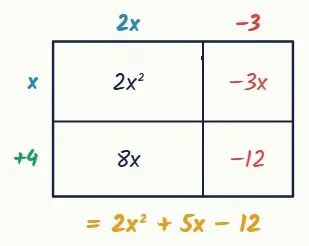
Expand (2x − 3)(x + 4)
- Each term meets each term: four products.
- 2x², 8x, −3x and −12.
- Collect: 2x² + 5x − 12.
A minus in front of a bracket
- Expand the square first.
- Keep it in a bracket.
- Then change every sign.
- −(x − 5)²
- = −(x − 5)(x − 5)write the square out
- = −(x² − 5x − 5x + 25)four products
- = −(x² − 10x + 25)collect
- = −x² + 10x − 25change every sign
Factorising 2x² + 5x − 12
- Multiply a by c: −24.
- Product −24, sum 5.
- Split, group, factorise.
- a × c = 2 × (−12) = −24
- 8 × (−3) = −24, 8 − 3 = 5
- 2x² + 8x − 3x − 12split 5x
- = 2x(x + 4) − 3(x + 4)group in pairs
- = (2x − 3)(x + 4)common bracket
Check by expanding
- Expand your answer back.
- It must match the start.
- (2x − 3)(x + 4) = 2x² + 5x − 12
- 6x² − x − 2 = (3x − 2)(2x + 1)
- (3x − 2)(2x + 1)
- = 6x² + 3x − 4x − 2four products
- = 6x² − x − 2collect
Simplifying a fraction: factorise first
- Factorise top and bottom.
- Cancel a whole factor.
- x² − 9 = (x − 3)(x + 3)two squares
- 3 × (−2) = −6, 3 − 2 = 1
- x² + x − 6 = (x + 3)(x − 2)
- (x² − 9)/(x² + x − 6)
- = (x − 3)(x + 3)/((x + 3)(x − 2))
- = (x − 3)/(x − 2)cancel (x + 3)
Only whole factors cancel
- (x + 6)/6 is not x.
- 6 multiplies nothing on top; it is added.
- A factor must multiply the whole top.
| Fraction | Simplifies? | Because |
|---|---|---|
| (x + 6)/6 | is NOT x | 6 is not a factor of x + 6 |
| (x² + 3x)/x | is x + 3 | x is a factor of both terms |
Adding algebraic fractions
- Common denominator first.
- Then add the numerators.
- 2/x + 3/(x + 1)
- common denominator x(x + 1)
- 2/x = 2(x + 1)/(x(x + 1))
- 3/(x + 1) = 3x/(x(x + 1))
- sum = (2(x + 1) + 3x)/(x(x + 1))
- = (2x + 2 + 3x)/(x(x + 1))expand
- = (5x + 2)/(x(x + 1))collect
Subtracting: bracket the second top
- Bracket the second top.
- The minus hits both terms.
- 3/(x − 2) − 1/(x + 2)
- denominator (x − 2)(x + 2)
- top: 3(x + 2) − (x − 2)bracket it
- = 3x + 6 − x + 2expand
- = 2x + 8collect
- bottom: (x − 2)(x + 2) = x² − 4
- result: (2x + 8)/(x² − 4)
- 3x + 6 − x − 2 = 2x + 4no bracket
Where the marks are
- Achieved: expand and factorise accurately.
- Merit: factorise and cancel.
- Simplest form, with every step shown.
What to take away
- Factorise first. Cancel only factors.
| Expand | every term by every term |
| A minus outside | changes every sign inside |
| Factorise ax² + bx + c | split using a × c |
| Cancel | only whole factors |
| Add or subtract | common denominator first |
| Subtracting | bracket the second numerator |
Your turn: four questions
- Pause here and answer each one.
- Check factorising by expanding.
- Simplest form.
| Question | |
|---|---|
| 1 | Expand (3x + 1)(x − 5). |
| 2 | Factorise 3x² + 10x − 8. |
| 3 | Simplify (x² − 4x) ÷ (x² − 16). |
| 4 | Write x/2 + (x + 1)/3 as a single fraction. |
Show answer
1. 3x² − 15x + x − 5 = 3x² − 14x − 5. 2. a × c = −24, use 12 and −2: (3x − 2)(x + 4). 3. x(x − 4) ÷ (x − 4)(x + 4) = x/(x + 4). 4. (3x + 2(x + 1))/6 = (5x + 2)/6.
The answers: questions 1 and 2
- 1. (3x + 1)(x − 5)
- = 3x² − 15x + x − 5four products
- = 3x² − 14x − 5collect
- 2. a × c = 3 × (−8) = −24
- 12 × (−2) = −24, 12 − 2 = 10
- 3x² + 12x − 2x − 8split 10x
- = 3x(x + 4) − 2(x + 4)group in pairs
- = (3x − 2)(x + 4)common bracket
The answers: questions 3 and 4
- 3. (x² − 4x)/(x² − 16)
- = x(x − 4)/((x − 4)(x + 4))factorise both
- = x/(x + 4)cancel (x − 4)
- 4. x/2 + (x + 1)/3
- = 3x/6 + 2(x + 1)/6denominator 6
- = (3x + 2x + 2)/6expand
- = (5x + 2)/6collect
Is your child on track?
Take the free placement test